


Business model implementation in healthcare has become a critical capability for organizations facing rising costs, workforce pressures, digital transformation, and increasing expectations for quality and value. In the first stages of strategic planning, healthcare leaders often focus on designing innovative business models; however, without effective implementation, even the most well-designed models fail to deliver measurable outcomes. For healthcare professionals, understanding how business models are translated into operational reality is essential for improving care delivery, financial sustainability, and organizational resilience.
This article provides an evidence-based, structured explanation of business model implementation in healthcare, grounded in trusted academic and institutional sources. It clarifies core concepts, outlines implementation steps, and connects theory to real-world healthcare practice.
WHAT IS IMPLEMENTATION IN HEALTHCARE?
Implementation in healthcare refers to the systematic process of putting planned strategies, models, or interventions into practice within real clinical and organizational settings.
Effective implementation bridges the gap between evidence-based design and actual performance outcomes by addressing workflows, resources, governance, and stakeholder engagement.
In the context of business models, implementation focuses on:
- Translating strategic intent into operational processes.
- Aligning clinical, financial, and administrative functions.
- Ensuring the sustainability and scalability of healthcare services.
Healthcare implementation differs from other sectors because it must balance quality of care, patient safety, regulatory compliance, and cost control simultaneously.
BUSINESS MODEL IMPLEMENTATION IN HEALTHCARE
Business model implementation in healthcare is the structured execution of a defined business model to deliver value to patients, payers, and communities while maintaining organizational viability. Academic research emphasizes that healthcare business models must integrate clinical pathways, payment mechanisms, workforce models, and technology infrastructure.
Implementation typically involves:
- Governance and leadership alignment.
- Resource allocation and budgeting.
- Redesign of care delivery processes.
- Performance measurement and feedback.
Without disciplined implementation, healthcare organizations risk fragmentation, inefficiency, and poor patient outcomes.
HOW TO IMPLEMENT A BUSINESS MODEL IN HEALTHCARE ORGANIZATIONS
Successful implementation follows a phased, evidence-based approach recognized in healthcare management literature.
1. Strategic Alignment and Leadership Commitment
Implementation begins with ensuring that the business model aligns with the organization’s mission, the needs of its population, and the regulatory environment. WHO and academic institutions consistently identify strong leadership commitment as a determinant of successful health system change.
Key actions include:
- Defining clear strategic objectives.
- Assigning executive ownership.
- Establishing governance structures.
2. Operational Design and Process Integration
Business models must be embedded into day-to-day operations. This includes redesigning clinical workflows, administrative processes, and support services to reflect the model’s value proposition.
Healthcare organizations often focus on:
- Care pathway redesign
- Workforce role clarification
- Integration of digital health tools
3. Financial and Payment Model Alignment
Implementation requires aligning the business model with reimbursement mechanisms and cost structures.
Researches and studies highlights that misalignment between care delivery and payment models is a common cause of implementation failure.
Key considerations:
- Cost accounting and budgeting
- Value-based payment readiness
- Financial risk management
4. Monitoring, Evaluation, and Continuous Improvement
Effective implementation is iterative. Performance indicators are used to assess whether the business model achieves its intended clinical and financial outcomes.
Common metrics include:
- Quality and safety indicators.
- Patient experience measures.
- Operational efficiency and cost metrics.
WHAT ARE THE 7 TYPES OF BUSINESS MODELS IN HEALTHCARE?
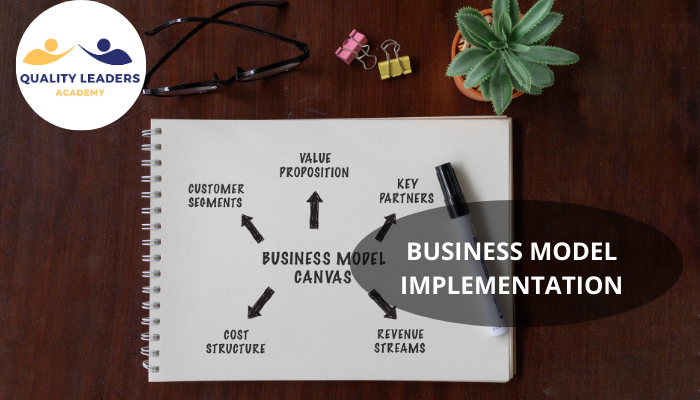
Healthcare literature identifies several recurring business model types, often adapted to local contexts. Commonly referenced models include:
- Traditional fee-for-service model.
- Value-based care model.
- Integrated delivery systems.
- Population health management models.
- Digital health and virtual care models.
- Public–private partnership models.
- Subscription or bundled payment models.
Each model requires a tailored implementation approach depending on regulatory, financial, and population factors.
COMMON BARRIERS TO BUSINESS MODEL IMPLEMENTATION IN HEALTHCARE
Peer-reviewed research identifies recurring challenges, including:
- Resistance to change among clinical staff.
- Fragmented information systems.
- Limited implementation capacity.
- Regulatory and reimbursement constraints.
Addressing these barriers requires structured change management, training, and continuous stakeholder engagement.
THE ROLE OF STRATEGIC MANAGEMENT SKILLS IN SUCCESSFUL IMPLEMENTATION
Evidence from healthcare management studies consistently shows that successful business model implementation depends on strong strategic management capabilities. Healthcare professionals must be able to:
- Translate strategy into execution.
- Lead multidisciplinary teams.
- Use data to guide decisions.
- Align quality, finance, and operations.
These competencies are not intuitive and require formal development.
To support healthcare professionals involved in business model implementation in healthcare, structured education in strategic management is essential. The Advanced Strategic Management Course offered by Quality Leaders Academy is designed to build practical competencies in strategy formulation, implementation, and performance evaluation within healthcare organizations.
The course focuses on:
- Translating strategic plans into operational actions.
- Aligning business models with quality and safety goals.
- Managing change and organizational performance.
- Applying real-world healthcare case studies.
For professionals seeking to lead or support business model implementation initiatives, this training provides the structured foundation required for effective execution in complex healthcare environments.
Business model implementation in healthcare is a disciplined, evidence-based process that transforms strategic design into measurable clinical, operational, and financial outcomes. Successful implementation requires leadership alignment, operational integration, financial coherence, and continuous performance evaluation. As healthcare systems evolve toward value-based and digitally enabled models, implementation capability becomes a core professional competency. By strengthening strategic management skills and applying structured implementation approaches, healthcare organizations can ensure that business model implementation in healthcare delivers sustainable value for patients, professionals, and health systems alike.
References
https://pmc.ncbi.nlm.nih.gov/articles/PMC10229027/
https://www.sciencedirect.com/science/article/abs/pii/S0277953619305660
https://www.aha.io/roadmapping/guide/product-strategy/what-are-some-examples-of-a-business-model