

Healthcare systems in Saudi Arabia are undergoing significant transformation, supported by national healthcare reforms, growing patient expectations, and a strong focus on safety, quality, and accountability.
As hospitals and healthcare providers expand services, ensuring standardized care delivery and regulatory compliance has become a core priority.
Within this evolving landscape, CHI Accreditation plays an important role in strengthening healthcare quality oversight and ensuring that healthcare providers meet required standards for safe and effective care delivery. Accreditation in general is a key mechanism used globally to evaluate healthcare performance, improve patient safety systems, and enhance organizational accountability.
In Saudi Arabia’s healthcare environment, CHI Accreditation contributes to aligning healthcare providers with structured quality expectations, supporting continuous improvement, and strengthening trust in healthcare services.
WHAT IS CHI ACCREDITATION?
CHI Accreditation refers to the formal evaluation and approval process applied to healthcare providers to ensure compliance with established healthcare quality and operational standards within the Saudi healthcare system.
Accreditation goes beyond administrative compliance; it is a structured evaluation process that measures how effectively healthcare organizations provide safe, effective, and patient-centered care.
Healthcare governance and accreditation systems are used to:
- Validate compliance with healthcare quality standards.
- Ensure patient safety systems are in place.
- Evaluate clinical and operational performance.
- Strengthen accountability across healthcare organizations.
- Promote continuous improvement in service delivery.
CHI Accreditation supports these goals by directing healthcare providers to operate within a structured quality system aligned with national healthcare priorities.
WHY CHI ACCREDITATION MATTERS IN HEALTHCARE?
CHI Accreditation plays a critical role in improving healthcare system performance by establishing a standardized approach to evaluating care delivery.
1. Enhancing Patient Safety
Accreditation helps healthcare organizations implement structured safety systems that reduce medical errors, improve infection control practices, and strengthen clinical risk management.
2. Standardizing Healthcare Services
It ensures that healthcare services are delivered consistently across different facilities, reducing variation in care quality.
3. Improving Healthcare Outcomes
By enforcing structured quality requirements, accreditation contributes to better patient outcomes and improved clinical effectiveness.
4. Strengthening Organizational Accountability
Healthcare providers become more accountable for maintaining quality standards, documentation practices, and operational performance.
5. Building Public Trust
Accredited healthcare organizations are generally perceived as more reliable and quality-driven, which increases patient confidence in healthcare services.
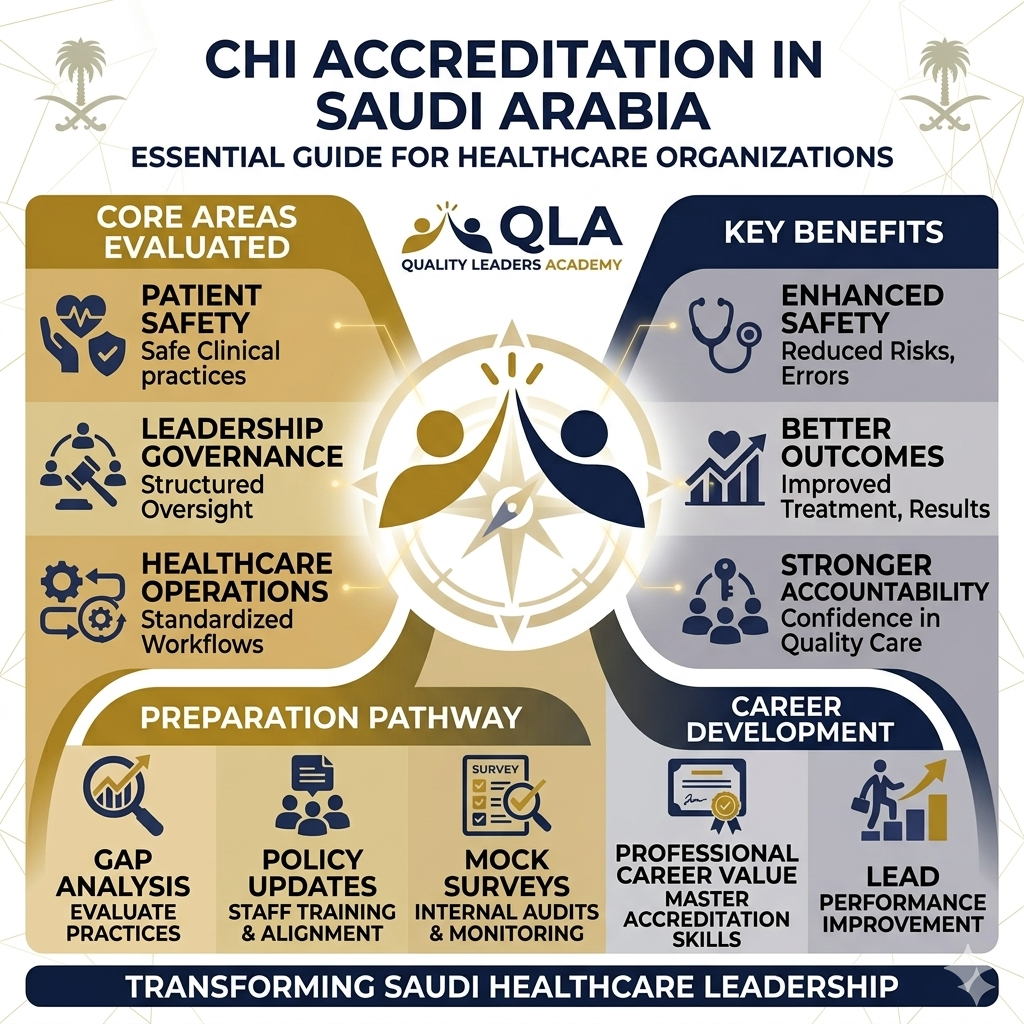
CORE AREAS EVALUATED DURING CHI ACCREDITATION
CHI Accreditation typically evaluates multiple dimensions of healthcare performance to ensure comprehensive quality assurance.
Patient Safety and Clinical Quality
This area focuses on direct patient care and safety systems, including:
- Infection prevention and control practices.
- Medication safety systems.
- Clinical risk management.
- Patient-centered care delivery.
- Adverse event reporting and prevention.
Leadership and Governance
Healthcare leadership is evaluated based on:
- Organizational governance structures.
- Quality oversight systems.
- Compliance with healthcare regulations.
- Leadership accountability in quality improvement.
Healthcare Operations
Operational performance is assessed through:
- Standardization of clinical and administrative processes.
- Documentation accuracy and completeness.
- Workforce competency and training systems.
- Efficiency of service delivery workflows.
Data and Performance Monitoring
Accreditation also examines how organizations use data to improve care:
- Quality indicators and KPIs.
- Performance measurement systems.
- Continuous improvement tracking.
- Reporting and audit mechanisms.
COMMON CHALLENGES IN ACCREDITATION PREPARATION
Healthcare organizations often face several challenges when preparing for CHI Accreditation:
Resistance to Change
Staff may be resistant to new documentation requirements, workflow adjustments, or compliance procedures.
Documentation Gaps
Incomplete or inconsistent records can affect compliance during accreditation reviews.
Limited Quality Management Knowledge
Some organizations lack trained personnel in healthcare quality and accreditation systems.
Operational Pressures
High patient volumes and workload demands can limit time available for accreditation preparation activities.
Maintaining Consistency
Ensuring consistent compliance across departments remains a common challenge in large healthcare facilities.
HOW HEALTHCARE ORGANIZATIONS PREPARE FOR CHI ACCREDITATION
Successful accreditation preparation requires structured planning and engagement from leadership.
Gap Assessment
Organizations begin by evaluating current practices against accreditation requirements to identify areas needing improvement.
Policy and Procedure Standardization
Healthcare facilities update clinical and administrative policies to align with accreditation standards.
Staff Training and Awareness
Training programs ensure that all healthcare staff understand compliance requirements and patient safety protocols.
Mock Surveys and Internal Audits
Simulated accreditation assessments help identify weaknesses before official evaluation.
Quality Monitoring Systems
Hospitals implement structured performance indicators to track improvement continuously.
Leadership Engagement
Strong leadership involvement ensures alignment between organizational strategy and accreditation goals.
WHY ACCREDITATION SKILLS MATTER FOR HEALTHCARE PROFESSIONALS?
Understanding accreditation systems is increasingly important for healthcare professionals working in:
- Quality and patient safety departments.
- Hospital administration.
- Clinical governance roles.
- Risk management units.
- Healthcare compliance functions.
Professionals with accreditation knowledge are better equipped to:
- Improve healthcare system performance.
- Support regulatory compliance.
- Lead quality improvement initiatives.
- Strengthen patient safety systems.
- Contribute to organizational excellence.
This makes accreditation competency a valuable skill set for career development in modern healthcare environments.
Strengthening Accreditation Readiness Through Professional Education
Building strong accreditation capabilities requires more than operational experience; it requires structured learning in healthcare quality systems, patient safety frameworks, and performance improvement methodologies.
Quality Leaders Academy supports healthcare professionals by offering structured education in areas such as:
- Healthcare quality management systems.
- Patient safety and risk management.
- Accreditation readiness and compliance frameworks.
- Healthcare leadership and operational excellence.
- Performance improvement methodologies.
These educational programs support healthcare professionals in applying accreditation standards directly in hospital and clinical practice during regulatory preparation.
In addition, combining accreditation knowledge with improvement methodologies such as Lean Six Sigma strengthens the ability to identify inefficiencies, reduce errors, and improve healthcare delivery systems.
CHI Accreditation is an essential component of healthcare quality assurance in Saudi Arabia. It supports hospitals and healthcare organizations in maintaining high standards of patient safety, operational performance, and regulatory compliance.
By implementing structured accreditation systems, healthcare providers can improve care consistency, strengthen governance, and enhance patient trust. For healthcare professionals, understanding accreditation principles is equally important, as it directly contributes to career growth and effectiveness in quality-focused roles.
As healthcare continues to evolve in Saudi Arabia, accreditation will remain a key driver of quality improvement and organizational accountability, ensuring that healthcare systems deliver safe, efficient, and patient-centered care.
Resources:
https://www.scribd.com/document/647567484/Provider-6-3-Manual