

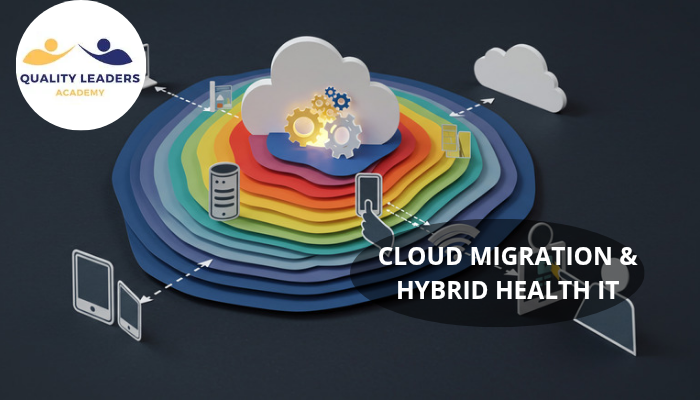
Cloud migration is transforming the way healthcare organizations store information, manage clinical systems, and maintain digital resilience. As hospitals and health systems increasingly rely on electronic health records and data-driven decision-making, cloud migration provides a secure and scalable foundation aligned with the standards of global health authorities, such as the World Health Organization (WHO), and national regulatory bodies. This transformation allows healthcare institutions to modernize operations while protecting patient data and ensuring continuity of care.
UNDERSTANDING CLOUD MIGRATION IN HEALTHCARE

Cloud migration refers to the process of moving healthcare applications, data, and digital services from on-premises environments to cloud-based platforms. In healthcare, this requires strict compliance with national and international security standards, including ISO IEC 27001 information security guidelines and data protection frameworks established by organizations like the CDC, AHRQ, and NIH.
By shifting to cloud infrastructures, healthcare organizations can improve performance, reduce operational risks, and create integrated systems that support safe, efficient, and coordinated care.
BENEFITS OF CLOUD MIGRATION IN HEALTHCARE
Cloud migration supports digital transformation efforts that align with WHO and AHRQ recommendations for robust health information systems. Its benefits extend across clinical, operational, and security domains.
1. Enhanced Data Accessibility and Care Coordination
Cloud-based systems allow clinicians and authorized staff to securely access patient data in real time. WHO emphasizes that timely access to reliable information improves decision-making, strengthens care pathways, and enhances coordination among health teams.
2. Scalable and Flexible Data Management
Healthcare data continues to grow rapidly due to imaging, laboratory systems, and digital records. Cloud infrastructures offer on-demand scalability that adjusts to workload needs without requiring major investments in physical hardware.
3. Cost Optimization and Efficient Resource Use
Migrating to the cloud allows organizations to shift from capital-intensive hardware spending to predictable operational costs. This reduces maintenance demands and enables IT teams to focus on supporting clinical priorities.
4. Advanced Security and Compliance Measures
Cloud platforms incorporate built-in security features such as encryption, multi-factor authentication, and continuous monitoring that align with international information security standards. When combined with strong organizational governance, these capabilities help protect sensitive patient data and reduce cybersecurity vulnerabilities.
5. Support for Analytics, Research, and AI
Cloud environments provide the computational strength required for large-scale analytics, predictive modeling, and biomedical research. NIH-supported initiatives highlight cloud infrastructure as essential for advancing precision medicine and population health research.
THE ROLE OF HYBRID HEALTH IT INFRASTRUCTURE
Hybrid cloud models that combine public cloud, private cloud, and on-premises systems are widely adopted in healthcare because they balance security requirements with operational flexibility.
1. Balance Between Control and Agility
Hybrid environments allow institutions to keep highly sensitive patient information within controlled private environments while using public cloud platforms for tasks that benefit from agility and scalability.
2. Support for Legacy Systems
Many clinical systems, including imaging equipment and EHR platforms, rely on legacy architectures. Hybrid models integrate these systems with modern cloud capabilities without disrupting clinical operations.
3. Stronger Disaster Recovery and Continuity of Care
Health authorities stress the importance of reliable healthcare delivery during emergencies. Hybrid infrastructures distribute data and workloads across multiple environments, reducing downtime risks and improving recovery speed.
4. Improved Interoperability Across Health Systems
Hybrid models facilitate secure data exchange between departments, facilities, and external health partners to support coordinated care and population health management.
KEY STEPS FOR A SUCCESSFUL HEALTHCARE CLOUD MIGRATION
A structured and evidence-informed approach ensures safe and effective migration without compromising patient care.
1. Assess the Existing Infrastructure
Organizations should perform a comprehensive audit of applications, data workflows, and system dependencies. ISO guidelines emphasize risk assessment and system mapping as foundational steps for digital transformation.
2. Establish Strategic Goals and Migration Roadmap
Clear goals such as reducing costs, improving performance, or enhancing patient safety guide the choice of migration strategies, including rehosting, replatforming, or redesigning.
3. Select a Cloud Provider with Healthcare Expertise
The chosen provider should demonstrate compliance with recognized security and healthcare data protection standards and have a proven track record supporting clinical environments.
4. Execute Migration in Phases with Rigorous Testing
Gradual migration, beginning with non-critical systems, minimizes disruptions. Continuous validation ensures that applications function correctly and meet performance expectations.
5. Implement Governance, Monitoring, and Security Controls
Post migration, organizations must maintain strong governance practices that include encryption, endpoint protection, role-based access, incident response planning, and regular security auditing. These practices align with WHO and ISO cybersecurity guidelines.
6. Train Staff and Support Change No Management
Effective digital transformation requires comprehensive workforce preparation. Training ensures that staff can use cloud systems properly, maintain data security, and adapt to new workflows.
A PRACTICAL STEP TO STRENGTHEN YOUR HEALTHCARE INFORMATION MANAGEMENT SKILLS
If you are seeking a structured and reliable way to enhance your expertise in healthcare information and management systems, the CPHIMS Course offered by Quality Leaders Academy is the perfect next step. This course supports the core themes discussed in the article: digital transformation, data integration, health IT governance, and system optimization by breaking them down into practical, easy-to-apply learning modules.
Guided by certified instructors, participants gain real-world skills and focused exam preparation for the international CPHIMS certification.
The workshop equips professionals with the knowledge and confidence necessary to advance their careers and contribute effectively to the growing digital health landscape.
Cloud migration enables healthcare organizations to modernize their digital ecosystems while enhancing security, interoperability, and operational resilience. By integrating hybrid IT infrastructures, institutions can protect sensitive patient information, support legacy systems, and adopt advanced analytics that enhance clinical decision-making. Guided by standards from WHO, ISO, NIH, and AHRQ, cloud migration provides a future-ready foundation for delivering safe, efficient, and high-quality healthcare.