

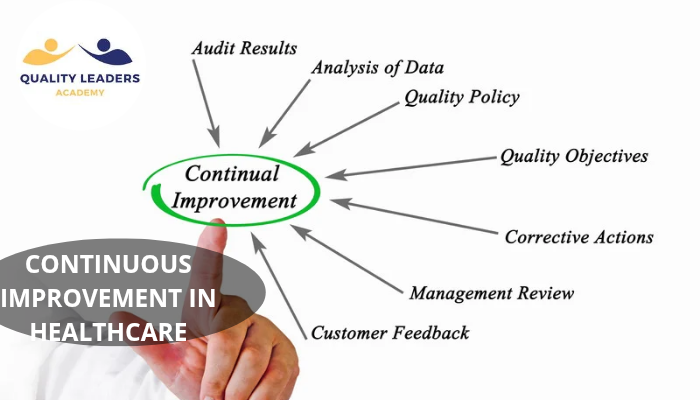
Continuous improvement in healthcare is no longer a theoretical concept or an administrative trend. It has become an essential leadership skill for healthcare providers who want to improve patient outcomes, reduce errors, and build high-performing clinical environments. In modern healthcare systems, where complexity and patient expectations are increasing, continuous improvement in healthcare helps professionals move from reactive care to proactive quality management.
This article explains what continuous improvement truly means in a healthcare context, why it matters for leadership growth, and how healthcare providers can apply it in real clinical settings.
WHAT IS CONTINUOUS IMPROVEMENT IN HEALTHCARE?

Continuous improvement in healthcare is a structured, ongoing process aimed at enhancing patient safety, clinical quality, operational efficiency, and workforce performance. It focuses on making small, consistent, data-driven improvements rather than relying on major one-time changes.
This approach is built on a simple but powerful idea:
Every healthcare process can be improved, and improvement should never stop.
Unlike traditional quality control methods that focus only on fixing mistakes after they happen, continuous improvement emphasizes preventing problems before they occur by improving systems, workflows, and behaviors.
In healthcare settings, this includes improving areas such as:
- Patient safety practices.
- Clinical pathways.
- Patient flow and waiting times.
- Infection prevention processes.
- Staff communication and teamwork.
- Documentation and handover procedures.
WHY CONTINUOUS IMPROVEMENT MATTERS FOR HEALTHCARE LEADERS
Healthcare providers who aim to become leaders must understand that clinical excellence alone is no longer enough. Leadership today requires the ability to improve systems, motivate teams, and drive sustainable change.
Continuous improvement supports leadership by helping professionals:
Build a problem-solving mindset
Leaders trained in improvement methods learn how to analyze challenges systematically instead of reacting emotionally or relying on assumptions.
Improve patient safety and outcomes
Improved systems reduce variation, minimize risks, and lower the chances of preventable errors.
Strengthen team performance
A culture of improvement encourages open communication, learning from mistakes, and shared accountability.
Make better decisions using data
Continuous improvement relies on real performance data, not opinions.
Prepare for leadership roles
Healthcare leaders are expected to lead change, not just manage current processes.
DEVELOPING HEALTHCARE LEADERS THROUGH CONTINUOUS IMPROVEMENT TRAINING
Building a culture of continuous improvement requires more than tools; it requires capable leaders who can translate improvement theory into daily practice. Structured professional workshops, such as the Quality Improvement Approach workshop offered by Quality Leaders Academy, focus on strengthening core competencies in problem analysis, process mapping, risk-based thinking, and performance measurement within healthcare settings.
These programs are designed to help healthcare providers move from reactive problem-solving to proactive system improvement by applying internationally recognized quality and safety concepts in real clinical and operational environments. When integrated into organizational development plans, this type of training supports sustainable improvement initiatives, stronger team engagement, and more consistent patient-centered outcomes.
CONTINUOUS IMPROVEMENT IN HEALTHCARE AND PATIENT SAFETY CULTURE
One of the core outcomes of continuous improvement in healthcare is the development of a strong patient safety culture.
This culture is characterized by:
- Open reporting of errors and near misses.
- Blame-free learning environments.
- Continuous learning and reflection.
- Involvement of all staff levels in improvement activities.
- Leadership commitment to safety.
A strong quality improvement culture does not punish individuals for system failures. Instead, it focuses on fixing the root causes that allow errors to happen.
For healthcare providers aspiring to leadership, this mindset is essential. Leaders control the environment in which safety either thrives or fails.
CORE PRINCIPLES BEHIND CONTINUOUS IMPROVEMENT IN HEALTHCARE
Continuous improvement is not just about tools. It is driven by clear principles that shape daily behavior in clinical settings.
Patient-centered focus
All improvement efforts must start with the patient’s needs, safety, dignity, and experience.
System thinking
Errors rarely come from one person. They emerge from complex systems. Leaders must understand how processes interact and influence one another.
Employee involvement
Improvement does not belong to managers alone. Frontline staff must be empowered because they understand real problems better than anyone.
Data-driven decision-making
Changes should be based on measurements, not assumptions.
Standardization with flexibility
Standard processes reduce variation but must stay adaptable to patient needs and clinical judgment.
PRACTICAL METHODS USED IN CONTINUOUS IMPROVEMENT
Although continuous improvement is a mindset, it also uses practical approaches that healthcare leaders should master.
Plan Do Study Act cycles
This simple improvement cycle allows teams to test changes on a small scale before implementing them on a larger level.
Root cause analysis
Used to understand why incidents or failures occurred by identifying system weaknesses rather than blaming individuals.
Process mapping
This visual method helps teams understand how work flows across departments and where delays and risks happen.
Run charts and performance tracking
Used to monitor if changes are actually leading to improvement over time.
These approaches help healthcare leaders translate ideas into measurable improvements.
COMMON BARRIERS TO CONTINUOUS IMPROVEMENT IN HEALTHCARE
Despite its importance, continuous improvement faces challenges in real practice.
Heavy workload and time pressures
Healthcare staff often feel too busy to focus on improvement activities.
Resistance to change
Some professionals may feel threatened by change or believe current practices are sufficient.
Lack of leadership support
When leadership does not actively support improvement efforts, staff motivation declines.
Poor use of data
Improvement fails when decisions are based on assumptions instead of performance evidence.
Understanding these barriers helps future leaders address them proactively.
HOW HEALTHCARE PROVIDERS CAN START PRACTICING CONTINUOUS IMPROVEMENT?
Healthcare providers do not need managerial positions to begin practicing continuous improvement in healthcare. Leadership starts with behavior, not titles.
You can start by:
Observing your daily work
Pay attention to repeated problems, delays, and unnecessary steps.
Asking why multiple times
This helps uncover the root causes behind routine issues.
Collecting simple data
Track small problems such as medication delays or patient waiting times within your unit.
Proposing small changes
Start with simple improvements that do not require major resources.
Encouraging team discussion
Involve colleagues and create a habit of shared problem-solving.
Over time, these small actions create leadership impact.
THE LINK BETWEEN CONTINUOUS IMPROVEMENT AND CAREER GROWTH
For healthcare professionals aiming for leadership, understanding continuous improvement is a powerful career advantage.
Many modern healthcare organizations require leaders to demonstrate skills in:
- Quality management.
- Patient safety improvement.
- Process optimization.
- Data-driven decision-making.
- Change management.
By practicing continuous improvement early, providers position themselves not only as clinicians but as system thinkers and future leaders.
CONTINUOUS IMPROVEMENT IN HEALTHCARE AND LONG-TERM SUSTAINABILITY
Sustainable healthcare systems depend on their ability to learn and improve continuously. Without improvement, systems become rigid, inefficient, and unsafe.
Continuous improvement contributes to sustainability by:
- Reducing waste and unnecessary costs.
- Optimizing resource utilization.
- Improving workforce efficiency.
- Enhancing patient trust and satisfaction.
- Supporting healthy work environments.
Healthcare leadership today is not about controlling systems, but about improving them continuously.
Continuous improvement in healthcare is no longer optional for healthcare providers who want to grow into leadership roles. It is a core professional competence that strengthens patient safety, improves clinical outcomes, and builds resilient healthcare systems.
By adopting a mindset of ongoing learning, systematic problem solving, and patient-focused improvement, healthcare providers move beyond routine practice and become true agents of change.
In a constantly evolving healthcare environment, continuous improvement in healthcare is the key that transforms good providers into effective healthcare leaders.
Resources:
https://www.ncbi.nlm.nih.gov/books/NBK559239/
https://www.twi-institute.com/continuous-improvement-healthcare/
https://bmchealthservres.biomedcentral.com/articles/10.1186/s12913-024-10828-0