

Healthcare systems increasingly depend on accurate, timely data to support clinical decisions and improve patient outcomes. Medical imaging is central to this process, enabling clinicians to diagnose, monitor, and treat a wide range of conditions.
To manage this data effectively, healthcare organizations rely on standardized systems and tools. One of the most important of these is the DICOM Viewer in healthcare, which allows professionals to access and interpret medical images efficiently.
Understanding how these tools function—and how they fit into broader health information systems—is essential for healthcare professionals working in clinical, administrative, or informatics roles.
WHAT IS A DICOM VIEWER IN HEALTHCARE?
A DICOM Viewer is a software application used to display and analyze medical images stored in the Digital Imaging and Communications in Medicine (DICOM) format.
DICOM is an internationally recognized standard for handling, storing, and transmitting medical imaging information. It ensures that images produced by different imaging devices, such as CT scanners, MRI machines, and ultrasound systems, can be accessed and shared across healthcare systems.
A DICOM Viewer enables healthcare professionals to:
- View high-resolution medical images.
- Adjust image settings such as contrast and brightness.
- Measure anatomical structures.
- Review multi-frame or layered images.
These capabilities support clinical evaluation and decision-making in various healthcare settings.
HOW DICOM VIEWER IS USED IN CLINICAL PRACTICE?
The DICOM Viewer in healthcare is used across multiple specialties and clinical workflows.
Diagnostic Imaging
Radiologists and clinicians use DICOM viewers to examine imaging studies and identify clinical findings. The ability to manipulate images supports detailed analysis.
Multidisciplinary Care
Medical images can be reviewed by multiple healthcare professionals, enabling collaboration between specialties such as radiology, surgery, and cardiology.
Integration with Healthcare Systems
DICOM viewers are commonly integrated with:
- Picture Archiving and Communication Systems (PACS).
- Electronic Health Records (EHRs).
This integration allows clinicians to access imaging data within the patient’s overall medical record, supporting continuity of care.
KEY BENEFITS OF DICOM VIEWER IN HEALTHCARE
The use of DICOM viewers contributes to several important aspects of healthcare delivery:
Support for Clinical Decision-Making
Access to detailed imaging data allows clinicians to make informed diagnostic and treatment decisions.
Improved Workflow Efficiency
Digital access to medical images reduces delays associated with physical film handling and supports faster clinical processes.
Enhanced Collaboration
Shared access to imaging facilitates communication among healthcare teams, particularly in complex cases.
Standardized Data Exchange
Using the DICOM standard supports consistent data sharing across systems, which is essential for coordinated care.
These benefits align with broader healthcare priorities related to quality, safety, and efficiency.
Challenges in Medical Imaging and Interoperability
While DICOM provides a standardized framework, healthcare organizations may still face challenges in managing imaging systems.
System Integration
Integrating imaging systems with other health information technologies requires careful planning and technical expertise.
Interoperability
Ensuring that different systems can exchange and interpret data correctly remains a key challenge in many healthcare settings.
Data Management
Handling large volumes of imaging data requires secure storage, efficient retrieval systems, and clear governance policies.
Addressing these challenges is essential for maximizing the value of digital imaging in healthcare.
THE ROLE OF HEALTH INFORMATICS IN IMAGING SYSTEMS
Health informatics focuses on the effective use of data, information systems, and technology in healthcare. Professionals in this field play a critical role in ensuring that systems like DICOM viewers function efficiently within the broader healthcare environment.
Key areas of focus include:
- Data standards and interoperability.
- System integration and workflow optimization.
- Information governance and data security.
A strong understanding of these areas supports the effective use of imaging technologies and improves overall healthcare delivery.
HOW CPHIMS CERTIFICATION SUPPORT HEALTH INFORMATICS KNOWLEDGE?
The Certified Professional in Healthcare Information and Management Systems (CPHIMS) credential, offered by the Healthcare Information and Management Systems Society, is a recognized certification in the field of health informatics.
It is designed to validate knowledge in:
- Healthcare information systems.
- Data management and governance.
- Technology implementation in clinical settings.
For professionals working with systems such as DICOM viewers, this certification supports a broader understanding of how imaging technologies integrate into healthcare operations.
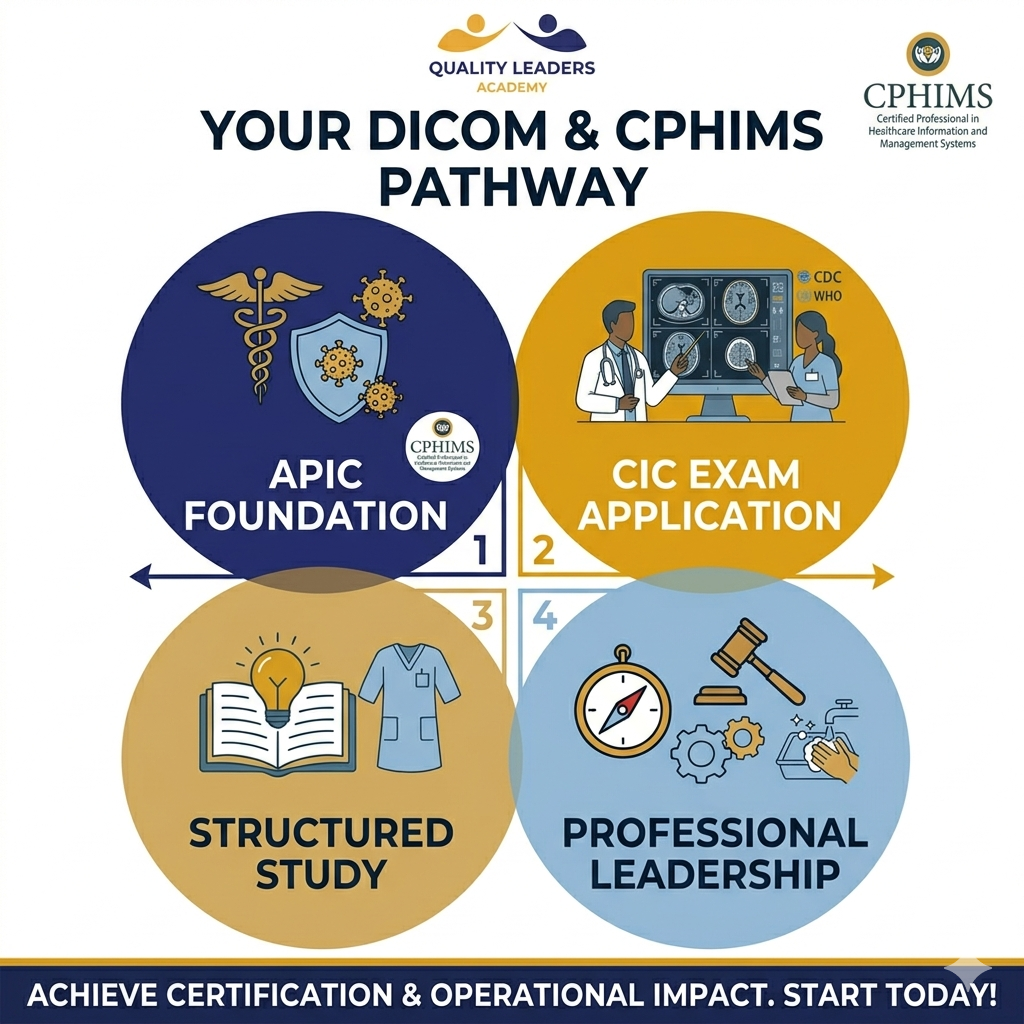
QUALITY LEADERS ACADEMY: STRUCTURED PREPARATION FOR CPHIMS
Healthcare professionals preparing for CPHIMS benefit from structured study approaches that organize complex topics into manageable content. Quality Leaders Academy offers preparation programs designed to support this process.
CPHIMS Live Zoom Session
This course provides guided learning through live sessions, allowing participants to engage with instructors and review key health informatics concepts.
CPHIMS Recorded Videos
CPHIMS recorded videos course offers a self-paced learning option with access to recorded sessions, supporting flexible study schedules.
These programs focus on:
- Core health informatics principles.
- System integration concepts.
- Preparation aligned with certification requirements.
This structured approach supports both understanding and practical application.
CAREER RELEVANCE OF DICOM AND HEALTH INFORMATICS KNOWLEDGE
As healthcare systems continue to adopt digital technologies, professionals with knowledge of imaging standards and health informatics are increasingly valuable.
Career opportunities may include roles in:
- Health information management.
- Clinical systems coordination.
- Healthcare IT and digital transformation.
- Quality and patient safety initiatives.
Understanding tools such as the DICOM Viewer in healthcare, along with broader informatics concepts, supports professional development in these areas.
The DICOM Viewer in healthcare plays a key role in enabling access to medical imaging data and supporting clinical decision-making. Its integration within health information systems reflects the broader shift toward digital, data-driven healthcare.
For healthcare professionals, developing knowledge in imaging standards and health informatics is essential for adapting to this evolving environment. Certifications such as CPHIMS provide a structured pathway to build this expertise.
With organized preparation and a focus on practical application, professionals can enhance their ability to contribute to efficient, high-quality healthcare delivery.