

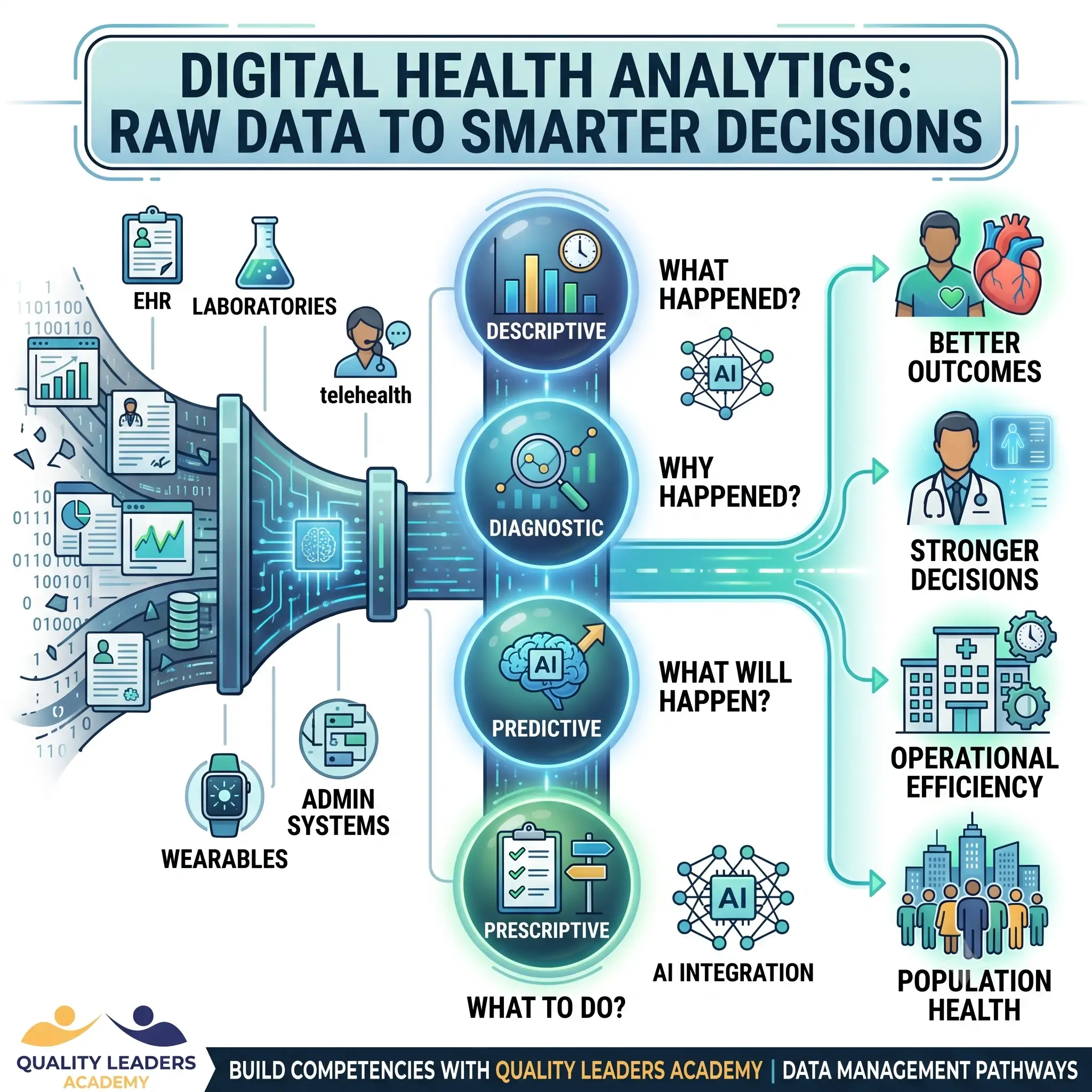
Healthcare systems are generating more data than ever before. Electronic health records, laboratory systems, imaging platforms, wearable devices, telehealth applications, and administrative systems continuously produce large volumes of clinical and operational information.
At the same time, healthcare organizations face increasing pressure to improve patient outcomes, reduce costs, enhance operational efficiency, and support evidence-based decision-making. Traditional approaches that rely on manual reporting or retrospective analysis are no longer sufficient in complex healthcare environments.
This shift is driving the rapid adoption of Digital Health Analytics, a discipline that transforms raw healthcare data into meaningful insights that support clinical, operational, and strategic decisions.
According to global digital health perspectives from organizations such as the World Health Organization (WHO) and HealthIT.gov, data-driven healthcare systems are now essential for improving quality of care, strengthening health system performance, and supporting population health management.
WHAT IS DIGITAL HEALTH ANALYTICS?
Digital Health Analytics refers to the systematic collection, integration, analysis, and interpretation of healthcare data to support decision-making across clinical and operational settings.
It combines healthcare data from multiple digital sources, including:
Electronic Health Records (EHRs).
Laboratory and imaging systems.
Telehealth platforms.
Wearable and remote monitoring devices.
Healthcare administrative and billing systems.
The goal is to transform fragmented healthcare data into structured insights that support better decisions at the point of care and at the organizational level.
Digital health analytics sits at the intersection of health informatics, healthcare data management, and digital transformation, enabling healthcare leaders to understand what is happening in their systems, why it is happening, and what actions should be taken.
THE MAIN TYPES OF DIGITAL HEALTH ANALYTICS
Healthcare analytics is typically categorized into four key types, each serving a different purpose in healthcare decision-making.
1. Descriptive Analytics
Descriptive analytics focuses on understanding what has already happened within healthcare systems.
It uses historical data to summarize performance, such as:
Hospital admission trends
Average length of stay
Infection rates
Patient satisfaction scores
For example, a hospital may analyze monthly emergency department visits to understand peak demand patterns.
2. Diagnostic Analytics
Diagnostic analytics helps explain why certain outcomes occurred.
It goes beyond reporting and investigates relationships and root causes. For example:
Why did readmission rates increase in a specific department?
What factors contributed to delayed discharges?
Which processes are associated with medication errors?
This level is essential for healthcare quality improvement initiatives.
3. Predictive Analytics
Predictive analytics uses statistical models, AI, and machine learning techniques to forecast future outcomes.
Examples include:
Predicting patient readmission risk.
Identifying patients at risk of sepsis.
Forecasting hospital bed demand.
Anticipating resource shortages.
This type of analytics supports proactive healthcare decision-making rather than reactive responses.
4. Prescriptive Analytics
Prescriptive analytics recommends actions based on data insights.
It helps healthcare leaders and clinicians decide what should be done next, such as:
Optimizing staffing schedules.
Recommending treatment pathways.
Improving patient flow.
Reducing bottlenecks in care delivery.
This level represents the most advanced stage of healthcare analytics maturity.
HOW DIGITAL HEALTH ANALYTICS IMPROVES HEALTHCARE SYSTEMS
Better Patient Outcomes
Digital health analytics enables earlier detection of diseases, more accurate diagnoses, and more personalized treatment plans. By analyzing patient data patterns, healthcare providers can intervene earlier and improve long-term outcomes.
Stronger Clinical Decision-Making
Clinicians can use real-time data insights to support evidence-based decisions. This reduces variation in care and improves consistency in treatment approaches across healthcare settings.
Operational Efficiency
Healthcare leaders use analytics to optimize workflows, reduce waiting times, improve resource allocation, and manage hospital capacity more effectively. This contributes directly to healthcare operational efficiency.
Population Health Management
By analyzing large datasets, healthcare organizations can identify high-risk populations and design preventive interventions. This supports public health strategies and chronic disease management programs.
THE ROLE OF AI AND INTEROPERABILITY IN DIGITAL HEALTH ANALYTICS
Artificial intelligence is increasingly integrated into healthcare analytics systems to enhance data interpretation and decision support.
AI-powered tools can:
Detect patterns in large datasets.
Support clinical risk prediction.
Automate reporting processes.
Improve diagnostic accuracy.
However, AI systems are only as effective as the quality of the underlying data.
This is where interoperability becomes critical.
Standards such as HL7 and FHIR enable different healthcare systems to communicate and exchange data effectively. Interoperability ensures that data from hospitals, laboratories, pharmacies, and clinics can be integrated into unified analytics platforms.
Interoperability is essential for enabling coordinated care, improving patient safety, and supporting advanced analytics across healthcare ecosystems.
CHALLENGES IN IMPLEMENTING DIGITAL HEALTH ANALYTICS
Despite its benefits, implementing digital health analytics in healthcare organizations presents several challenges.
Data Quality Issues
Incomplete, inconsistent, or inaccurate data can significantly reduce the reliability of analytics outputs.
Fragmented Systems
Many healthcare organizations use multiple disconnected systems, making it difficult to integrate data effectively.
Cybersecurity and Privacy Concerns
Healthcare data is highly sensitive, requiring strong security frameworks and compliance with privacy regulations.
Workforce Skill Gaps
Healthcare professionals often require additional training in data interpretation, analytics tools, and informatics concepts.
Resistance to Change
Shifting toward data-driven decision-making requires cultural change, which can be challenging in traditional healthcare environments.
WHY DIGITAL HEALTH ANALYTICS MATTERS FOR HEALTHCARE PROFESSIONALS
Healthcare professionals are increasingly expected to understand how data influences healthcare performance and decision-making.
Knowledge of healthcare data analytics supports:
Better clinical judgment.
Improved quality improvement initiatives.
Stronger leadership decision-making.
Effective healthcare performance management.
Understanding of healthcare digital transformation strategies.
As healthcare systems evolve, analytics literacy is becoming a core competency for clinicians, managers, and healthcare leaders.
BUILDING DIGITAL HEALTHCARE COMPETENCIES THROUGH QUALITY LEADERS ACADEMY
As healthcare organizations continue advancing toward digital transformation, structured education plays a critical role in developing practical analytics competencies.
Quality Leaders Academy provides structured learning pathways that support healthcare professionals in building expertise in digital health analytics, healthcare data systems, and healthcare transformation.
Healthcare professionals may begin with the Data Management in Healthcare program, which focuses on healthcare data collection, validation, descriptive statistics, KPI development, dashboards, and data visualization using tools such as Excel, SPSS, and Power BI. The course also introduces foundational healthcare information systems concepts that support quality improvement and operational decision-making.
For professionals seeking more advanced capabilities, the Advanced Data Management in Healthcare program builds on these foundations by focusing on advanced healthcare data analysis, applied statistics, and deeper interpretation of healthcare datasets to support leadership decisions and performance improvement initiatives.
To support flexible learning, Quality Leaders Academy provides recorded sessions for enrolled students, allowing healthcare professionals to revisit course materials and reinforce understanding while balancing professional responsibilities.
Healthcare professionals interested in broader digital transformation competencies may also benefit from developing knowledge in:
Healthcare interoperability and health information exchange.
Healthcare IT infrastructure and digital systems.
Artificial intelligence and clinical decision support systems.
Healthcare analytics and performance dashboards.
Cloud technologies and healthcare data integration.
Rather than focusing only on technology adoption, structured learning helps healthcare professionals understand how digital health analytics can improve patient outcomes, strengthen operational efficiency, and support more informed healthcare leadership decisions across modern healthcare systems.
Resources:
https://www.medtecheurope.org/about-the-industry/data-for-health/
https://pmc.ncbi.nlm.nih.gov/articles/PMC12516163/