

Healthcare organizations today are expected to achieve far more than clinical effectiveness alone. Hospitals and healthcare systems must improve patient outcomes, strengthen operational efficiency, maintain workforce engagement, manage financial sustainability, and continuously respond to changing healthcare demands.
This growing complexity has increased interest in structured organizational excellence frameworks that help healthcare institutions evaluate performance systematically and improve long-term outcomes. One of the most recognized frameworks globally is the EFQM Excellence Model, developed by the European Foundation for Quality Management.
Across healthcare settings, the EFQM model in healthcare is increasingly used to support quality improvement, organizational learning, leadership effectiveness, and healthcare performance improvement. As organizations adopt these frameworks, the role of an EFQM Certified Assessor is becoming more valuable for healthcare professionals involved in quality management, accreditation, organizational development, and healthcare leadership.
For healthcare quality leaders, hospital administrators, and performance improvement professionals, understanding the role of an EFQM assessor provides valuable insight into how healthcare organizations evaluate maturity, strengthen governance, and build sustainable excellence.
WHAT IS AN EFQM CERTIFIED ASSESSOR?
An EFQM Certified Assessor is a professional trained to evaluate organizational performance using the EFQM Excellence Model, an internationally recognized framework designed to assess how organizations create sustainable value and achieve continuous improvement.
Rather than focusing only on compliance or isolated performance metrics, assessors evaluate how different parts of an organization function together to support long-term success.
Using EFQM assessment methodologies, assessors examine areas such as:
- Leadership and organizational culture.
- Strategy and execution.
- Workforce engagement and capability.
- Partnerships and resource management.
- Operational performance.
- Measurable organizational outcomes.
The EFQM framework encourages organizations to view performance as an interconnected system. Assessors, therefore, evaluate not only what results are achieved, but also how those outcomes are generated and sustained over time.
In healthcare environments, this systems-based approach is particularly important because patient care outcomes are influenced by leadership, communication, workforce engagement, clinical systems, and organizational culture.
WHY THE EFQM MODEL MATTERS IN HEALTHCARE?
The EFQM model healthcare approach aligns closely with healthcare priorities such as patient-centered care, quality improvement, operational efficiency, and leadership accountability.
Research examining the use of the EFQM model in healthcare suggests that organizations applying excellence principles may strengthen organizational learning, workforce engagement, governance, and performance measurement practices.
Supporting Patient-Centered Care
Patient-centered care remains central to healthcare quality initiatives worldwide. The EFQM framework encourages healthcare organizations to evaluate whether services are aligned with patient expectations, needs, and experiences.
Healthcare institutions applying EFQM principles often focus on:
- Care coordination improvement.
- Better communication processes.
- Service quality enhancement.
- Improved responsiveness to patient feedback.
Encouraging Continuous Quality Improvement
Healthcare organizations increasingly rely on performance measurement systems to identify gaps and improve outcomes. The EFQM framework encourages organizations to adopt an ongoing approach to performance evaluation and improvement rather than relying on isolated initiatives.
This structured approach may help organizations:
- Monitor quality indicators.
- Identify performance variations.
- Improve operational consistency.
- Support evidence-informed decision-making.
Strengthening Organizational Culture
Organizational culture significantly influences healthcare quality and patient safety. Research suggests excellence frameworks such as EFQM can support stronger collaboration, accountability, and workforce engagement by encouraging shared organizational goals.
THE ROLE OF AN EFQM CERTIFIED ASSESSOR IN HEALTHCARE
An organizational excellence assessor helps healthcare organizations evaluate how effectively leadership, systems, and operational practices contribute to performance goals.
Supporting Hospital Quality Initiatives
Healthcare organizations often manage multiple quality improvement initiatives simultaneously. EFQM assessors help organizations evaluate whether these efforts align with strategic priorities and measurable outcomes.
Assessments may involve reviewing:
- Quality management structures.
- Improvement initiatives.
- Leadership effectiveness.
- Organizational performance systems.
Evaluating Leadership and Governance
Healthcare leadership directly influences workforce engagement, patient safety culture, and strategic execution. Assessors examine whether leadership approaches support accountability, innovation, and sustainable improvement.
Effective governance assessment may support:
- Better organizational alignment.
- More consistent strategic direction.
- Stronger quality improvement culture.
Supporting Healthcare Transformation
Healthcare systems continue adapting to workforce shortages, financial pressures, technological change, and evolving patient expectations.
EFQM assessors help organizations identify:
- Performance barriers.
- Process inefficiencies.
- Strategic improvement opportunities.
- Areas requiring organizational development.
This makes the EFQM Certified Assessor role increasingly relevant in healthcare transformation initiatives.
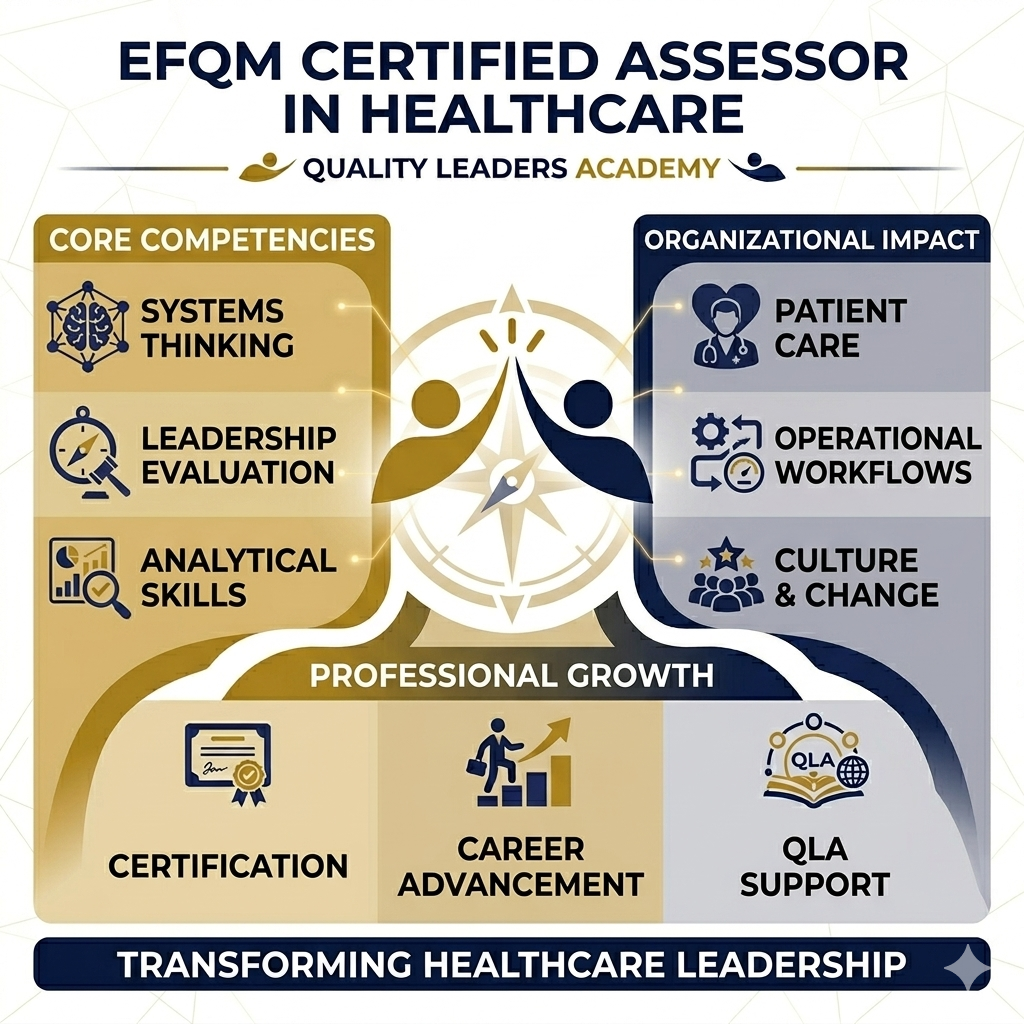
SKILLS AND COMPETENCIES OF AN EFQM CERTIFIED ASSESSOR
Professionals pursuing EFQM assessor certification develop competencies that are increasingly valuable in modern healthcare environments.
Systems Thinking
Healthcare organizations operate through interconnected systems rather than isolated departments. Assessors must understand how leadership, workforce engagement, operational processes, and quality systems influence outcomes.
Analytical and Assessment Skills
Assessors evaluate organizational evidence, interpret performance data, and identify relationships between systems and measurable results.
Leadership Evaluation
Healthcare organizations require leaders who support improvement, accountability, and strategic alignment. Assessors evaluate how leadership contributes to organizational performance.
Healthcare Quality Management Knowledge
A strong understanding of healthcare quality management principles helps assessors interpret quality indicators, performance measures, and organizational priorities.
Communication and Reporting Skills
Assessors are expected to communicate findings clearly through structured reports that support evidence-based improvement planning.
These competencies are increasingly important in healthcare settings where organizations must demonstrate measurable outcomes and sustained performance improvement.
BENEFITS OF BECOMING AN EFQM CERTIFIED ASSESSOR
For healthcare professionals, becoming an EFQM Certified Assessor can support both professional growth and organizational contribution.
Stronger Professional Credibility
Certification demonstrates knowledge of organizational excellence frameworks and structured performance evaluation.
Better Understanding of Healthcare Systems
Assessors gain deeper insight into how leadership, strategy, operations, and workforce systems influence healthcare outcomes.
Expanded Leadership Competencies
Healthcare professionals involved in transformation initiatives benefit from stronger skills in organizational analysis, systems thinking, and performance improvement.
Career Growth Opportunities
Knowledge related to healthcare leadership and quality may support professional advancement in areas such as:
- Healthcare quality departments.
- Performance improvement teams.
- Accreditation initiatives.
- Organizational excellence programs.
- Strategic healthcare leadership roles.
Challenges Healthcare Organizations Face in Excellence Assessment
Although organizational excellence frameworks offer value, healthcare organizations often encounter implementation barriers.
Resistance to Change
Because healthcare environments often depend on established routines and systems, implementing transformation initiatives may be complex.
Leadership Misalignment
Organizational improvement efforts require consistent leadership engagement and clear priorities.
Limited Quality Management Expertise
Some healthcare organizations face gaps in formal training related to organizational excellence and performance assessment.
Difficulty Measuring Performance
Healthcare organizations manage complex data systems, making performance evaluation challenging without structured frameworks.
Trained EFQM-certified assessors can help organizations evaluate these challenges more systematically and identify opportunities for sustainable improvement.
PROFESSIONAL GROWTH THROUGH QUALITY LEADERS ACADEMY
Healthcare professionals interested in organizational excellence, healthcare quality, and performance improvement often benefit from structured educational pathways.
Quality Leaders Academy supports healthcare professionals seeking knowledge in:
- Healthcare quality management.
- Leadership development.
- Organizational performance improvement.
- Patient safety culture.
- Healthcare excellence frameworks.
For professionals exploring the EFQM model in healthcare, broader competencies in areas such as Lean Six Sigma, healthcare quality leadership, systems thinking, and performance improvement can strengthen organizational excellence capabilities.
Developing these skills helps professionals contribute more effectively to healthcare transformation efforts and quality improvement initiatives.
The role of an EFQM Certified Assessor continues to grow as healthcare organizations increasingly prioritize measurable performance, leadership effectiveness, patient-centered care, and sustainable improvement.
The EFQM model healthcare approach offers organizations a structured way to evaluate systems, strengthen governance, and support continuous quality improvement. For healthcare professionals, understanding organizational excellence frameworks provides valuable skills that extend beyond traditional quality management.
As healthcare systems continue evolving, professionals with expertise in organizational assessment, performance improvement, and healthcare quality management will play an increasingly important role in shaping resilient, high-performing healthcare organizations.
Resources: