
Healthcare organizations are under growing pressure to enhance patient outcomes, improve operational performance, sustain financial stability, and respond effectively to evolving healthcare demands. Beyond clinical performance alone, hospitals and healthcare systems are now expected to demonstrate strong leadership, innovation, workforce engagement, and measurable quality improvement.
As a result, many healthcare institutions are adopting internationally recognized organizational excellence frameworks to guide performance improvement efforts. Among the most respected models globally is the EFQM Excellence Award, developed by the European Foundation for Quality Management.
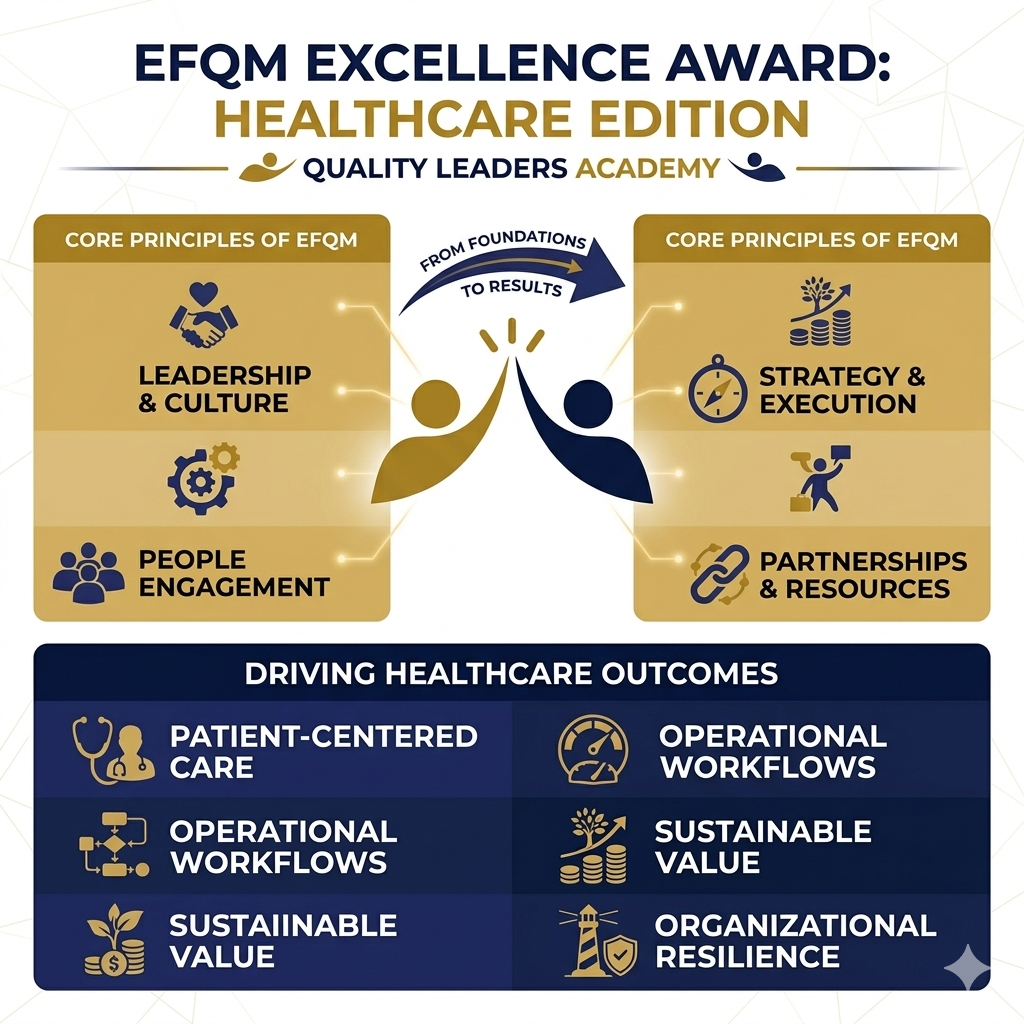
The award is based on the EFQM Model, a comprehensive management framework used by organizations to assess performance, improve strategy execution, and create sustainable value for stakeholders. Within healthcare organizations, the model helps improve patient-centered services, strengthen leadership effectiveness, optimize operational workflows, and support long-term organizational resilience.
For healthcare leaders and quality professionals, understanding the EFQM model in healthcare has become increasingly important as organizations focus on long-term excellence rather than isolated quality initiatives.
WHAT IS THE EFQM EXCELLENCE AWARD?
The EFQM Excellence Award is an international recognition program that evaluates organizations based on their ability to achieve sustainable performance and organizational excellence using the EFQM framework.
Introduced by EFQM in 1992, the model was designed to help organizations improve competitiveness, innovation, and stakeholder value through structured management practices. The framework encourages organizations to evaluate how leadership, strategy, people, partnerships, and operational processes contribute to measurable results.
The EFQM Model assesses organizations across several interconnected areas, including:
- Leadership and organizational culture.
- Strategic direction and execution.
- People engagement and workforce development.
- Partnerships and resource management.
- Operational performance.
- Customer and stakeholder outcomes.
- Organizational sustainability and innovation.
Rather than emphasizing compliance alone, the EFQM framework promotes continuous organizational development and long-term performance improvement.
Healthcare organizations pursuing the award are evaluated not only on outcomes, but also on how those outcomes are achieved and sustained over time.
WHY THE EFQM MODEL MATTERS IN HEALTHCARE?
The EFQM framework aligns closely with many healthcare priorities, including patient safety, quality improvement, leadership accountability, and operational excellence.
Supporting Patient-Centered Care
Healthcare organizations increasingly recognize that patient experience and clinical outcomes are deeply connected to organizational culture and system performance. The EFQM Model encourages institutions to evaluate healthcare delivery from the patient perspective and continuously improve services accordingly.
This may include:
- Improving care coordination.
- Strengthening communication processes.
- Enhancing patient engagement.
- Reducing delays and inefficiencies.
Strengthening Organizational Culture
A strong organizational culture is essential for healthcare quality and patient safety. The EFQM approach emphasizes leadership responsibility, workforce engagement, and shared organizational values.
Healthcare organizations applying EFQM principles often focus on:
- Collaboration between departments.
- Transparent communication.
- Staff involvement in improvement initiatives.
- Continuous learning environments.
Driving Healthcare Performance Improvement
The EFQM Model also supports data-driven decision-making and measurable improvement. Healthcare organizations use performance indicators to evaluate operational effectiveness, patient outcomes, and strategic progress.
This structured approach helps organizations:
- Identify performance gaps.
- Monitor quality indicators.
- Improve operational consistency.
- Support evidence-based improvement initiatives.
As healthcare systems become more complex, frameworks like EFQM help organizations align strategy, operations, and quality management into a unified performance improvement system.
KEY BENEFITS OF PURSUING THE EFQM EXCELLENCE AWARD
Healthcare organizations implementing the EFQM model in healthcare often experience benefits across both operational and clinical areas.
Improved Organizational Alignment
The EFQM framework helps align leadership priorities, operational goals, and quality initiatives across departments. This supports more coordinated decision-making and clearer organizational direction.
Better Patient Experience
Organizations focused on excellence frameworks frequently prioritize service quality, communication, and patient-centered improvement efforts that contribute to stronger patient experiences.
Enhanced Operational Efficiency
Performance assessment and process evaluation can help healthcare organizations identify inefficiencies, improve workflows, and optimize resource utilization.
Increased Workforce Engagement
The EFQM Model recognizes the importance of workforce involvement in organizational success. Healthcare organizations that engage staff in improvement initiatives often strengthen accountability and collaboration.
Continuous Improvement Mindset
The EFQM approach emphasizes sustained improvement by encouraging ongoing review, innovation, and performance refinement. This supports long-term sustainability and organizational resilience.
Stronger Organizational Resilience
Healthcare organizations operate in environments shaped by financial pressures, workforce shortages, and evolving patient needs. Structured excellence frameworks help organizations respond more effectively to change while maintaining performance standards.
CHALLENGES HEALTHCARE ORGANIZATIONS FACE WHEN IMPLEMENTING EFQM PRINCIPLES
Although the EFQM Excellence Award offers substantial value, implementation can be complex within healthcare environments.
Resistance to Change
Healthcare organizations often operate with established workflows and hierarchical structures. Organizational transformation efforts may encounter resistance from teams unfamiliar with improvement frameworks.
Leadership Inconsistency
Successful implementation depends heavily on sustained leadership engagement. Without consistent support from leadership teams, improvement initiatives may lose momentum.
Limited Quality Management Training
Many healthcare professionals have strong clinical backgrounds but limited formal education in organizational excellence, systems thinking, or strategic quality management.
Performance Measurement Difficulties
Healthcare systems manage large volumes of operational and clinical data. Identifying meaningful indicators and interpreting results effectively requires structured performance management approaches.
Balancing Daily Operations with Transformation Efforts
Hospitals and healthcare facilities must maintain continuous patient care while implementing organizational changes, making improvement initiatives particularly demanding.
These challenges highlight the growing need for healthcare professionals with expertise in quality management, leadership, and organizational performance improvement.
EFQM AND HEALTHCARE LEADERSHIP DEVELOPMENT
Today’s healthcare leaders need skills that go beyond clinical practice alone. Healthcare leaders need to recognize how systems, staff engagement, operational workflows, and strategic direction collectively affect healthcare performance and patient outcomes.
Professionals involved in organizational excellence healthcare initiatives increasingly benefit from competencies in:
- Healthcare quality management.
- Leadership and change management.
- Systems thinking.
- Performance improvement methodologies.
- Strategic healthcare operations.
The EFQM framework supports this broader understanding by encouraging leaders to evaluate healthcare organizations as interconnected systems rather than isolated departments.
As healthcare organizations continue emphasizing value-based care, patient safety, and operational sustainability, leadership development and organizational excellence skills are becoming essential for career advancement.
PROFESSIONAL DEVELOPMENT THROUGH QUALITY LEADERS ACADEMY
Healthcare professionals seeking deeper knowledge in organizational excellence, healthcare quality management, and leadership development often benefit from structured educational pathways focused on practical healthcare applications.
Quality Leaders Academy provides programs designed to support professionals working in:
- Healthcare quality management.
- Leadership and organizational development.
- Patient safety and performance improvement.
- Accreditation and healthcare excellence initiatives.
For professionals interested in the EFQM Excellence Award and broader excellence frameworks, educational programs related to:
- Lean Six Sigma.
- Healthcare quality management.
- Leadership and performance improvement.
- Patient safety culture.
- Strategic healthcare management.
can help strengthen understanding of organizational excellence principles and practical improvement methodologies.
This integrated learning approach supports healthcare professionals in developing the competencies needed to contribute to sustainable healthcare transformation and quality excellence initiatives.
ADVANCING ORGANIZATIONAL EXCELLENCE IN HEALTHCARE
The EFQM Excellence Award represents a structured approach to sustainable organizational excellence, leadership effectiveness, and continuous improvement. For healthcare organizations, the EFQM framework offers valuable guidance to strengthen quality management, improve patient-centered care, enhance operational performance, and build resilient healthcare systems.
As healthcare environments continue to evolve, organizations increasingly need leaders and quality professionals who understand how to integrate strategy, culture, performance measurement, and continuous improvement into a unified excellence approach.
By developing competencies in healthcare leadership, quality management, and organizational excellence frameworks, healthcare professionals can play a meaningful role in advancing safer, more effective, and more sustainable healthcare systems.
Resources:
https://aigproexcellence.com/blog/efqm-excellence-award/#:~:text=Introduced%20in%201992%2C%20the%20EFQM,%2C%20innovation%2C%20and%20stakeholder%20value.
https://aigproexcellence.com/blog/efqm-excellence-award/
https://www.sciencedirect.com/science/article/pii/S2351978915004801