

Healthcare organizations today operate in highly complex environments shaped by rising patient expectations, workforce shortages, regulatory requirements, and continuous pressure to improve safety, quality, and efficiency. Hospitals are no longer evaluated only on clinical outcomes, but also on their ability to demonstrate sustainable performance, patient-centered care, and organizational resilience.
To manage this complexity, healthcare systems increasingly rely on structured excellence frameworks that connect strategy, leadership, operations, and outcomes. One of the most widely recognized approaches in this area is the EFQM Management Model, developed within the broader EFQM excellence framework.
In healthcare, the EFQM model is used to support organizational learning, performance evaluation, and continuous improvement. It helps healthcare leaders understand how systems, processes, and people interact to produce measurable results, making it highly relevant for hospitals aiming to strengthen quality management and operational excellence.
WHAT IS THE EFQM MANAGEMENT MODEL?
The EFQM Management Model is a structured framework designed to help organizations understand how they function, how they create value, and how they can improve performance sustainably. In healthcare, it is used as a strategic tool for evaluating organizational effectiveness and guiding long-term improvement.
Rather than focusing on isolated performance indicators, the model encourages healthcare organizations to take a holistic view of performance. It examines how leadership decisions, organizational strategy, workforce engagement, and operational processes contribute collectively to outcomes.
At its core, the EFQM Management Model helps healthcare organizations:
- Understand organizational strengths and weaknesses.
- Align strategy with operational execution.
- Improve decision-making based on evidence.
- Strengthen continuous improvement systems.
- Enhance value delivered to patients and stakeholders.
This systems-based perspective is particularly valuable in healthcare, where outcomes depend on coordination across multiple departments and disciplines.
CORE COMPONENTS OF THE EFQM MANAGEMENT MODEL
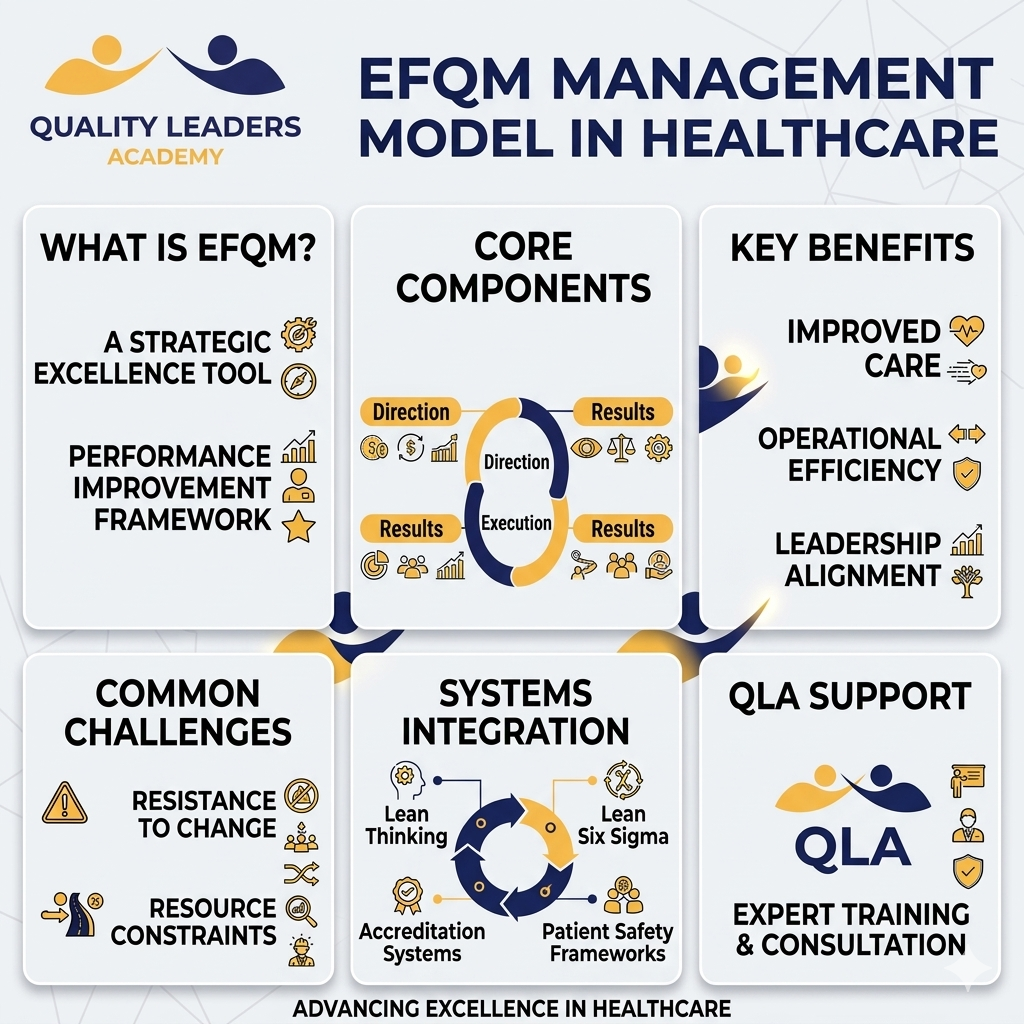
The EFQM Management Model is generally structured around three interconnected dimensions: Direction, Execution, and Results. Each dimension plays a critical role in shaping organizational performance in healthcare settings.
1. Direction
Direction refers to how an organization defines its purpose and strategic intent. In healthcare, this includes:
- Organizational mission and vision.
- Leadership approach and governance.
- Strategic planning and alignment.
- Organizational culture and values.
Strong direction ensures that hospitals and healthcare systems maintain a clear focus on patient care, safety, and long-term sustainability.
2. Execution
Execution focuses on how strategies are implemented across the organization. In healthcare environments, this includes:
- Patient pathways and care delivery processes.
- Workforce engagement and capability development.
- Resource and partnership management.
- Change management and operational coordination.
Execution is where strategy becomes reality. In hospitals, effective execution ensures that clinical and administrative processes work together efficiently to support patient outcomes.
3. Results
Results reflect what the organization achieves through its strategy and execution. In healthcare, results typically include:
- Patient outcomes and safety indicators.
- Patient experience and satisfaction.
- Workforce engagement and retention.
- Operational and financial performance.
The EFQM Management Model emphasizes that results should be measured not only in terms of performance outcomes but also in terms of sustainability and long-term impact.
WHY THE EFQM MANAGEMENT MODEL MATTERS IN HEALTHCARE?
Healthcare organizations require frameworks that go beyond compliance and support continuous improvement. The EFQM Management Model is particularly valuable because it links leadership, strategy, and operations directly to measurable outcomes.
In healthcare settings, the model supports:
Patient-Centered Care Improvement
Hospitals can evaluate whether their systems are designed around patient needs, ensuring better coordination, communication, and care experience.
Operational Efficiency
The model helps identify inefficiencies in workflows, resource use, and service delivery, supporting more streamlined healthcare operations.
Leadership Alignment
Effective healthcare leadership requires alignment between strategic goals and daily operations. The EFQM framework helps assess and strengthen this alignment.
Quality and Safety Performance
By evaluating processes and outcomes together, healthcare organizations can better understand risks, variations, and improvement opportunities.
Continuous Improvement Culture
The model encourages organizations to move beyond reactive problem-solving and adopt structured, ongoing improvement practices.
BENEFITS OF USING THE EFQM MANAGEMENT MODEL IN HOSPITALS
Healthcare organizations that apply the EFQM Management Model often experience improvements in several key areas of performance.
Stronger Organizational Performance
By connecting strategy with execution, hospitals can improve consistency and overall performance across departments.
Improved Patient Experience
A structured focus on value creation helps healthcare providers better align services with patient expectations.
Better Strategic Alignment
The model ensures that organizational goals are consistently reflected in operational decisions and resource allocation.
Enhanced Decision-Making
Healthcare leaders gain clearer insights into performance drivers, enabling more informed and evidence-based decisions.
Increased Staff Engagement
When workforce contributions are aligned with organizational goals, engagement and accountability improve.
Greater Organizational Resilience
The model supports adaptability, helping healthcare systems respond effectively to changing demands and pressures.
COMMON CHALLENGES IN IMPLEMENTING THE EFQM MANAGEMENT MODEL
Despite its benefits, healthcare organizations may face challenges when implementing the EFQM Management Model.
Resistance to Change
Healthcare environments often rely on established routines, which can make organizational transformation difficult.
Leadership Alignment Issues
Successful implementation requires consistent leadership commitment across all levels of the organization.
Limited Quality Management Capabilities
Some healthcare organizations lack structured training in performance measurement and quality management systems.
Difficulty Measuring Outcomes
Healthcare data is often complex, making it challenging to translate information into meaningful performance insights.
Operational Pressures
High patient volumes and resource constraints can limit the time available for structured improvement initiatives.
EFQM MANAGEMENT MODEL AND CONTINUOUS QUALITY IMPROVEMENT IN HEALTHCARE
The EFQM Management Model aligns closely with established healthcare improvement approaches. It supports principles commonly found in:
- Healthcare quality management systems.
- Lean thinking and process optimization.
- Six Sigma methodologies for reducing variation.
- Patient safety and risk management frameworks.
- Accreditation and compliance readiness systems.
By integrating these approaches, healthcare organizations can create a more structured and sustainable improvement environment. The EFQM model encourages organizations to view performance as a continuous cycle of assessment, learning, and adaptation rather than isolated improvement projects.
ADVANCING HEALTHCARE EXCELLENCE THROUGH PROFESSIONAL DEVELOPMENT
Developing expertise in the EFQM Management Model requires more than theoretical understanding. Healthcare professionals benefit from structured learning pathways that connect organizational excellence principles with real-world healthcare applications.
Quality Leaders Academy supports healthcare professionals seeking to strengthen competencies in:
- Healthcare quality management.
- Leadership and organizational development.
- Performance improvement systems.
- Patient safety and operational excellence.
- Accreditation and healthcare transformation frameworks.
For professionals working in hospital quality departments, clinical governance, or healthcare leadership roles, understanding frameworks like EFQM enhances the ability to evaluate systems, interpret performance data, and support improvement initiatives.
In addition, combining EFQM knowledge with methodologies such as Lean Six Sigma can strengthen problem-solving capabilities and improve the effectiveness of quality improvement initiatives in healthcare environments.
The EFQM Management Model provides healthcare organizations with a structured approach to understanding and improving performance across leadership, strategy, operations, and outcomes. In an environment where healthcare systems face increasing pressure to deliver high-quality, efficient, and patient-centered care, such frameworks are essential for sustainable improvement.
By applying the EFQM model, healthcare organizations can strengthen alignment, improve decision-making, enhance patient outcomes, and build a stronger culture of continuous improvement. For healthcare professionals, it also offers a valuable foundation for developing expertise in organizational excellence and healthcare performance improvement.
As healthcare continues to evolve, structured management models like EFQM will remain central to building resilient, high-performing healthcare systems focused on quality, safety, and long-term value.
Resources: