
Healthcare systems worldwide face increasing pressure to deliver safer care, improve patient outcomes, strengthen operational efficiency, and maintain financial sustainability. Rising patient expectations, workforce challenges, regulatory requirements, and growing demands for accountability have made healthcare improvement more complex than ever.
While accreditation and compliance standards remain important, many healthcare organizations recognize that meeting minimum requirements alone is no longer enough. Sustainable improvement requires structured frameworks that help organizations strengthen leadership, culture, performance, and patient-centered care over time.
This is where the European Excellence Model becomes increasingly valuable in healthcare.
The EFQM Excellence Model healthcare framework provides healthcare organizations with a structured approach to evaluating performance, identifying improvement opportunities, and building long-term organizational excellence. Rather than focusing solely on inspection or compliance, the model encourages continuous improvement, leadership accountability, and sustainable organizational growth.
For healthcare leaders seeking practical ways to improve systems, quality, and outcomes, the European Excellence Model offers a comprehensive pathway toward performance excellence.
WHAT IS THE EUROPEAN EXCELLENCE MODEL?
The European Excellence Model, commonly known as the EFQM Excellence Model, is an organizational improvement framework developed by the European Foundation for Quality Management (EFQM). It was designed to help organizations improve performance through structured self-assessment, leadership development, innovation, and continuous improvement.
Unlike traditional quality systems that focus mainly on compliance, the EFQM framework encourages organizations to evaluate how leadership, strategy, people, partnerships, processes, and results work together to create sustainable value.
In healthcare settings, the model supports organizations in strengthening systems that influence patient care, workforce engagement, governance, and operational performance.
Healthcare organizations adopt excellence frameworks because healthcare delivery involves highly interconnected systems. Patient outcomes are influenced not only by clinical expertise but also by communication, operational workflows, leadership effectiveness, and organizational culture.
One key difference between the EFQM healthcare framework and accreditation programs is focus. Accreditation often evaluates whether organizations meet predefined standards at a specific point in time. The EFQM model, however, promotes ongoing organizational maturity through reflection, learning, and continuous performance improvement.
The model emphasizes:
Continuous improvement
Sustainable organizational performance
Leadership accountability
Stakeholder value creation
Innovation and learning
For healthcare organizations, this means moving beyond short-term fixes toward long-term excellence.
HOW THE EUROPEAN EXCELLENCE MODEL APPLIES TO HEALTHCARE?
The European Excellence Model becomes especially relevant when adapted to healthcare quality improvement efforts.
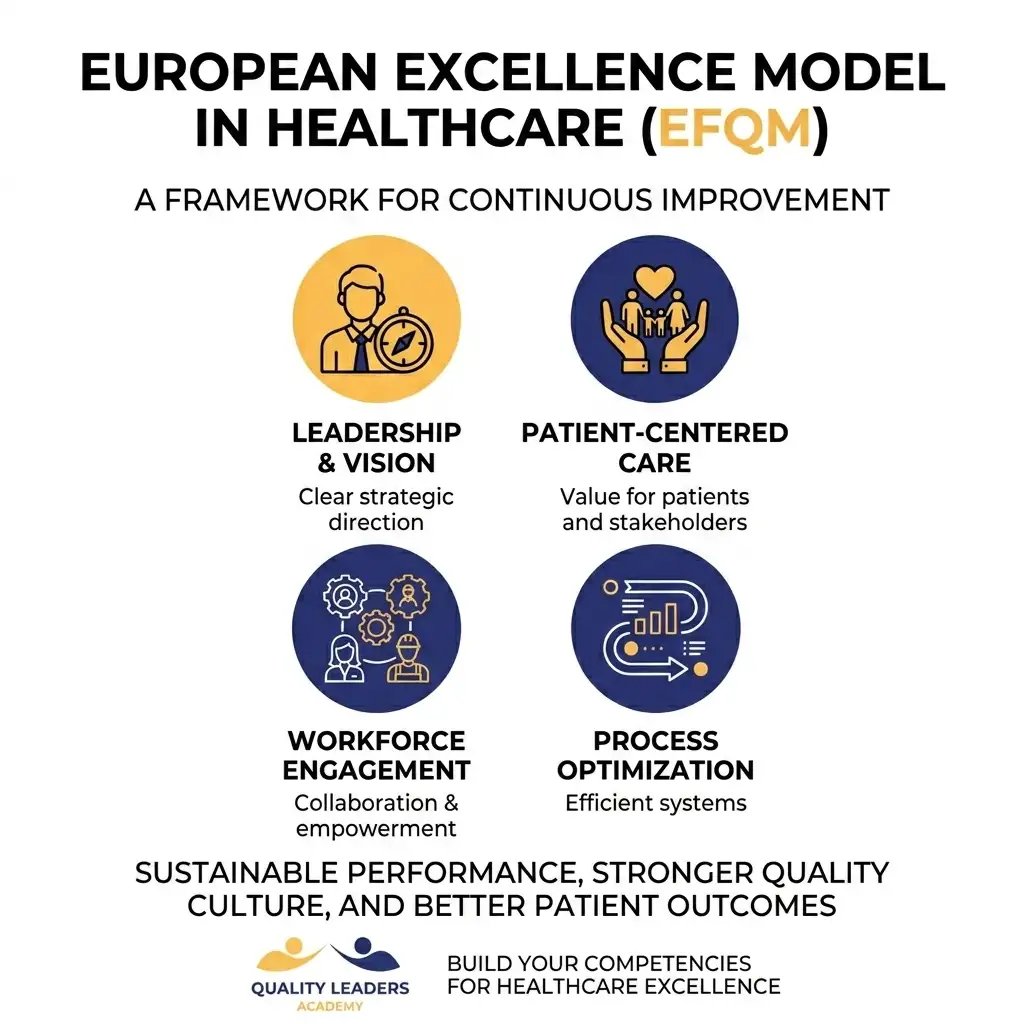
Leadership and Strategic Direction
Strong healthcare organizations require clear leadership and strategic alignment.
The EFQM framework emphasizes leadership accountability, governance, and organizational vision. Healthcare executives and leaders are encouraged to establish a clear direction while creating cultures that prioritize quality, patient safety, and performance improvement.
In healthcare environments, effective leadership directly influences decision-making, workforce engagement, and organizational resilience during periods of change.
Patient-Centered Care and Stakeholder Value
Patient-centered care remains one of the most important goals in modern healthcare.
The EFQM model encourages healthcare organizations to evaluate how services create value for patients, families, employees, and the broader healthcare system.
Organizations using healthcare quality improvement models often focus on improving patient experience, reducing care variation, strengthening communication, and building trust.
By emphasizing stakeholder value, healthcare organizations can better align services with patient expectations and long-term care quality goals.
Workforce Engagement
Healthcare improvement depends heavily on engaged professionals.
The EFQM approach highlights the importance of employee involvement, collaboration, and organizational culture. Healthcare organizations benefit when staff members feel empowered to participate in problem-solving, process improvement, and quality initiatives.
In many healthcare settings, workforce engagement contributes to stronger teamwork, reduced burnout, and more consistent quality performance.
Process Optimization and Performance
Healthcare organizations operate through highly complex systems.
The EFQM framework supports organizations in improving workflows, reducing inefficiencies, and strengthening performance measurement systems.
Whether addressing patient flow, care coordination, safety processes, or operational bottlenecks, structured improvement helps healthcare organizations deliver services more efficiently while maintaining quality standards.
This makes the model highly relevant to continuous improvement in healthcare.
WHY HEALTHCARE ORGANIZATIONS USE THE EUROPEAN EXCELLENCE MODEL?
Healthcare organizations increasingly adopt the European Excellence Model because it supports improvement across multiple performance areas.
One major advantage is the development of a stronger quality culture. Rather than viewing quality as a compliance requirement, organizations begin embedding improvement into daily operations and leadership practices.
Healthcare organizations also use EFQM to strengthen organizational performance. Better alignment between leadership, operations, workforce, and strategy often improves consistency and accountability.
Patient outcomes may also improve when organizations systematically evaluate processes, identify inefficiencies, and strengthen service quality.
Leadership systems become more effective as organizations establish clearer priorities and encourage cross-functional collaboration.
Operational efficiency is another important benefit. Organizations using structured excellence frameworks frequently work to reduce waste, improve coordination, and strengthen decision-making systems.
Ultimately, the EFQM framework supports sustainable healthcare transformation by helping organizations improve performance while adapting to changing healthcare demands.
LESSONS FROM HEALTHCARE ORGANIZATIONS USING EFQM
Research examining EFQM Excellence Model healthcare implementation highlights several practical lessons for healthcare organizations.
One important finding is that leadership engagement plays a critical role in success. Improvement efforts are more effective when leaders actively support quality initiatives and communicate a clear organizational vision.
Continuous assessment also matters. Organizations benefit when performance evaluation becomes an ongoing process rather than a one-time project.
Staff participation is equally important. Healthcare professionals across departments often contribute valuable insight into operational challenges and opportunities for improvement.
Healthcare organizations that treat EFQM as an organizational learning tool rather than an administrative requirement often experience stronger long-term results.
These experiences reinforce the importance of collaboration, transparency, and organizational commitment.
COMMON CHALLENGES IN EFQM IMPLEMENTATION
Despite its benefits, implementing the European Excellence Model can present challenges.
Resistance to organizational change is common, especially in environments facing operational pressure or workforce fatigue. Improvement initiatives may feel overwhelming if communication is limited.
Staff engagement can also become difficult when employees do not fully understand the purpose of organizational excellence frameworks.
Measurement challenges represent another barrier. Healthcare organizations sometimes struggle to define meaningful indicators that accurately reflect quality and performance.
Leadership inconsistency may also slow progress. Sustainable improvement requires ongoing commitment rather than temporary enthusiasm.
Balancing quality improvement with operational realities remains an important challenge, particularly in busy healthcare environments managing staffing shortages and resource limitations.
However, organizations that approach implementation gradually and collaboratively often build stronger improvement cultures over time.
Why the European Excellence Model Matters for Healthcare Professionals?
Healthcare professionals increasingly benefit from understanding organizational excellence frameworks.
Knowledge of healthcare performance excellence, leadership systems, and quality improvement methods supports stronger decision-making across healthcare settings.
Professionals working in healthcare quality, accreditation, patient safety, healthcare operations, and leadership roles often benefit from greater understanding of:
Healthcare quality systems
Organizational excellence frameworks
Leadership and governance
Performance improvement methods
Patient-centered quality approaches
As healthcare systems continue evolving, professionals who understand structured improvement models are often better prepared to contribute to meaningful organizational change.
STRENGTHENING HEALTHCARE EXCELLENCE COMPETENCIES THROUGH QUALITY LEADERS ACADEMY
For healthcare professionals involved in quality improvement, patient safety, accreditation, and organizational performance, continuous professional development plays an important role in building practical expertise.
Educational opportunities offered through Quality Leaders Academy can help professionals strengthen competencies related to healthcare quality frameworks, leadership, operational excellence, healthcare systems thinking, and performance improvement methodologies.
Understanding concepts connected to the EFQM healthcare framework, organizational maturity, and quality culture development may help professionals contribute more effectively to healthcare transformation efforts.
As healthcare organizations increasingly prioritize excellence, leadership, and sustainable improvement, investing in structured learning becomes an important step toward supporting stronger healthcare systems and better patient outcomes.
Resources:
https://pubmed.ncbi.nlm.nih.gov/26335168/