

Hospitals today face constant pressure to deliver safe, high-quality care in complex and unpredictable environments. Despite advances in technology and clinical practice, preventable harm remains a concern. This is why the concept of the high-reliability hospital has gained increasing attention in healthcare systems worldwide.
A high reliability hospital is not simply a well-performing organization. It is a system designed to anticipate risks, prevent errors, and maintain consistent safety under pressure. For healthcare professionals, understanding how these hospitals operate is essential, especially for those working in patient safety, quality, and risk management.
WHAT IS A HIGH RELIABILITY HOSPITAL?
A high-reliability hospital applies the principles of High-Reliability Organizations (HROs) to healthcare settings. These organizations operate in high-risk environments yet maintain exceptionally low failure rates.
According to the Agency for Healthcare Research and Quality, high reliability in healthcare is built on continuous awareness of risk, strong system design, and a culture that prioritizes safety over short-term efficiency.
Hospitals adopting this model focus on preventing harm before it occurs rather than reacting after incidents happen.
WHY HIGH RELIABILITY HOSPITALS MATTER?
Healthcare delivery involves multiple systems, teams, and technologies working simultaneously. This complexity increases the likelihood of errors unless systems are carefully designed.
High reliability hospitals help:
- Reduce preventable patient harm.
- Improve clinical outcomes.
- Strengthen communication across care teams.
- Increase trust in healthcare systems.
- Support accreditation and regulatory compliance.
Research published in peer-reviewed medical literature highlights that hospitals implementing high reliability principles show measurable improvements in patient safety and system performance.
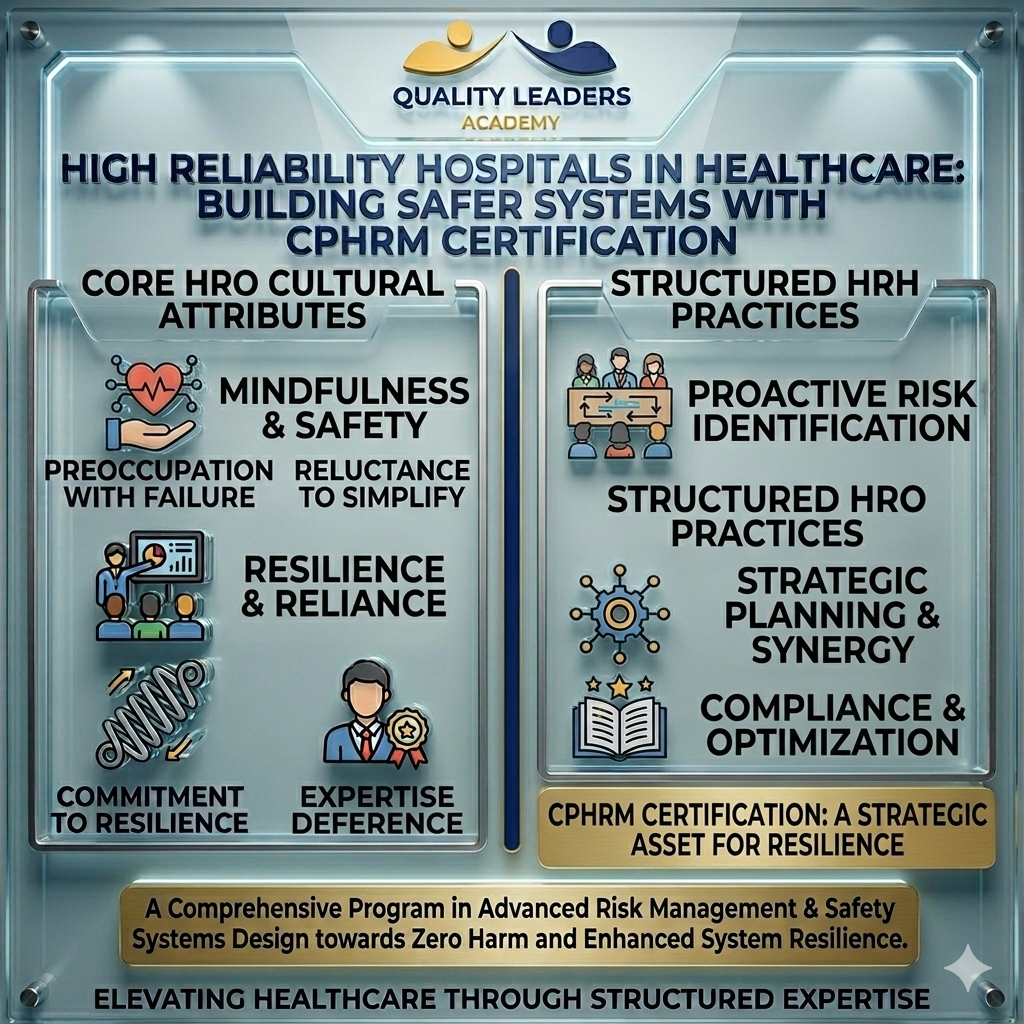
CORE PRINCIPLES OF HIGH RELIABILITY IN HOSPITALS
High reliability hospitals operate based on well-established principles supported by patient safety research.
Continuous Awareness of Risk
Healthcare teams remain alert to early signs of failure, including near-misses, not just major incidents.
Deep Understanding of System Failures
Rather than accepting simple explanations, teams investigate underlying system causes of errors.
Real-Time Operational Awareness
Frontline staff and leadership maintain close attention to daily operations to detect risks early.
Strong Response and Recovery Systems
Hospitals develop the ability to respond quickly and effectively when unexpected events occur.
Expertise-Driven Decision Making
Decisions are guided by the most knowledgeable individuals in a given situation, regardless of hierarchy.
These principles shift hospitals from reactive environments to proactive, safety-focused systems.
KEY CHARACTERISTICS OF HIGH RELIABILITY HOSPITALS
High reliability hospitals share common organizational traits that support safety and consistency.
Culture of Safety
Staff are encouraged to report errors and near-misses without fear of punishment. This creates transparency and continuous learning.
Leadership Commitment
Hospital leadership invests in safety systems, training, and long-term improvement strategies.
Standardized Yet Flexible Processes
Protocols are standardized to reduce variation, while flexibility is maintained for complex clinical situations.
System-Based Accountability
The focus is on improving systems rather than assigning blame to individuals.
These characteristics are consistently emphasized in healthcare safety frameworks and improvement models.
THE ROLE OF RISK MANAGEMENT IN HIGH RELIABILITY HOSPITALS
Risk management is central to achieving high reliability in healthcare. It provides the structure needed to identify vulnerabilities and prevent failures.
Effective risk management in hospitals includes:
- Proactive identification of risks across clinical and operational processes.
- Incident reporting and analysis.
- Root cause analysis to understand system failures.
- Implementation of preventive strategies.
- Continuous monitoring and performance improvement.
This structured approach ensures that safety is built into the system, not dependent on individual performance alone.
CHALLENGES IN BUILDING HIGH RELIABILITY HOSPITALS
Despite clear benefits, many hospitals struggle to implement high reliability principles.
Common challenges include:
- Limited training in risk management and systems thinking.
- Resistance to cultural change.
- Inconsistent leadership engagement.
- Weak reporting systems for errors and near-misses.
- Difficulty integrating safety practices into daily workflows.
Addressing these challenges requires both organizational commitment and professional development.
PROFESSIONAL DEVELOPMENT THROUGH QUALITY LEADERS ACADEMY
Mastering the complexities of high reliability hospitals and preparing for the CPHRM exam requires structured guidance.
Quality Leaders Academy provides specialized pathways tailored to different learning styles:
CPHRM Focus Study & Review (Live):
Cphrm Live Course interactive sessions are designed for real-time engagement, discussion, and case study analysis. Ideal for professionals who benefit from direct interaction and guided learning.
CPHRM Focus Study & Review (Recorded):
In the CPHRM Recorded Course, there is a flexible, self-paced option that allows busy healthcare professionals to learn according to their schedule without compromising content depth.
CPHRM Revision Package:
A focused and intensive review program that targets core concepts and exam strategies, helping candidates refine their knowledge and build confidence before the exam.
These programs ensure that participants do more than prepare for certification. They develop practical, verifiable skills that can be applied to improve patient safety and support the transition toward high reliability hospital systems.
CAREER IMPACT OF HIGH RELIABILITY AND RISK MANAGEMENT EXPERTISE
Healthcare professionals trained in high reliability principles and risk management are increasingly in demand.
Career opportunities include:
- Patient safety officer.
- Healthcare risk manager.
- Quality improvement specialist.
- Hospital administrator.
- Compliance and regulatory professional.
These roles are essential for building safer healthcare systems and improving organizational performance.
High reliability hospitals represent a shift toward safer, more consistent healthcare systems. They focus on preventing harm, improving processes, and building a culture where safety is a shared responsibility.
Achieving this level of performance requires more than awareness. It demands structured knowledge in risk management and patient safety.
Through professional development pathways like those offered by Quality Leaders Academy, healthcare professionals can gain the skills needed to support high reliability systems and advance their careers.
For those committed to improving patient safety and healthcare quality, investing in CPHRM preparation is a meaningful step toward building safer hospitals and stronger healthcare systems.
Resources: