
Healthcare systems operate in complex, high-stakes, volatile environments where minor systemic lapses can escalate into catastrophic outcomes and lead to serious patient harm. Despite technological strides and advances in clinical practice, achieving consistent unwavering safety remains an elusive goal for many. This is why High Reliability Organization (HRO) principles have shifted from being a "nice-to-have" framework to a strategic imperative for global healthcare leaders.
For professionals in the field, moving from theoretical understanding to operational excellence requires a specialized toolkit—one that is masterfully provided through the CPHRM (Certified Professional in Healthcare Risk Management) certification.
WHAT IS A HIGH RELIABILITY ORGANIZATION IN HEALTHCARE?
An HRO is an entity that maintains an exceptional safety record over extended periods, despite operating in complex, hazardous environments. Drawing inspiration from aviation and nuclear power, healthcare HROs cultivate a culture of "chronic unease"—a state of constant mindfulness where risks are anticipated and safety is hardwired into the organizational DNA
The five Pillars OF HIGH RELIABILITY ORGANIZATIONS
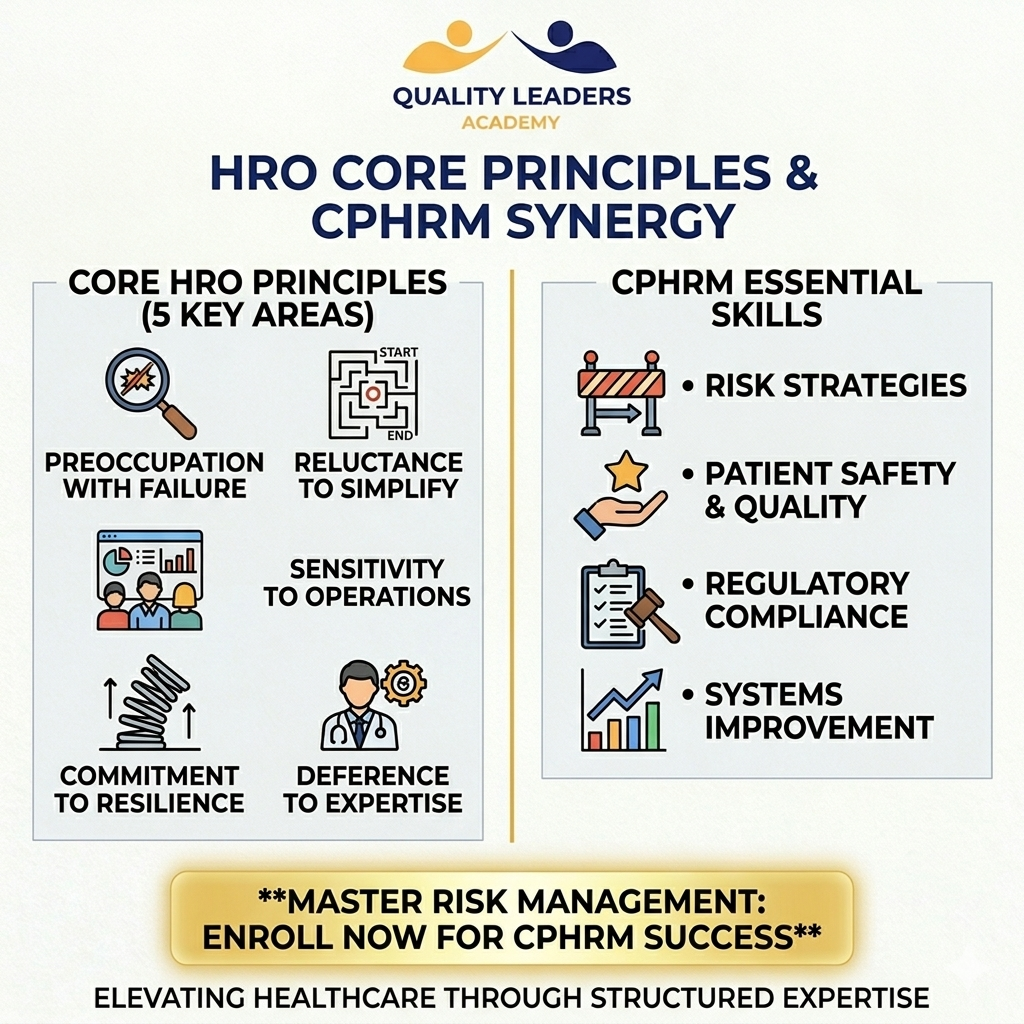
Research from institutions such as UC Berkeley and healthcare safety frameworks identifies five core principles that distinguish HROs:
1. Preoccupation with Failure
HROs assume that errors are always possible. They actively analyze near-misses to prevent future harm.
2. Reluctance to Simplify Interpretations
Healthcare is messy. HROs reject simple explanations and dig deep into the systemic root causes of every anomaly.
3. Sensitivity to Operations
Leaders stay connected to the front lines, ensuring real-time awareness of how care is actually delivered, not just how it’s designed on paper.
4. Commitment to Resilience
Because perfection is impossible, HROs build the systemic muscle to contain, bounce back, and learn from errors rapidly.
5. Deference to Expertise
In a crisis, hierarchy fades. Decision-making authority migrates to the person with the most relevant knowledge, regardless of their job title.
WHY HIGH RELIABILITY ORGANIZATIONS MATTER IN HEALTHCARE?
Healthcare systems are inherently complex, involving multiple teams, technologies, and workflows. Without structured safety systems, the risk of error increases.
Organizations that adopt HRO principles can:
- Reduce preventable harm and medical errors.
- Improve patient safety outcomes.
- Strengthen communication and teamwork.
- Build a non-punitive safety culture.
- Achieve compliance with accreditation standards.
Institutions such as the Joint Commission promote HRO adoption as a key strategy for improving healthcare quality and safety.
Risk Management: The Engine of Reliability
If HRO is the destination, Risk Management is the vehicle. It provides the practical methodologies needed to translate high-level safety theories into daily clinical practice.
A robust risk management framework—anchored by CPHRM standards—empowers organizations to:
Transition from reactive crisis management to proactive risk mitigation.
Foster a non-punitive culture where reporting is encouraged, not punished.
Standardize complex workflows to reduce human variance and clinical error.
Why CPHRM Certification is Non-Negotiable
The CPHRM certification is the industry gold standard. It bridges the gap between general management and the highly technical demands of healthcare safety. By mastering the CPHRM curriculum, professionals gain expertise in:
Clinical & Patient safety Risk: Systematically identifying and mitigating vulnerabilities in patient care processes to prevent harm before it occurs.
Healthcare Operations: Understanding the intricate workflows of clinical and non-clinical departments to ensure that safety protocols are seamlessly integrated into daily operations without disrupting efficiency.
Legal & Regulatory Mastery: Navigating the complex landscape of healthcare law and accreditation.
Risk Financing: Mastering the financial side of risk, including insurance mechanisms, self-insurance funding, and the strategic allocation of resources to protect the organization’s financial health.
Claims & Litigation: Managing the financial and reputational fallout of adverse events.
Leadership: Driving the cultural shift required to sustain an HRO.
Excellence Through Quality Leaders Academy
Transitioning to an HRO model requires more than just reading—it requires structured, expert-led preparation. Quality Leaders Academy offers a comprehensive suite of CPHRM programs tailored to different professional needs:
Live Review Sessions: Interactive, real-time deep dives into the core domains of risk management.
Recorded Sessions: Flexible, self-paced learning for busy healthcare executives.
Revision Packages: Targeted, high-intensity prep for those ready to sit for the exam.
Each pathway is designed to do more than just help you pass a test; they are built to transform you into a leader capable of steering your organization toward zero harm.
The Path Forward: Career & Systemic Impact
The demand for HRO expertise is at an all-time high. Professionals with CPHRM credentials are no longer just "staff"—they are architects of safety in roles such as:
Patient Safety Officers
Risk Management Directors
Quality & Compliance Leaders
Conclusion
The future of healthcare belongs to organizations that can promise—and deliver—consistent safety. The journey to becoming a High Reliability Organization is rigorous, but with the CPHRM certification and the support of Quality Leaders Academy, that excellence is within reach.
Take the Lead: Invest in your expertise. Secure your organization’s future. Explore our CPHRM programs today.
Resources:
https://www.sciencedirect.com/science/article/abs/pii/S1521689611000334
https://blog.kainexus.com/improvement-disciplines/hro/5-principles
https://pmc.ncbi.nlm.nih.gov/articles/PMC11473027/
https://www.qualityleadersacademy.com/high-reliability-organization