

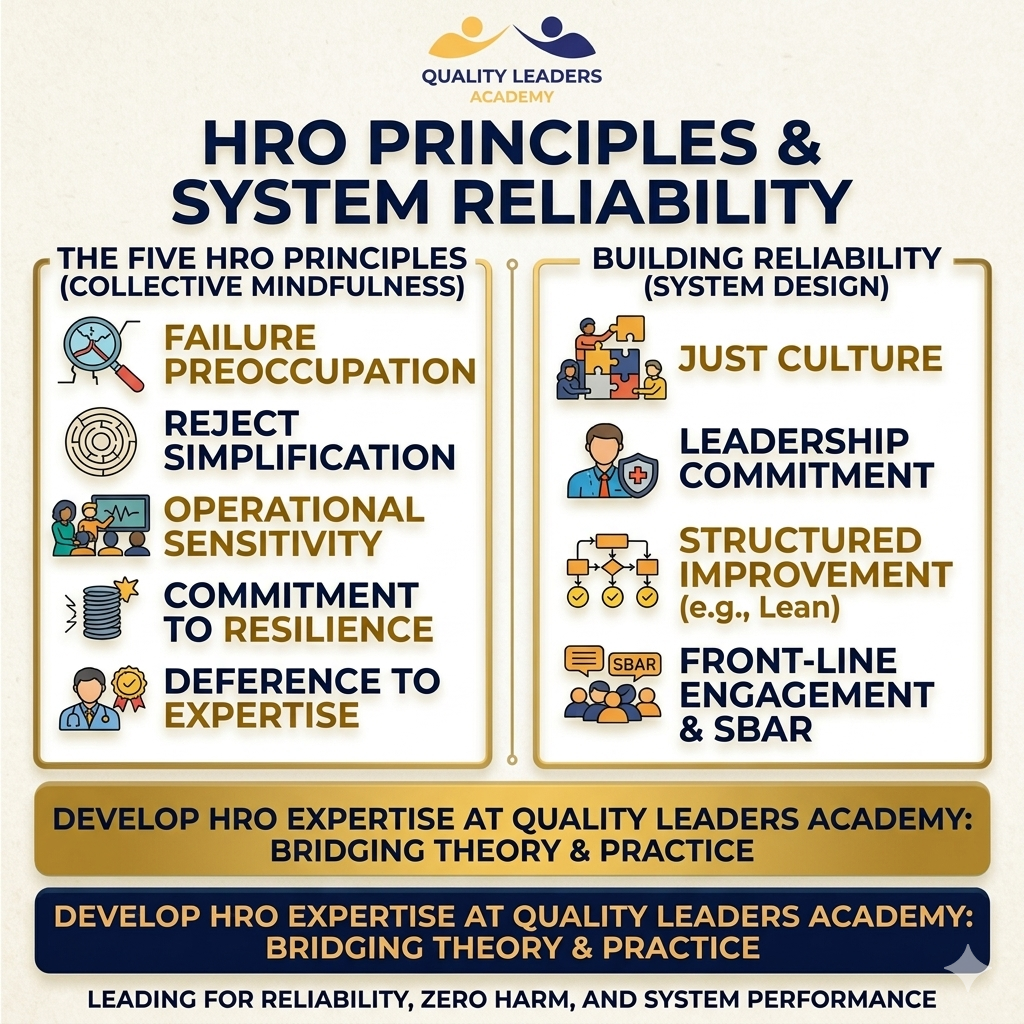
In the high-stakes environment of modern healthcare, patient safety cannot rely solely on the heroism of individual clinicians. When system complexity increases, the margin for error narrows. To build truly resilient organizations, we must shift our focus from individual performance to system-level reliability. This is the promise of High Reliability Organization (HRO) principles—a framework designed to help organizations operate reliably under pressure while minimizing preventable harm.
HROs aim to achieve consistently safe performance in complex environments where errors can have serious consequences. At its core, high reliability is rooted in continuous risk awareness, strong communication, and system-level learning rather than individual blame.
WHAT ARE HRO PRINCIPLES IN HEALTHCARE?
HRO principles in healthcare refer to a set of organizational behaviors and system design strategies that help healthcare institutions maintain high levels of safety despite complexity and uncertainty.
These principles are widely used in industries such as aviation and nuclear energy and are increasingly applied in healthcare to reduce medical errors and improve patient outcomes.
Research and guidance from sources such as the Agency for Healthcare Research and Quality and peer-reviewed literature in PMC emphasize that high reliability is achieved through collective mindfulness and continuous system improvement, not isolated interventions.
WHY HRO PRINCIPLES MATTER FOR PATIENT SAFETY?
Healthcare systems face constant risk due to high patient volume, complex workflows, and time-sensitive decision-making.
Studies published in peer-reviewed medical literature show that organizations applying high reliability practices experience improvements in safety culture, communication, and error reduction over time.
HRO principles help healthcare organizations:
- Identify risks before they cause harm.
- Improve coordination across clinical teams.
- Strengthen communication during transitions of care.
- Reduce variability in clinical processes.
- Build a proactive safety culture.
The focus shifts from reacting to errors to preventing them through system design.
THE FIVE CORE HRO PRINCIPLES IN HEALTHCARE
HRO systems are built around five widely recognized principles, originally developed by Weick and Sutcliffe and widely referenced in healthcare safety literature, including PSNet resources.
1. Preoccupation with Failure
Healthcare teams assume that errors are always possible. Near-misses are treated as valuable opportunities to identify system weaknesses.
2. Reluctance to Simplify Interpretations
Complex clinical problems are not reduced to simple explanations. Instead, organizations examine deeper system causes.
3. Sensitivity to Operations
Frontline awareness is maintained at all times to detect early signs of system failure.
4. Commitment to Resilience
Healthcare systems are designed to respond quickly, contain errors, and recover safely when problems occur.
5. Deference to Expertise
Decision-making authority shifts to individuals with the most relevant knowledge in a specific situation, regardless of rank.
These principles are consistently highlighted in patient safety frameworks and HRO guidance materials, including those from Joint Commission resources.
HOW HEALTHCARE ORGANIZATIONS IMPLEMENT HRO PRINCIPLES?
Building a Strong Safety Culture
A key requirement of HRO implementation is creating a culture where staff can report errors, hazards, and near-misses without fear. This is often referred to as a “Just Culture,” and it is strongly emphasized in healthcare safety literature.
Leadership Commitment to Reliability
Leadership plays a critical role in prioritizing safety over operational pressure.
High reliability organizations require visible leadership engagement, accountability, and long-term commitment to safety goals.
Structured Process Improvement
Hospitals apply structured methodologies such as Lean and Six Sigma to reduce variation and improve consistency in care delivery.
Frontline Engagement and Communication
Frontline staff are actively involved in identifying risks and improving workflows.
Tools like safety huddles and structured communication systems help ensure critical information is shared effectively.
REAL-WORLD EVIDENCE SUPPORTING HRO ADOPTION
Many studies showed that healthcare organizations implementing HRO frameworks experience improvements in:
- Patient safety outcomes.
- Organizational learning systems.
- Staff communication and teamwork.
- Reduction in preventable harm over time.
While outcomes vary depending on implementation quality, long-term adoption is consistently associated with stronger safety performance and more resilient healthcare systems.
CHALLENGES IN APPLYING HRO PRINCIPLES IN HEALTHCARE
Despite strong evidence supporting HRO adoption, healthcare organizations face several barriers:
- Difficulty sustaining cultural change over time.
- Limited training in systems thinking and risk management.
- Inconsistent leadership engagement.
- Weak feedback loops for safety reporting.
- Operational pressure is competing with safety priorities.
These challenges are widely documented in healthcare implementation research and safety improvement literature.
DEVELOPING HIGH RELIABILITY EXPERTISE THROUGH QUALITY LEADERS ACADEMY
Effective application of HRO principles in healthcare and successful CPHRM exam preparation require structured and applied learning pathways.
Quality Leaders Academy delivers specialized programs tailored to healthcare professionals seeking advancement in risk management and patient safety:
CPHRM Live Study & Review Program:
Engaging instructor-led sessions focused on discussion, analysis, and applied learning.
CPHRM Recorded Study & Review Program:
Flexible learning designed for professionals who require self-paced access to structured content.
CPHRM Revision Package:
Focused preparation designed to reinforce essential knowledge and improve exam readiness.
These programs are designed to build both certification readiness and real-world competencies in high reliability healthcare systems.
BUILDING SAFER HEALTHCARE SYSTEMS THROUGH HRO PRINCIPLES
HRO principles in healthcare provide a proven framework for improving patient safety, reducing risk, and strengthening system performance in complex environments.
Supported by research, safety organizations, and healthcare workforce studies, these principles help organizations move from reactive problem-solving to proactive safety design.
However, HRO principles are not a 'set and forget' framework. They require constant calibration and specialized leadership. Transformation doesn't happen through awareness alone—it happens through applied expertise. At Quality Leaders Academy, we bridge the gap between theory and practice, ensuring you have the tools to lead resilient, high-reliability systems.
Are you leading for reliability?
Ask yourself these three questions this week:
- When was the last time we celebrated a 'near-miss' report as a learning opportunity?
- In our last committee meeting, did we give the floor to the person with the most relevant data, or the highest rank?
- Does our current workflow design support staff, or does it force them to create "workarounds" just to get the job done?
Resources:
https://psnet.ahrq.gov/perspective/high-reliability-organization-hro-principles-and-patient-safety