

Healthcare organizations operate in environments where complexity, urgency, and risk overlap every day. In such conditions, safety cannot depend only on individual vigilance. It must be designed into the system itself.
This is the foundation of Joint Commission High Reliability, a structured approach developed by the Joint Commission to help healthcare organizations achieve consistent excellence in safety and quality with the long-term goal of zero harm.
The framework is widely recognized in healthcare safety transformation because it focuses on system behavior, leadership accountability, and continuous improvement rather than isolated fixes.
WHAT JOINT COMMISSION HIGH RELIABILITY MEANS IN HEALTHCARE
Joint Commission High Reliability is a model designed to help healthcare organizations perform safely and consistently in high-risk, high-complexity environments.
It is based on the concept of High Reliability Organizations (HROs), which are industries that maintain extremely low failure rates despite operating under constant risk.
In healthcare, this means:
- reducing preventable harm.
- improving system consistency.
- strengthening communication and teamwork.
- identifying risks before they cause patient injury.
- creating a culture of continuous learning.
Guidance from the Agency for Healthcare Research and Quality and PSNet emphasizes that high reliability is achieved through system design, not individual perfection.
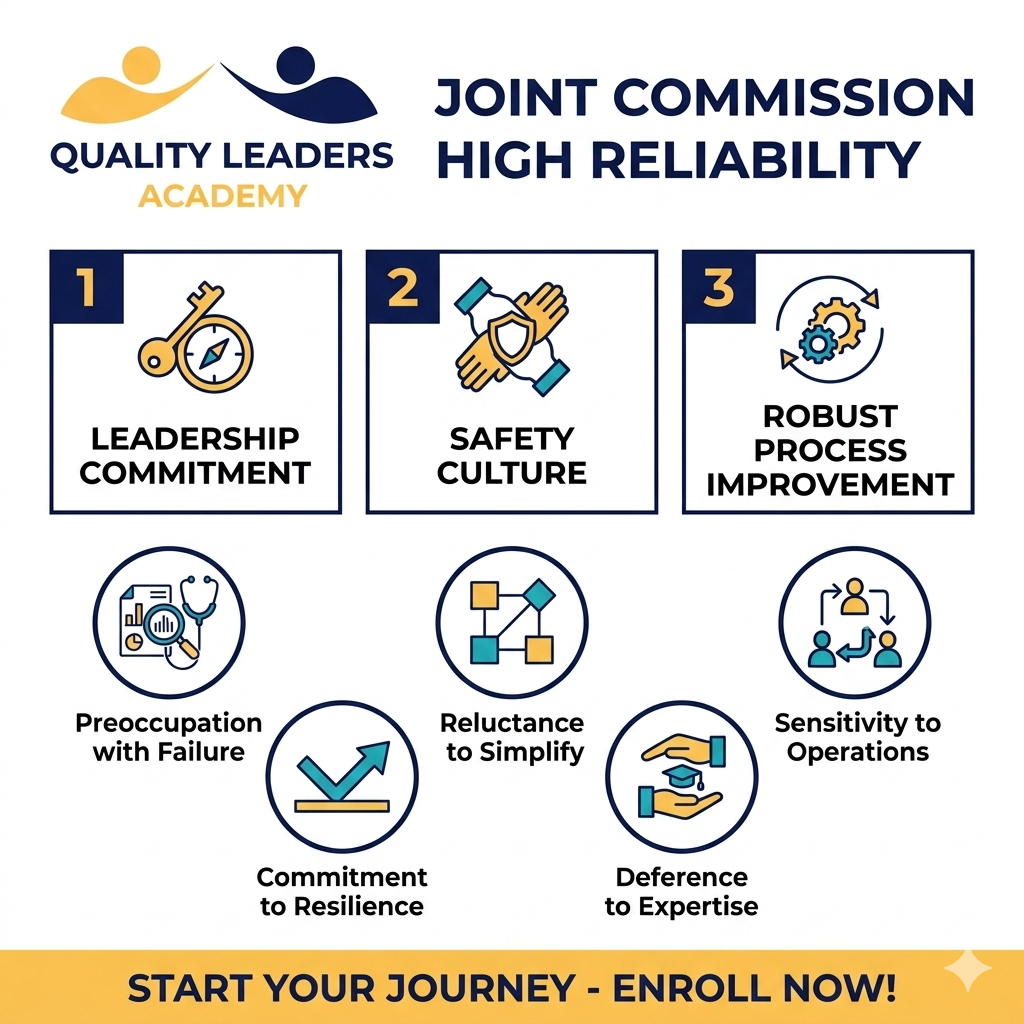
THE THREE CORE DOMAINS OF THE JOINT COMMISSION HIGH RELIABILITY FRAMEWORK
The Joint Commission organizes its high reliability model around three interconnected domains of change.
1. Leadership Commitment
Leadership is the foundation of high reliability. Executives and governing boards must actively prioritize patient safety above operational pressures such as cost, speed, or productivity.
Key responsibilities include:
- setting a clear vision for zero harm.
- allocating resources for safety initiatives.
- Reinforcing accountability at every level.
- modeling safety-focused decision-making.
Without leadership alignment, high reliability efforts cannot be sustained.
2. Safety Culture
A strong safety culture enables healthcare workers to speak openly about risks, errors, and near-misses without fear of blame or punishment.
Core characteristics include:
- psychological safety for frontline staff.
- transparency in incident reporting.
- learning-focused response to errors.
- trust between leadership and clinical teams.
A safety culture shifts the organization from reactive problem-solving to proactive risk identification.
3. Robust Process Improvement
Robust Process Improvement is the operational engine of high reliability.
It integrates:
- Lean methodology (reducing waste and variation).
- Six Sigma (improving process accuracy and consistency).
- Change management (ensuring sustainable improvement).
RPI focuses on identifying root causes of failures and redesigning systems to prevent recurrence rather than relying on individual performance correction.
THE FIVE CORE PRINCIPLES OF HIGH RELIABILITY IN HEALTHCARE
Joint Commission High Reliability is also guided by five behavioral principles widely used in safety science:
1. Preoccupation with Failure
Organizations continuously look for weak signals, including near-misses, as early warnings of system failure.
2. Reluctance to Simplify
Complex clinical problems are examined deeply rather than reduced to overly simple explanations.
3. Sensitivity to Operations
Teams maintain real-time awareness of frontline conditions and operational risks.
4. Commitment to Resilience
Healthcare systems are designed to detect errors early, contain them quickly, and recover safely.
5. Deference to Expertise
Decision-making is guided by the person with the most relevant knowledge, regardless of hierarchy.
These principles are consistently referenced in high reliability literature and patient safety frameworks.
KEY COMPONENTS OF THE JOINT COMMISSION HIGH RELIABILITY MODEL
Beyond the three domains and five principles, the Joint Commission also supports organizations through structured maturity development.
The High Reliability Health Care Maturity Model helps organizations assess their progress across multiple dimensions of reliability and safety behavior.
It evaluates:
- leadership alignment.
- culture maturity.
- process consistency.
- learning systems.
- performance reliability.
This staged approach helps hospitals move gradually toward full high-reliability status rather than attempting rapid transformation.
PRACTICAL TOOLS THAT SUPPORT HIGH RELIABILITY IMPLEMENTATION
To support healthcare organizations, the Joint Commission provides several practical tools:
Targeted Solutions Tool (TST)
An online system that helps organizations identify safety gaps and apply evidence-based solutions.
Maturity Assessments
Structured evaluations that measure progress toward high reliability maturity levels.
Daily Safety Briefings
Short, structured meetings used to review recent events and anticipate risks for upcoming shifts. These briefings strengthen communication and situational awareness.
These tools help translate high reliability principles into daily operational behavior.
HOW HIGH RELIABILITY CHANGES HEALTHCARE OPERATIONS?
When implemented effectively, Joint Commission High Reliability transforms how hospitals operate.
Instead of focusing on post-incident responses, healthcare systems start to:
- Identify risk patterns early.
- Treat near-misses as system learning opportunities.
- Standardize critical care processes.
- Improve real-time communication.
- Engage leadership in frontline safety issues.
This shift creates a proactive safety environment where risk is continuously managed rather than periodically reviewed.
EVIDENCE SUPPORTING HIGH RELIABILITY IN HEALTHCARE
Research in healthcare safety literature, including peer-reviewed studies indexed in PMC, shows that high reliability approaches are associated with:
- Improved patient safety outcomes
- Reduced preventable adverse events over time
- Stronger organizational learning systems
- Improved teamwork and communication
- More consistent clinical performance
However, research also emphasizes that results depend on long-term commitment, leadership consistency, and cultural transformation—not short-term initiatives.
COMMON CHALLENGES IN ACHIEVING HIGH RELIABILITY
Despite its benefits, many healthcare organizations struggle with implementation.
Common challenges include:
- Inconsistent leadership engagement.
- Resistance to cultural change.
- Limited systems-thinking training among staff.
- Weak feedback loops for incident reporting.
- Competing operational and financial pressures.
These barriers are consistently highlighted in healthcare transformation research and Joint Commission implementation resources.
PROFESSIONAL DEVELOPMENT THROUGH QUALITY LEADERS ACADEMY
Understanding and applying Joint Commission High Reliability principles requires structured training and applied healthcare expertise.
Quality Leaders Academy provides specialized learning pathways designed for healthcare professionals in quality, safety, and risk management roles.
CPHRM Focus Study & Review (Live)
Interactive sessions focused on real-time engagement, case-based learning, and expert-led discussion.
CPHRM Focus Study & Review (Recorded)
Flexible self-paced learning designed for professionals balancing clinical and administrative responsibilities.
CPHRM Revision Package
A structured review program focused on strengthening core concepts and improving CPHRM exam readiness through targeted preparation.
These programs align with the CPHRM pathway and are designed to help professionals move beyond theoretical understanding into practical application in real healthcare environments.
Joint Commission High Reliability represents a shift from traditional compliance-based healthcare quality to a system-based approach focused on safety, resilience, and continuous improvement.
By integrating leadership commitment, safety culture, and robust process improvement, healthcare organizations can reduce harm and improve consistency in care delivery.
However, achieving true high reliability requires more than frameworks—it requires trained professionals who can apply these principles in real clinical environments and sustain them over time.
Through structured programs like those offered by Quality Leaders Academy, healthcare professionals can develop the expertise needed to support safer, more reliable healthcare systems and advance their careers in patient safety and risk management.
Resources:
https://www.jointcommissionjournal.com/article/S1553-7250
https://www.jointcommission.org/en/products-and-services/high-reliability
https://www.jointcommission.org/en-us/products-and-services/high-reliability