

Clinical laboratories play a critical role in modern healthcare by supporting diagnosis, treatment decisions, and disease monitoring. As healthcare systems become more data-driven and diagnostic testing volume increases, laboratories face growing financial and operational pressure to ensure accurate reimbursement for services provided.
Laboratory Revenue Cycle Management (Lab RCM) has become essential for maintaining financial sustainability and operational efficiency in diagnostic environments. It ensures that laboratory services—from test ordering to final reimbursement—are accurately documented, coded, billed, and reimbursed according to payer requirements.
Unlike general hospital billing, laboratory billing involves high test volumes, complex coding structures, strict medical necessity rules, and frequent payer-specific claim rejections. As a result, effective Lab RCM requires specialized workflows, integrated systems, and strong coordination between clinical, technical, and financial teams.
WHAT IS LABORATORY REVENUE CYCLE MANAGEMENT?
Laboratory Revenue Cycle Management refers to the end-to-end financial process used to manage diagnostic laboratory services from the moment a test is ordered until full reimbursement is received.
It connects clinical laboratory operations with financial systems by ensuring that every diagnostic test performed is:
- Properly documented.
- Accurately coded.
- Correctly billed.
- Submitted according to payer rules.
- Reimbursed on time.
Lab RCM is more complex than standard healthcare billing due to:
- High-frequency testing environments.
- Strict payer coverage policies for diagnostic services.
- Requirement for strong medical necessity documentation.
- High rate of claim denials if coding or documentation is incomplete.
Industry guidance from laboratory billing and revenue cycle frameworks highlights that successful Lab RCM depends on accuracy, automation, and tight integration between laboratory and billing systems.
KEY STAGES OF LABORATORY REVENUE CYCLE MANAGEMENT
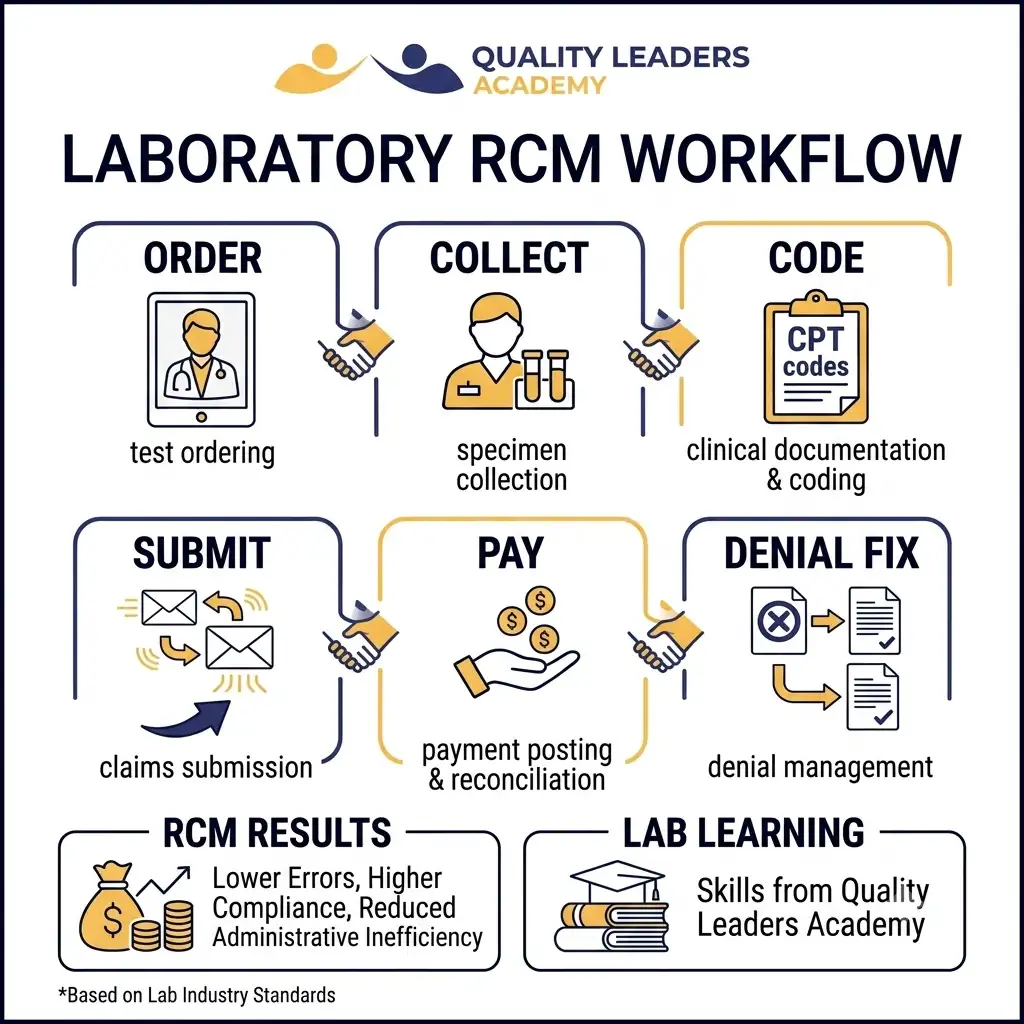
Laboratory revenue cycle operations follow a structured workflow that ensures diagnostic services are properly converted into reimbursable claims.
1. Test Ordering and Patient Registration
The revenue cycle begins when a physician orders a diagnostic test.
Key activities include:
- Capturing patient demographic information.
- Verifying insurance eligibility.
- Confirming coverage for ordered laboratory tests.
Errors at this stage often lead to downstream claim denials and reimbursement delays.
2. Specimen Collection and Tracking
After test ordering, specimens are collected and tracked within the laboratory system.
This stage includes:
- Proper sample labeling.
- Chain-of-custody documentation.
- Integration with Laboratory Information Systems (LIS).
Accurate specimen tracking ensures that test results are correctly matched to patient records.
3. Clinical Documentation and Coding
Clinical documentation and coding form the foundation of laboratory reimbursement.
Laboratory services are translated into standardized codes, primarily CPT codes, which determine how services are billed.
Key requirements include:
- Accurate test classification.
- Alignment with medical necessity requirements.
- Clear linkage between diagnosis and laboratory testing justification.
Coding accuracy is essential for preventing claim rejections and ensuring compliance with payer policies.
4. Claims Submission
Once coding is completed, claims are generated and submitted to insurance payers.
Effective claim submission requires:
- Clean and complete claim data.
- Compliance with payer-specific submission rules.
- Accurate coding and documentation alignment.
Clean claims improve reimbursement speed and reduce administrative rework.
5. Payment Posting and Reconciliation
After claims are processed, payments are received and recorded.
This stage includes:
- Matching payments to submitted claims.
- Identifying discrepancies or underpayments.
- Ensuring financial records align with payer transactions.
Accurate reconciliation supports financial transparency and operational control.
6. Denial Management
Denial management is a critical component of laboratory RCM due to high rejection rates in diagnostic billing.
Common denial reasons include:
- Lack of medical necessity documentation.
- Incorrect or incomplete coding.
- Coverage limitations for specific tests.
- Missing or inaccurate patient information.
Denial management workflows focus on identifying root causes, correcting errors, and resubmitting claims efficiently to recover lost revenue.
WHY LABORATORY REVENUE CYCLE MANAGEMENT MATTERS
Effective Lab RCM delivers significant operational and financial benefits for healthcare organizations.
Improved Cash Flow
Efficient billing workflows ensure faster reimbursement cycles.
Reduced Claim Denials
Accurate documentation and coding reduce billing errors and rework.
Faster Reimbursement
Clean claims processing accelerates payment timelines.
Stronger Compliance
Proper coding and documentation support regulatory and payer requirements.
Operational Efficiency
Streamlined workflows reduce administrative burden and duplication of effort.
Financial Stability for Diagnostic Services
Efficient revenue cycles ensure laboratories remain financially sustainable while supporting clinical care delivery.
COMMON CHALLENGES IN LAB REVENUE CYCLE MANAGEMENT
Despite its importance, laboratory billing faces several operational challenges:
- Complexity of diagnostic coding systems.
- High claim denial rates in laboratory services.
- Inconsistent alignment between clinical documentation and billing requirements.
- Fragmentation between Laboratory Information Systems (LIS) and billing platforms.
- Insurance coverage restrictions for specific tests.
- Variability in payer policies and reimbursement rules.
These challenges can lead to revenue leakage and operational inefficiencies if not properly addressed.
TECHNOLOGY AND DIGITAL TRANSFORMATION IN LAB RCM
Digital transformation is significantly improving laboratory revenue cycle performance.
Modern laboratory environments increasingly rely on:
Laboratory Information Systems (LIS)
LIS platforms manage specimen tracking, test processing, and result reporting, forming the operational backbone of laboratory workflows.
Integration with EHR and Billing Systems
Seamless integration between clinical systems and billing platforms reduces manual data entry errors and improves accuracy.
Automation in Coding and Claims Processing
Automation tools help streamline coding workflows and improve claim submission efficiency.
AI and Predictive Analytics
Advanced analytics are increasingly used to:
- Predict claim denials
- Identify billing errors
- Optimize reimbursement performance
Interoperability Across Systems
Improved data exchange between laboratory, clinical, and financial systems enhances overall workflow efficiency and data accuracy.
LABORATORY RCM AND HEALTHCARE QUALITY
Efficient laboratory revenue cycle management directly contributes to healthcare quality and system performance.
When Lab RCM is optimized, healthcare organizations benefit from:
- Faster diagnostic reporting and decision-making.
- Improved coordination between laboratory and clinical teams.
- Reduced administrative delays in patient care pathways.
- Better financial sustainability for diagnostic services.
- Enhanced data accuracy supporting clinical decisions.
This demonstrates that laboratory financial operations are closely linked to clinical efficiency and patient care quality.
PROFESSIONAL DEVELOPMENT THROUGH QUALITY LEADERS ACADEMY
As laboratory operations become more complex and data-driven, healthcare professionals working in diagnostics, billing, coding, and laboratory administration increasingly require broader knowledge of healthcare systems and revenue cycle workflows.
Quality Leaders Academy provides structured educational pathways that help healthcare professionals strengthen their understanding of healthcare operations, clinical documentation principles, healthcare billing systems, and healthcare data management.
For professionals in laboratory environments, developing these competencies supports a better understanding of:
- End-to-end laboratory workflows.
- Healthcare billing and reimbursement structures.
- Clinical documentation accuracy and its financial impact.
- Healthcare data quality and interoperability.
- Operational efficiency in diagnostic services.
This knowledge helps bridge the gap between laboratory operations and financial performance, supporting more efficient and sustainable healthcare delivery systems.
Laboratory Revenue Cycle Management is a critical component of modern diagnostic healthcare operations. It ensures that laboratory services are accurately documented, coded, billed, and reimbursed while maintaining compliance with payer requirements.
By optimizing workflows across test ordering, specimen tracking, coding, claims submission, and denial management, laboratories can significantly improve financial performance and operational efficiency.
As healthcare continues to evolve, professionals who understand laboratory RCM, billing workflows, and healthcare data systems will play a key role in improving both diagnostic service quality and financial sustainability.
Read also:
PREDICTIVE ANALYTICS IN HEALTHCARE
Resources:
https://sbs-me.com/lab-revenue-cycle-management/
https://www.prolisphere.com/laboratory-revenue-cycle-management-a-guide/
https://blog.creliohealth.com/ultimate-guide-to-lab-revenue-cycle-management-for-clinical-lab/