

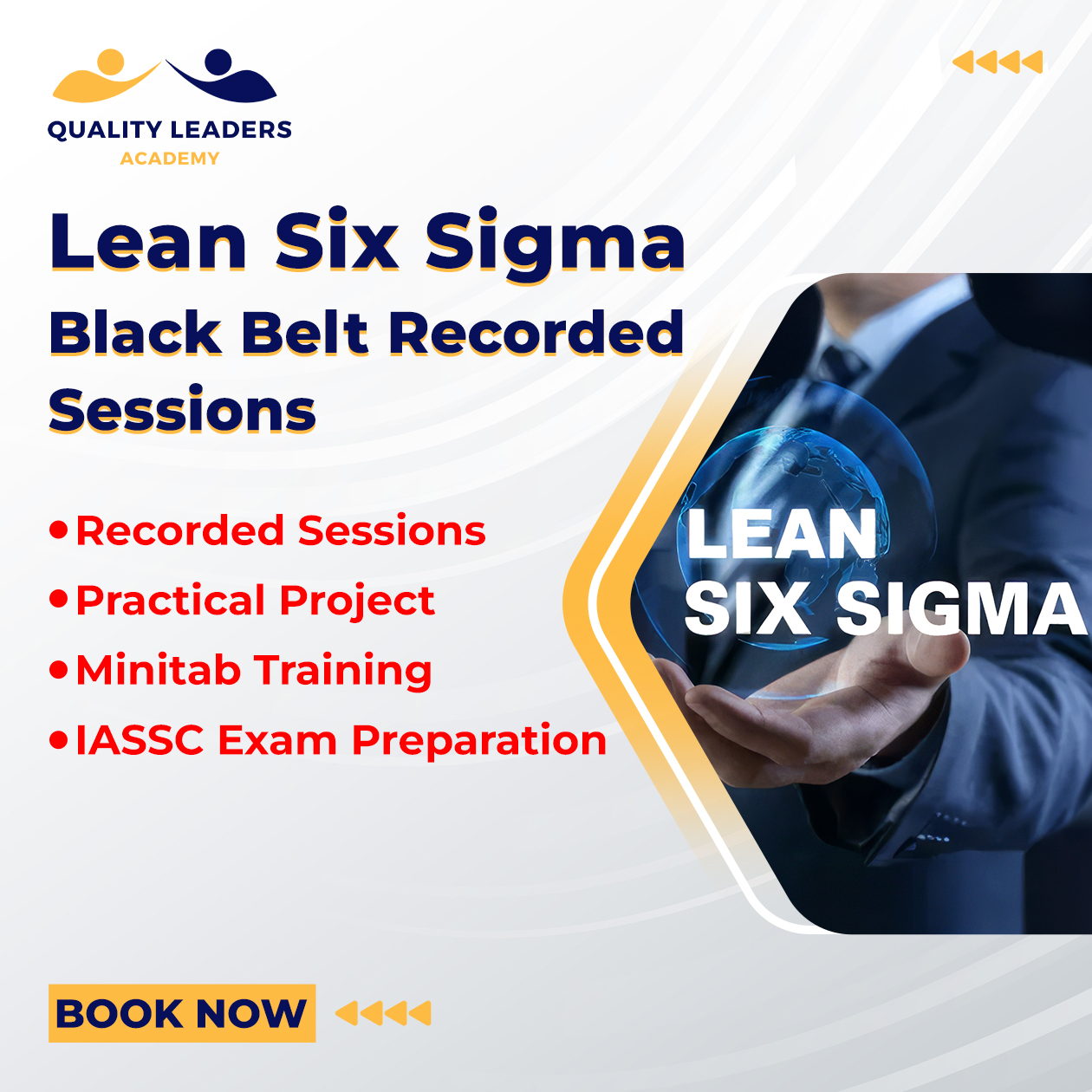
Lean Six Sigma® Black Belt Study and Review Full Package Course - Recorded Videos
Lean Six Sigma Black Belt Study and Review Full Package Course - Recorded Videos
$250.00 each
The add to cart button will appear once you select the values above
The Six Sigma Black Belt for healthcare professionals course is specifically designed for medical background professionals who are passionate about improving the performance and quality of the healthcare environment. This comprehensive course provides in-depth training on Six Sigma methodologies, tools, and techniques, tailored to address the unique challenges and opportunities within the healthcare industry.
This Review and Study Course is designed for all healthcare workers who are seeking for passing the LEAN SIX SIGMA BLACK BELT Exam Accredited by IASSC (International Association for Six Sigma Certification).
This Review Course is an Intensive Study and Review for the comprehensive IASSC Universally Accepted Lean Six Sigma Body of Knowledge for Black Belts.
This Study Course contains handouts that is simply prepared from the textbooks and considered the main source of study beside the question bank that fully qualify any participant to fully understand the SIX SIGMA Methodology and to be fully prepared to the exam.
Throughout the course, participants will learn how to apply Six Sigma principles to analyse processes, identify areas for improvement, and implement effective solutions to enhance patient care, operational efficiency, and organizational outcomes. With a focus on practical applications and real-world case studies, this course equips healthcare professionals with the knowledge and skills needed to lead successful Six Sigma projects within their organizations.
This Study and Review Course has a mixed medium of instruction in both English and Arabic languages.
LEARNING OBJECTIVES:
Study and review for the IASSC Universally Accepted Lean Six Sigma Body of Knowledge for Black Belts:
1. Define Phase
1.1 The Basics of Six Sigma
1.1.1 Meanings of Six Sigma
1.1.2 General History of Six Sigma & Continuous Improvement
1.1.3 Deliverables of a Lean Six Sigma Project
1.1.4 The Problem-Solving Strategy Y = f(x)
1.1.5 Voice of the Customer, Business and Employee
1.1.6 Six Sigma Roles & Responsibilities
1.2 The Fundamentals of Six Sigma
1.2.1 Defining a Process
1.2.2 Critical to Quality Characteristics (CTQ’s)
1.2.3 Cost of Poor Quality (COPQ)
1.2.4 Pareto Analysis (80:20 rule)
1.2.5 Basic Six Sigma Metrics
a. including DPU, DPMO, FTY, RTY Cycle Time, deriving these metrics and these metrics
1.3 Selecting Lean Six Sigma Projects
1.3.1 Building a Business Case & Project Charter
1.3.2 Developing Project Metrics
1.3.3 Financial Evaluation & Benefits Capture
1.4 The Lean Enterprise
1.4.1 Understanding Lean
1.4.2 The History of Lean
1.4.3 Lean & Six Sigma
1.4.4 The Seven Elements of Waste
a. Overproduction, Correction, Inventory, Motion, Overprocessing, Conveyance, Waiting.
1.4.5 5S
a. Straighten, Shine, Standardize, Self-Discipline, Sort
2. Measure Phase
2.1 Process Definition
2.1.1 Cause & Effect / Fishbone Diagrams
2.1.2 Process Mapping, SIPOC, Value Stream Map
2.1.3 X-Y Diagram
2.1.4 Failure Modes & Effects Analysis (FMEA)
2.2 Six Sigma Statistics
2.2.1 Basic Statistics
2.2.2 Descriptive Statistics
2.2.3 Normal Distributions & Normality
2.2.4 Graphical Analysis
2.3 Measurement System Analysis
2.3.1 Precision & Accuracy
2.3.2 Bias, Linearity & Stability
2.3.3 Gage Repeatability & Reproducibility
2.3.4 Variable & Attribute MSA
2.4 Process Capability
2.4.1 Capability Analysis
2.4.2 Concept of Stability
2.4.3 Attribute & Discrete Capability
2.4.4 Monitoring Techniques
3.Analyse Phase
3.1 Patterns of Variation
3.1.1 Multi-Vari Analysis
3.1.2 Classes of Distributions
3.2 Inferential Statistics
3.2.1 Understanding Inference
3.2.2 Sampling Techniques & Uses
3.2.3 Central Limit Theorem
3.3 Hypothesis Testing
3.3.1 General Concepts & Goals of Hypothesis Testing
3.3.2 Significance; Practical vs. Statistical
3.3.3 Risk; Alpha & Beta
3.3.4 Types of Hypothesis Test
3.4 Hypothesis Testing with Normal Data
3.4.1 1 & 2 sample t-tests
3.4.2 1 sample variance
3.4.3 One Way ANOVA
a. Including Tests of Equal Variance, Normality Testing and Sample Size calculation, performing tests and interpreting results.
3.5 Hypothesis Testing with Non-Normal Data
3.5.1 Mann-Whitney
3.5.2 Kruskal-Wallis
3.5.3 Mood’s Median
3.5.4 Friedman
3.5.5 1 Sample Sign
3.5.6 1 Sample Wilcoxon
3.5.7 One and Two Sample Proportion
3.5.8 Chi-Squared (Contingency Tables)
a. Including Tests of Equal Variance, Normality Testing and Sample Size calculation, performing tests and interpreting results.
4. Improve Phase
4.1 Simple Linear Regression
4.1.1 Correlation
4.1.2 Regression Equations
4.1.3 Residuals Analysis
4.2 Multiple Regression Analysis
4.2.1 Non- Linear Regression
4.2.2 Multiple Linear Regression
4.2.3 Confidence & Prediction Intervals
4.2.4 Residuals Analysis
4.2.5 Data Transformation, Box Cox
5. Control Phase
5.1 Lean Controls
5.1.1 Control Methods for 5S
5.1.2 Kanban
5.1.3 Poka-Yoke (Mistake Proofing)
5.2 Statistical Process Control (SPC)
5.2.1 Data Collection for SPC
5.2.2 I-MR Chart
5.2.3 Xbar-R Chart
5.2.4 U Chart
5.2.5 P Chart
5.2.6 NP Chart
5.2.7 X-S chart
5.2.8 Kusum Chart
5.2.9 EWMA Chart
5.2.10 Control Chart Anatomy
5.3 Six Sigma Control Plans
5.3.1 Cost Benefit Analysis
5.3.2 Elements of the Control Plan
5.3.3 Elements of the Response Plan
- Training on the huge question bank with live sessions and real site exams.
- Assess your preparedness for the real Lean Six Sigma EXAM with real exam like quizzes.
- Assess the ability to recall or remember specific information.
- Assess the ability to apply the knowledge in specific situation.
- Assess the ability to analyse the situation and choose the best action or decision to be taken.
LEAN SIX SIGMA FULL PACKAGE Course Deliverables:
The study and review study contains but not limited to:
- Fourteen (14) recorded video sessions for main lectures. (Explanation and Study for the main 5 domains).
- Two (2) recorded video sessions for revision lectures. (Final review on the main topics and question bank discussion).
- Site exams with updated exam like questions like the real exam with time limited.
INTENDED LEARNING OUTCOMES:
At the end of that complete study and review course the participant can:
Understand Six Sigma methodology: Gain a thorough understanding of the principles, philosophy, and methodology of Six Sigma, with a focus on its application in healthcare settings.
Improve healthcare processes: Learn how to systematically analyse healthcare processes, identify inefficiencies, and implement data-driven improvements to enhance quality of care, patient safety, and operational efficiency.
Develop problem-solving skills: Acquire advanced problem-solving skills and techniques, including statistical analysis, root cause analysis, and process optimization, to address complex challenges in healthcare delivery.
Lead Six Sigma projects: Learn how to lead and manage Six Sigma projects from initiation to completion, including project selection, team management, and effective communication with stakeholders.
Ensure patient-centric care: Emphasize the importance of patient-centric care and incorporate patient feedback and satisfaction metrics into process improvement initiatives.
Drive organizational excellence: Develop leadership and change management skills necessary to drive a culture of continuous improvement and excellence within healthcare organizations.
Prepare for IASSC Black Belt certification: Prepare participants to successfully pass the International Association for Six Sigma Certification (IASSC) Black Belt certification exam, validating their proficiency in Six Sigma methodologies and their application in healthcare settings.
- By the end of the course, participants will be equipped with the knowledge, skills, and confidence to lead impactful Six Sigma projects, drive positive change in healthcare delivery, and contribute to improved patient outcomes and organizational performance.
IMPORTANT INFORMATION ABOUT THE COURSE:
- After registration on the course you can immediately start accessing available lecture videos and quizzes/exams.
- All recorded sessions are uploaded for all course contents.
- All quizzes and exams has the ability for retaking it many times during your registration period.
- Registration period is valid for 6 months from your first registration.
- You can download the certificate of completion after completion of the course.
- If you need any extension for you registration after the 6 allowed months, you must contact us to follow our policy for reattendance.
Connect with us
Head Office (International HQ):
Quality Leaders Academy
Mansoura City, Dakahlia Governorate, Egypt
+20 103 195 7832 / +20 103 193 8328
Regional Office (Saudi Arabia):
Quality Pioneers for Consultation and Development Services (CR No. 7050586317)
Ash Shawqiyah District, Makkah, Saudi Arabia
+966 54 879 4731
qualitypioneers.com.sa
Our international office manages the online training platform, while our Saudi branch serves clients and partners locally inside KSA and GCC.