

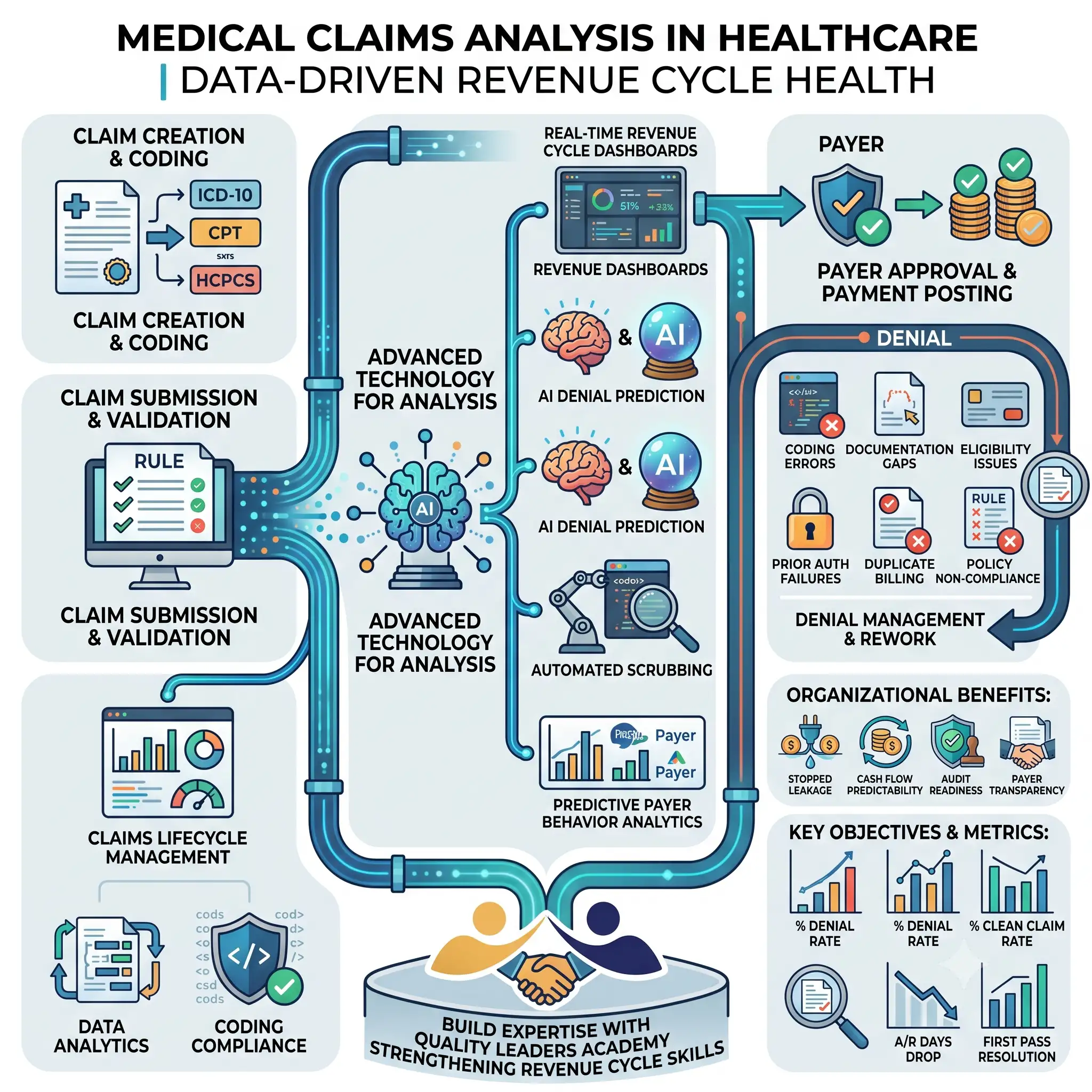
Healthcare organizations are under constant financial pressure due to rising operational costs, complex payer rules, and increasing claim denial rates. Even small inefficiencies in billing or coding can lead to significant revenue leakage across hospitals and health systems.
Within this environment, Medical Claims Analysis has become a core capability in modern revenue cycle management (RCM). Instead of simply processing claims, healthcare organizations now analyze them to understand why payments are delayed, denied, or underpaid, and how to prevent recurring financial loss.
Guidance from organizations such as CMS, HFMA, and AAPC consistently emphasizes that clean, accurate, and compliant claims are essential to maintaining financial stability in healthcare systems.
WHAT IS MEDICAL CLAIMS ANALYSIS?
Medical Claims Analysis is the systematic evaluation of healthcare insurance claims to identify patterns, errors, denial causes, reimbursement trends, and opportunities for revenue cycle improvement.
Rather than focusing on individual claims in isolation, claims analysis examines large datasets of claims across time, payers, service lines, and provider groups to uncover:
Why claims are denied or delayed.
Where revenue leakage occurs.
How payer behavior impacts reimbursement.
Which operational processes need improvement.
Modern healthcare organizations use claims analysis as a decision-support tool to connect clinical documentation, medical coding, billing accuracy, and payer reimbursement performance into a unified financial intelligence system.
As highlighted in healthcare analytics research, claims data is one of the richest sources for identifying utilization patterns, financial inefficiencies, and operational bottlenecks in healthcare delivery systems.
THE MEDICAL CLAIMS LIFECYCLE AND ROLE OF ANALYSIS
Medical claims analysis is not limited to a single stage; it operates across the entire revenue cycle.
1. Claim Creation
Clinical documentation is translated into standardized codes:
ICD-10 (diagnoses).
CPT (procedures).
HCPCS (services and supplies).
Errors at this stage are one of the leading causes of downstream claim denials.
2. Claim Submission
Claims are submitted through clearinghouses and validated for formatting, missing data, and payer compliance rules.
3. Claim Adjudication
Payers evaluate claims to determine payment outcomes:
Full approval.
Partial payment.
Denial.
This process is known as insurance adjudication and is highly dependent on payer policy interpretation.
4. Payment Posting
Payments are matched against billed amounts, and discrepancies are flagged for review.
5. Denial and Rework Management
Denied claims are reviewed, corrected, and resubmitted or appealed depending on the cause.
Medical claims analysis runs across all these stages, providing feedback loops that improve future claim accuracy and financial outcomes.
KEY OBJECTIVES OF MEDICAL CLAIMS ANALYSIS
Healthcare organizations use claims analysis to strengthen both financial and operational performance. Core objectives include:
Improving clean claim rates.
Reducing claim denials and underpayments.
Identifying revenue leakage points.
Shortening accounts receivable (A/R) cycles.
Enhancing coding accuracy and compliance.
Monitoring payer behavior and contract performance.
Recent industry research shows that effective claims analytics helps organizations reduce denials by identifying root causes and improving submission accuracy before claims reach payers.
COMMON CAUSES OF CLAIM DENIALS IDENTIFIED THROUGH ANALYSIS
Claims analysis is especially valuable for identifying recurring denial patterns. Common issues include:
1. Coding Errors
Incorrect ICD-10, CPT, or HCPCS coding leads to mismatched reimbursement or outright denial.
2. Documentation Gaps
Missing clinical justification or incomplete records prevent payer approval.
3. Eligibility Issues
Inactive insurance coverage or incorrect patient data results in automatic rejection.
4. Prior Authorization Failures
Services performed without payer authorization are frequently denied.
5. Duplicate Billing
Repeated claim submissions trigger payer compliance flags.
6. Policy Non-Compliance
Each payer applies unique reimbursement rules that must be followed precisely.
Modern claims analysis tools help detect these issues early and reduce avoidable financial losses.
KEY METRICS USED IN MEDICAL CLAIMS ANALYSIS
Claims performance is measured using financial and operational KPIs that reflect revenue cycle efficiency.
Denial Rate
Measures the percentage of claims rejected by payers. High denial rates indicate workflow or documentation issues.
Clean Claim Rate
Indicates the percentage of claims accepted on first submission without correction.
Accounts Receivable (A/R) Days
Measures how long it takes to collect payments after submission. Lower values indicate faster revenue recovery.
First Pass Resolution Rate
Tracks how efficiently claims are resolved without rework or appeals.
These metrics are widely used in hospital billing analytics to assess financial performance and operational efficiency.
HOW TECHNOLOGY IS TRANSFORMING MEDICAL CLAIMS ANALYSIS
Technology is reshaping how healthcare organizations manage and analyze claims data.
AI-Powered Denial Prediction
AI models identify patterns that indicate a high likelihood of claim denial before submission.
Automated Claims Scrubbing
Advanced systems detect coding errors and missing documentation in real time.
Revenue Cycle Dashboards
Interactive dashboards provide real-time visibility into denial trends, payer performance, and revenue leakage.
Predictive Analytics for Payer Behavior
Analytics platforms forecast reimbursement patterns and payer-specific risks.
Platforms such as Rivet Health demonstrate how AI-driven claims analytics can provide real-time denial detection, performance benchmarking, and revenue optimization insights across the entire claims lifecycle.
Similarly, Xevant highlights how claims data can be aggregated and analyzed at scale to identify utilization trends, cost-saving opportunities, and financial performance improvements.
WHY MEDICAL CLAIMS ANALYSIS MATTERS FOR HEALTHCARE ORGANIZATIONS
Effective claims analysis directly strengthens healthcare financial sustainability by:
Reducing revenue leakage.
Improving cash flow predictability.
Enhancing compliance and audit readiness.
Strengthening payer relationships through transparency.
Improving operational coordination across departments.
Ultimately, it transforms revenue cycle management from a reactive process into a proactive financial strategy.
STRENGTHENING REVENUE CYCLE EXPERTISE THROUGH QUALITY LEADERS ACADEMY
As healthcare finance becomes increasingly data-driven, professionals in billing, coding, HIM, and revenue cycle management need stronger analytical and operational competencies.
Quality Leaders Academy supports healthcare professionals in developing practical expertise in:
Medical claims processing and lifecycle management.
Healthcare financial analytics and performance metrics.
Coding accuracy and compliance frameworks.
Revenue cycle optimization strategies.
Healthcare data interpretation and reporting.
Structured learning helps professionals understand how claims data reflects broader system performance, enabling more informed financial decision-making and operational improvement.
By combining technical revenue cycle knowledge with analytical thinking, healthcare professionals can contribute more effectively to reducing denials, improving reimbursement accuracy, and strengthening overall healthcare financial performance.
Read also:
Resources:
https://www.rivethealth.com/blog/claims-analytics-analysis
https://www.xevant.com/blog/how-to-analyze-claims-data/