

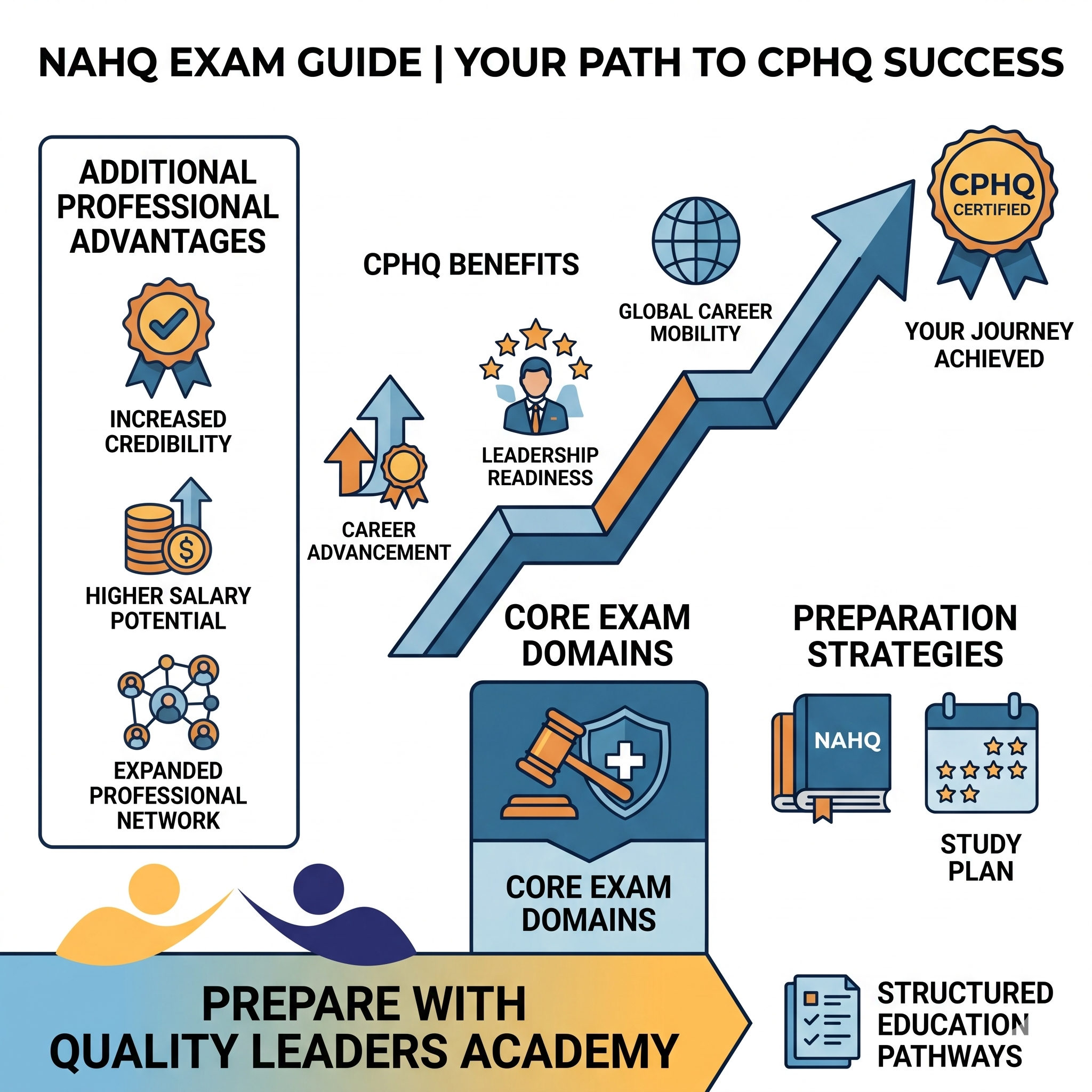
Healthcare organizations today face increasing expectations to improve patient safety, strengthen quality outcomes, reduce medical errors, and maintain regulatory compliance. As healthcare systems become more complex, organizations increasingly rely on skilled professionals who understand healthcare quality improvement, performance measurement, patient safety, and accreditation standards.
For healthcare professionals working in quality, risk management, nursing leadership, or healthcare administration, professional certification has become an important way to demonstrate expertise and commitment to continuous improvement.
One of the most recognized credentials in healthcare quality is earned through the NAHQ Exam, which leads to the Certified Professional in Healthcare Quality (CPHQ) certification.
The NAHQ Exam represents more than a professional milestone—it reflects a healthcare professional’s understanding of quality management principles, patient safety concepts, performance improvement, and healthcare leadership practices.
For professionals seeking growth in healthcare quality roles, understanding the exam process and preparation strategies can support long-term career development.
WHAT IS THE NAHQ EXAM?
The NAHQ Exam refers to the certification examination offered by the National Association for Healthcare Quality (NAHQ), a recognized organization focused on advancing healthcare quality competencies and professional excellence.
The exam is directly connected to the Certified Professional in Healthcare Quality (CPHQ) credential, which is widely recognized among healthcare quality professionals.
Unlike organization-specific certifications, the CPHQ certification is designed to validate core competencies across healthcare settings, making it relevant for hospitals, ambulatory care centers, healthcare systems, public health organizations, and other healthcare environments.
Healthcare professionals pursue the NAHQ certification guide pathway for several reasons:
To strengthen credibility in healthcare quality roles.
To demonstrate expertise in patient safety and quality improvement.
To support career advancement opportunities.
To deepen understanding of healthcare performance systems.
To expand leadership readiness in quality-focused positions.
Because healthcare quality increasingly influences patient outcomes and organizational performance, the certification has become highly relevant for professionals involved in improvement efforts.
WHO SHOULD TAKE THE NAHQ EXAM?
The NAHQ Exam is appropriate for healthcare professionals involved in quality improvement, patient safety, performance measurement, compliance, and organizational excellence.
Ideal candidates often include:
Healthcare Quality Professionals
Professionals working directly in quality departments often pursue healthcare quality certification to strengthen expertise in healthcare performance improvement, quality systems, and patient safety practices.
Patient Safety Specialists
Patient safety professionals benefit from certification because the exam covers risk reduction, safety improvement strategies, and healthcare performance measurement.
Nurses in Quality Improvement Roles
Many nurses transition into quality-focused positions involving audits, patient safety initiatives, regulatory readiness, and clinical performance improvement. The CPHQ exam preparation process can help strengthen knowledge of healthcare quality in these roles.
Healthcare Administrators
Healthcare administrators responsible for organizational performance, operational improvement, and quality outcomes may benefit from a stronger understanding of healthcare quality frameworks.
Accreditation Professionals
Professionals supporting accreditation and regulatory readiness often pursue healthcare quality management certification to improve understanding of performance standards and organizational compliance.
Healthcare Risk Managers
Risk managers involved in safety reporting, adverse event prevention, and quality systems may also find the certification valuable for professional growth.
Regardless of role, the exam supports professionals seeking deeper expertise in healthcare quality leadership.
WHAT DOES THE NAHQ EXAM COVER?
The NAHQ Exam evaluates a healthcare professional’s understanding of key healthcare quality competencies based on official CPHQ certification content domains.
Although the exam evolves, several core knowledge areas consistently remain important.
Healthcare Quality Leadership
Leadership plays an essential role in healthcare improvement.
Candidates are expected to understand how organizations build quality cultures, strengthen accountability, support performance improvement initiatives, and align leadership efforts with patient-centered goals.
Healthcare professionals preparing for the NAHQ certification guide often review topics related to strategic improvement, leadership influence, and organizational quality systems.
Patient Safety and Risk Reduction
Patient safety remains a major focus of healthcare quality.
The exam includes concepts related to error prevention, safety culture, risk identification, quality monitoring, and improvement initiatives designed to reduce harm.
Professionals pursuing patient safety certification pathways often find overlap between patient safety practices and healthcare quality competencies covered on the exam.
Data Analytics and Performance Measurement
Healthcare quality relies heavily on data-informed decision-making.
Candidates should understand healthcare quality indicators, performance metrics, benchmarking, and how organizations use data to improve outcomes.
This may include healthcare KPIs, performance trends, and interpretation of quality measures in practical healthcare settings.
Regulatory and Accreditation Concepts
Healthcare organizations operate within complex regulatory environments.
The NAHQ Exam includes knowledge areas related to accreditation readiness, compliance frameworks, quality standards, and performance monitoring.
Professionals preparing for the CPHQ exam often review healthcare regulations, quality frameworks, and organizational accountability systems.
The exam focuses on practical healthcare quality understanding rather than memorization alone, making applied learning especially important.
WHY THE NAHQ EXAM MATTERS FOR CAREER GROWTH
Earning a healthcare quality credential through the NAHQ Exam can support professional growth in several meaningful ways.
Stronger Professional Credibility
Certification demonstrates commitment to healthcare quality and continuous professional learning. It signals competency in areas that directly affect patient outcomes and organizational performance.
Expanded Leadership Opportunities
Healthcare organizations increasingly value professionals who understand quality improvement, performance systems, and patient safety. Certification may strengthen readiness for leadership or management responsibilities.
Deeper Healthcare Quality Expertise
Preparing for the CPHQ certification often helps professionals strengthen understanding of healthcare systems, safety science, quality improvement methodologies, and performance management.
Improved Patient Safety Knowledge
Because healthcare quality and patient safety are closely connected, certification preparation often improves understanding of risk reduction and safer care delivery.
Broader Career Mobility
Healthcare quality competencies are relevant across hospitals, outpatient organizations, public health systems, and healthcare consulting environments, making certification useful across multiple settings.
Rather than serving as a single career solution, certification often complements ongoing professional development.
COMMON CHALLENGES CANDIDATES FACE
Preparing for the NAHQ Exam can be rewarding, but candidates often face realistic challenges.
Balancing work and study responsibilities is one of the most common difficulties, especially for professionals already working demanding healthcare schedules.
Understanding healthcare quality terminology may also feel overwhelming at first, particularly for candidates transitioning from clinical roles into quality improvement positions.
Some candidates struggle to apply healthcare quality concepts to real-world situations rather than simply memorizing information.
Exam anxiety is another common concern. Maintaining consistent study habits while managing workplace demands can sometimes affect preparation confidence.
Recognizing these challenges early helps candidates develop more practical study strategies.
EFFECTIVE STRATEGIES TO PREPARE FOR THE NAHQ EXAM
Successful CPHQ exam preparation often begins with a structured study plan.
Healthcare professionals may benefit from:
Using Official NAHQ Resources
Official NAHQ Exam materials provide the most reliable guidance for understanding content areas, competencies, and expectations.
Creating a Study Schedule
Breaking preparation into manageable weekly goals helps reduce overwhelm and improve consistency.
Reviewing Healthcare Quality Concepts
Candidates often benefit from strengthening foundational knowledge related to patient safety, performance improvement, healthcare quality management, and accreditation principles.
Practice Questions and Mock Exams
Practice assessments may help candidates identify knowledge gaps and become more comfortable with exam-style questions.
Professional Study Communities
Study groups or peer learning environments can provide motivation, accountability, and opportunities to discuss challenging concepts.
A structured and consistent preparation approach often improves confidence over time.
ADVANCING HEALTHCARE QUALITY EXPERTISE THROUGH QUALITY LEADERS ACADEMY
For healthcare professionals pursuing stronger expertise in healthcare quality, patient safety, accreditation, and leadership, structured professional education can support both certification readiness and long-term career growth.
Educational pathways offered through Quality Leaders Academy are designed to help healthcare professionals strengthen competencies in healthcare quality improvement, patient safety, healthcare leadership, performance measurement, accreditation concepts, and compliance frameworks.
To support diverse learner needs, the academy offers both live and recorded learning pathways tailored to different audiences. Arabic-speaking healthcare professionals can benefit from structured live courses and recorded courses, providing flexibility for working professionals who may prefer instructor interaction or self-paced learning. For candidates preparing specifically for the NAHQ Exam and CPHQ certification, a dedicated revision package for Arabic learners helps reinforce healthcare quality concepts, patient safety principles, and exam-focused preparation.
For non-Arabic learners, Quality Leaders Academy also provides specialized learning pathways designed to strengthen healthcare quality competencies and professional readiness in globally relevant healthcare quality practices.
Rather than focusing only on passing an exam, structured education helps healthcare professionals build a deeper understanding of healthcare quality systems, leadership frameworks, accreditation readiness, and performance improvement methods that can be applied directly in healthcare settings.
For professionals preparing for the CPHQ certification or expanding expertise in healthcare quality leadership, stronger foundational knowledge often supports both professional confidence and practical application in real healthcare environments.
Resources:
https://nahq.org/credentials/cphq-certified-professional-in-healthcare-quality/prep/