

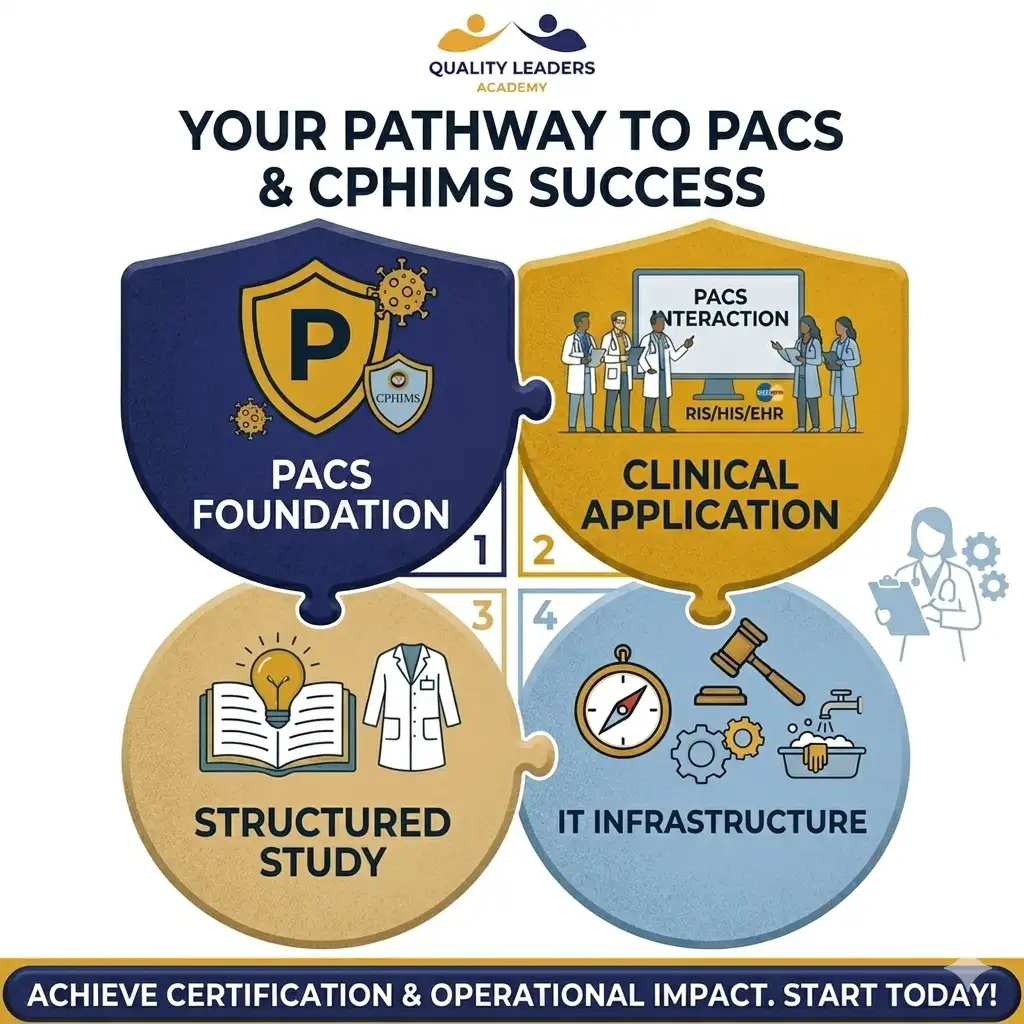
Healthcare is no longer driven by isolated tools. It is powered by interconnected systems that support clinical decisions, data exchange, and patient safety. For professionals preparing for the CPHIMS certification, understanding how these systems work together is essential.
One of the most important components of this ecosystem is the PACS viewer, which enables clinicians to access and interpret medical images as part of an integrated healthcare workflow.
WHAT IS A PACS VIEWER IN MODERN HEALTHCARE SYSTEMS?
A PACS viewer is a software application used to display and interact with medical images stored in a Picture Archiving and Communication System (PACS).
In modern healthcare environments, PACS is not a standalone system. It operates within a broader digital infrastructure that includes:
- Electronic Health Records (EHR).
- Radiology Information Systems (RIS).
- Hospital Information Systems (HIS).
According to the Society for Imaging Informatics in Medicine (SIIM), PACS workflows are designed to ensure that imaging data moves efficiently from acquisition to interpretation and reporting within clinical environments.
A PACS viewer is the user-facing component that allows healthcare professionals to visualize, analyze, and integrate imaging data into clinical decision-making.
PACS WORKFLOW AND CLINICAL INTEGRATION
Understanding PACS workflow is essential for both healthcare IT professionals and CPHIMS candidates.
In a typical workflow, imaging data moves through several stages:
- Image acquisition from imaging devices.
- Transmission to the PACS archive.
- Storage and indexing.
- Retrieval through the PACS viewer.
- Clinical interpretation and reporting.
This structured flow ensures that imaging data is accessible at the right time and place for clinical decision-making.
SIIM emphasizes that effective PACS workflows depend on system integration, speed, and accessibility across departments.
PACS VIEWERS IN REAL HEALTHCARE ENVIRONMENTS
Modern PACS viewers, such as enterprise-grade solutions like eRAD PACS Viewer, are designed to support high-performance clinical environments.
These systems typically provide:
- Fast image rendering for large datasets.
- Multi-modality support (CT, MRI, X-ray, ultrasound).
- Web-based access for distributed healthcare systems.
- Tools for measurement, annotation, and comparison.
Solutions like these are designed to support radiologists and clinicians working under time-sensitive conditions where accuracy and speed are critical.
WHY PACS VIEWERS MATTER FOR HEALTHCARE IT AND CPHIMS PROFESSIONALS?
For CPHIMS candidates, PACS viewers are more than imaging tools. They represent a real-world example of healthcare information system integration.
They directly relate to key CPHIMS domains such as:
- Healthcare information systems architecture.
- Interoperability and data exchange.
- Clinical workflow optimization.
- Health data management and security.
Understanding PACS helps professionals see how imaging systems connect with broader healthcare IT infrastructure and support clinical decision-making at scale.
PACS VIEWERS AND HEALTHCARE IT INFRASTRUCTURE
PACS does not operate in isolation. It depends on a strong healthcare IT foundation.
Key infrastructure components include:
- Secure data storage systems.
- High-speed hospital networks.
- Cloud-based architectures.
- System interoperability frameworks.
Healthcare IT infrastructure ensures that PACS systems can handle large imaging datasets while maintaining speed, reliability, and security.
This is a core focus area in healthcare IT education and a major component of CPHIMS preparation.
INTEROPERABILITY AND DATA EXCHANGE IN PACS SYSTEMS
Interoperability is one of the most important concepts in modern healthcare IT.
PACS viewers must be able to exchange data seamlessly across systems, including:
- EHR platforms.
- Radiology systems.
- Clinical decision support tools.
According to healthcare interoperability principles, systems must communicate using standardized formats to ensure accurate and timely access to patient data.
Quality Leaders Academy highlights interoperability as a foundational concept in digital healthcare transformation, where systems like PACS play a central role in connecting clinical data across platforms.
KEY FEATURES OF A PACS VIEWER
PACS viewers include several essential features that support clinical workflows:
Image Visualization Tools
- Zoom, pan, rotate.
- Contrast and brightness adjustment.
- Measurement and annotation tools.
Multi-Modality Imaging
Supports:
- CT.
- MRI.
- X-ray.
- Ultrasound.
System Integration
Connects with:
- EHR systems.
- RIS platforms.
- Hospital workflows.
Cloud and Remote Access
Supports telemedicine and distributed healthcare environments.
ARTIFICIAL INTELLIGENCE AND DECISION SUPPORT IN PACS
Modern PACS systems are increasingly integrating artificial intelligence.
AI-enabled tools can assist with:
- Image analysis and detection.
- Pattern recognition.
- Clinical decision support.
According to healthcare AI frameworks, these tools enhance diagnostic accuracy and reduce workload on clinicians.
Quality Leaders Academy also highlights AI-driven decision support as part of modern healthcare IT transformation, where imaging systems evolve beyond storage into intelligent clinical tools.
Cloud Migration and the Future of PACS Systems
Healthcare organizations are increasingly moving toward cloud-based PACS systems.
Benefits include:
- Scalable storage for large imaging datasets.
- Remote access from multiple locations.
- Reduced infrastructure costs.
- Improved disaster recovery capabilities.
Cloud migration is a key part of healthcare digital transformation strategies, enabling more flexible and connected healthcare systems.
HOW QUALITY LEADERS ACADEMY PREPARES YOU FOR CPHIMS SUCCESS
For healthcare professionals preparing for the CPHIMS exam, structured learning is essential to connect technical knowledge with real-world applications.
Quality Leaders Academy offers dedicated CPHIMS preparation courses through structured programs designed to cover core healthcare IT domains.
These courses include both live and recorded formats, allowing flexibility for working professionals. They focus on key areas such as:
- Healthcare IT infrastructure.
- System interoperability.
- Digital transformation in healthcare.
- Clinical workflow optimization.
- Decision support systems and AI applications.
By using real-world examples such as PACS viewers, learners gain a clearer understanding of how healthcare systems operate in practice. This approach strengthens both exam readiness and professional capability in healthcare IT environments.
WHY PACS KNOWLEDGE MATTERS FOR CPHIMS CERTIFICATION?
PACS systems are a practical foundation for many CPHIMS concepts.
They help candidates understand:
- How do healthcare systems integrate across departments?
- How does data flow between clinical applications?
- How does imaging support clinical decision-making?
- How does IT infrastructure support healthcare delivery?
This makes PACS one of the most relevant real-world examples for understanding healthcare information systems in depth.
PACS viewers are a critical component of modern healthcare IT systems. They support clinical workflows, enable interoperability, and enhance decision-making across healthcare environments.
For CPHIMS candidates, understanding PACS is essential for mastering core exam domains and applying healthcare IT concepts in real-world settings.
With the right training and a structured understanding of healthcare systems, professionals can strengthen both their certification success and their long-term career growth in healthcare information management.
For those aiming to succeed in the CPHIMS exam, structured preparation that connects theory with real-world systems like PACS can significantly improve outcomes and professional readiness.
Resources: