

Healthcare systems today operate in an increasingly complex financial and operational environment. Rising administrative costs, evolving payer requirements, regulatory compliance demands, and increasing expectations for accurate clinical documentation have made financial workflows more critical to organizational success.
Within this environment, Revenue Cycle Operations in Healthcare play a central role in ensuring that healthcare services are accurately documented, coded, billed, and reimbursed. These operations represent the execution layer of the revenue cycle, where clinical, administrative, and financial processes intersect to convert patient care into sustainable organizational revenue.
Efficient revenue cycle operations directly influence hospital financial performance, staff productivity, patient experience, and overall healthcare system efficiency. According to healthcare billing frameworks such as those outlined by CMS and professional coding standards referenced by AAPC, strong operational execution is essential for reducing claim errors, improving reimbursement accuracy, and maintaining financial stability.
WHAT ARE REVENUE CYCLE OPERATIONS IN HEALTHCARE?
Revenue Cycle Operations in Healthcare refer to the day-to-day execution processes that manage the financial lifecycle of patient care. While revenue cycle management (RCM) represents the overall strategy, revenue cycle operations focus on how that strategy is implemented across healthcare workflows.
These operations ensure that every clinical service delivered is properly captured, documented, coded, billed, submitted, and reimbursed.
Revenue cycle operations rely on coordination between:
- Clinical teams.
- Health information management professionals.
- Billing and coding departments.
- Finance and administrative staff.
Together, these teams ensure that patient care activities are translated into accurate financial transactions that support healthcare sustainability.
KEY COMPONENTS OF REVENUE CYCLE OPERATIONS
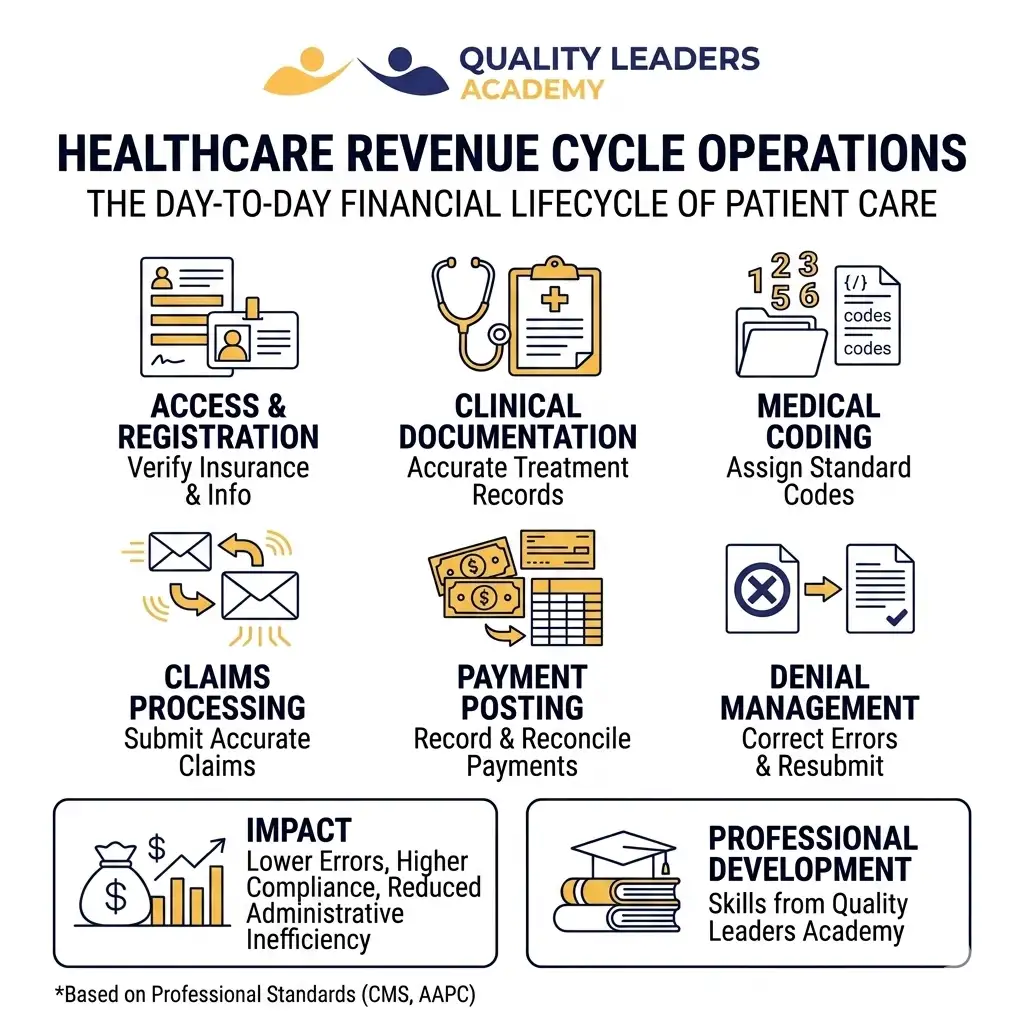
Revenue cycle operations involve multiple interconnected workflows that function as a continuous system.
Patient Access and Registration
This stage includes the initial collection of patient information and insurance verification.
Key activities include:
- Capturing accurate demographic data.
- Verifying insurance eligibility and coverage.
- Ensuring correct payer identification.
Errors at this stage can impact the entire revenue cycle, leading to downstream claim denials or delays.
Clinical Documentation and Charge Capture
Clinical documentation forms the foundation of revenue cycle operations.
Healthcare providers must accurately document:
- Diagnoses.
- Procedures.
- Patient conditions.
- Treatment decisions.
Accurate documentation ensures that services can be translated into appropriate billing codes. Clinical Documentation Improvement (CDI) initiatives, as referenced in healthcare transformation literature, help strengthen documentation accuracy and reduce revenue leakage.
Medical Coding Operations
Medical coding is the process of converting clinical documentation into standardized codes used for billing and reimbursement.
Coding teams apply systems such as ICD and CPT to ensure:
- Correct representation of diagnoses.
- Accurate classification of procedures.
- Compliance with payer requirements.
Coding accuracy is essential for ensuring that claims reflect the true complexity and value of care provided.
Claims Processing and Submission
Once coding is completed, claims are prepared and submitted to payers.
A key objective in this stage is generating “clean claims,” which:
- Contain no errors.
- Meet payer requirements.
- Include complete documentation.
Clean claim submission reduces delays and improves reimbursement efficiency.
Payment Posting and Reconciliation
After reimbursement is received, payments must be accurately recorded and reconciled.
This process involves:
- Matching payments to claims.
- Identifying discrepancies.
- Ensuring financial accuracy across systems.
Effective reconciliation supports financial transparency and accountability within healthcare organizations.
Denial Management Operations
Denial management focuses on identifying and correcting rejected claims.
Common reasons for claim denials include:
- Incomplete documentation.
- Coding errors.
- Eligibility issues.
- Missing authorization.
Denial management teams analyze trends, correct errors, and resubmit claims to recover lost revenue and improve future performance.
WHY REVENUE CYCLE OPERATIONS MATTER IN HEALTHCARE?
Strong revenue cycle operations provide several critical benefits to healthcare organizations:
Improved Cash Flow Stability
Efficient workflows ensure timely reimbursement and predictable financial performance.
Reduced Administrative Inefficiencies
Standardized processes minimize delays, duplication, and rework.
Lower Claim Denial Rates
Accurate documentation and coding improve claim acceptance rates.
Enhanced Compliance
Proper execution ensures alignment with payer and regulatory requirements.
Better Resource Utilization
Efficient financial operations allow organizations to allocate more resources to patient care.
Improved Financial Transparency
Clear operational workflows support better reporting and decision-making.
COMMON CHALLENGES IN REVENUE CYCLE OPERATIONS
Despite their importance, many healthcare organizations face operational challenges that reduce efficiency.
Key challenges include:
- Fragmented systems across departments.
- Inconsistent clinical documentation practices.
- Coding errors and variability.
- Staffing shortages in billing and coding teams.
- Increasing payer complexity.
- Lack of standardized workflows across facilities.
These challenges often result in delays, revenue leakage, and increased administrative burden.
REVENUE CYCLE OPERATIONS TECHNOLOGY AND DIGITAL TRANSFORMATION
Digital transformation is reshaping how revenue cycle operations are managed.
Healthcare organizations increasingly rely on:
- Electronic Health Record (EHR) integration.
- Automated billing workflows.
- Data analytics for performance monitoring.
- Predictive tools for denial prevention.
- Interoperable clinical and financial systems.
Clinical Documentation Improvement (CDI) initiatives, as described in healthcare transformation literature, also support digital alignment between clinical documentation and billing accuracy.
These technologies improve operational efficiency by reducing manual processes, enhancing data accuracy, and supporting real-time financial insights.
REVENUE CYCLE OPERATIONS AND HEALTHCARE QUALITY
Revenue cycle operations are not purely financial—they directly influence healthcare quality.
Operational efficiency affects:
- Patient experience through reduced billing errors and delays.
- Care delivery speed by minimizing administrative bottlenecks.
- Clinical staff workload by reducing documentation inefficiencies.
- Organizational performance through improved financial stability.
- Healthcare sustainability by supporting reinvestment in patient care.
This reflects the close integration between financial operations and clinical quality in contemporary healthcare environments.
PROFESSIONAL DEVELOPMENT THROUGH QUALITY LEADERS ACADEMY
As healthcare systems become more complex, professionals working in revenue cycle operations increasingly need broader knowledge of healthcare workflows, documentation systems, and operational performance improvement.
Quality Leaders Academy provides structured educational pathways that support healthcare professionals in developing competencies related to healthcare operations, financial workflows, clinical documentation improvement, and healthcare systems thinking.
For professionals in revenue cycle departments, billing operations, and health information management, strengthening these skills helps improve understanding of:
- End-to-end healthcare workflows.
- Documentation and coding accuracy.
- Healthcare data quality.
- Operational efficiency principles.
- Performance improvement methodologies.
This type of knowledge supports better collaboration between clinical, administrative, and financial teams, contributing to improved organizational performance and more efficient healthcare delivery.
Revenue Cycle Operations in Healthcare represent the operational backbone of healthcare financial systems. They ensure that clinical services are accurately documented, coded, billed, and reimbursed through coordinated workflows across multiple departments.
When these operations are optimized, healthcare organizations benefit from improved cash flow, reduced administrative inefficiencies, stronger compliance, and enhanced patient experience.
As healthcare continues to evolve, professionals who understand revenue cycle operations, clinical documentation processes, and healthcare workflow optimization will play a critical role in improving both financial sustainability and healthcare quality outcomes.
Read also:
EFQM Management Model in Healthcare
EFQM CERTIFIED ASSESSOR IN HEALTHCARE
Resources:
https://stripe.com/resources/more/revenue-cycle-management-101-what-businesses-need-to-know