

In today’s healthcare environment, infection prevention is a critical component of quality and patient safety. Healthcare-associated infections (HAIs) remain a major concern, pushing organizations to adopt structured, evidence-based approaches to care.
For professionals preparing for the CIC exam, mastering APIC standards is essential. These standards form the backbone of infection prevention practices and are directly reflected in exam content.
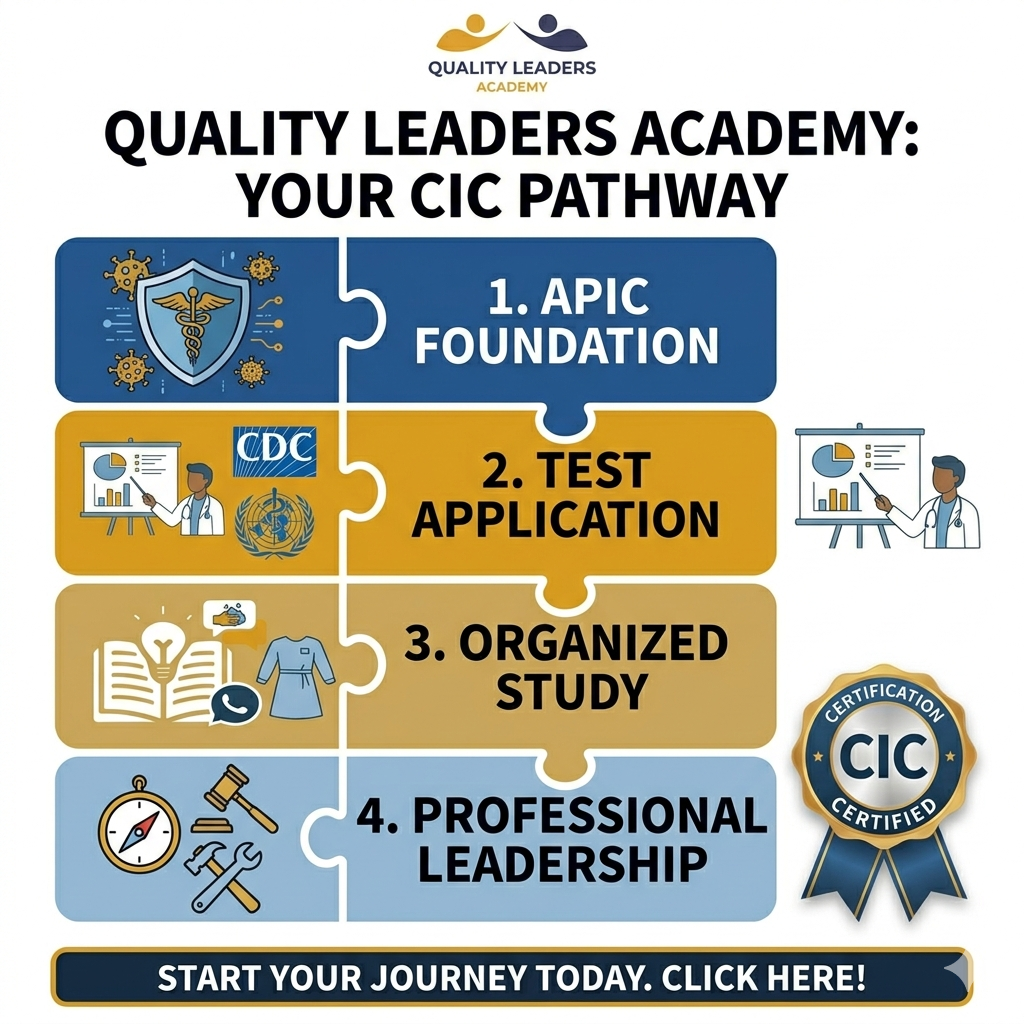
However, understanding APIC standards in isolation is not enough. Candidates must be able to apply them in real clinical scenarios. This is where structured preparation becomes valuable. Quality Leaders Academy supports healthcare professionals by organizing APIC-based content into practical, exam-focused learning pathways.
WHAT ARE APIC STANDARDS?
APIC standards are developed by the Association for Professionals in Infection Control and Epidemiology (APIC), a leading authority in infection prevention. These standards provide a framework for implementing effective infection control practices across healthcare settings.
They cover key areas such as:
- Infection surveillance and data analysis.
- Prevention and control strategies.
- Sterilization and disinfection processes.
- Occupational health and exposure management.
APIC standards are aligned with guidance from global organizations such as the CDC, WHO, and Joint Commission International (JCI). This alignment ensures consistency between clinical practice, accreditation requirements, and certification exams like the CIC.
HOW APIC STANDARDS SHAPE THE CIC EXAM?
The CIC exam is designed to evaluate how well candidates can apply infection prevention principles in real-world situations. APIC standards play a central role in this process.
Exam questions often require candidates to:
- Interpret infection data using surveillance frameworks.
- Select appropriate prevention strategies.
- Apply standardized protocols to clinical scenarios.
By understanding APIC standards, candidates can approach these questions systematically. Instead of relying on memorization, they use structured frameworks to guide their answers, improving both accuracy and confidence.
HEALTHCARE QUALITY TRENDS REINFORCING APIC STANDARDS
Modern healthcare is increasingly driven by quality improvement and patient safety initiatives. Several trends highlight the importance of APIC standards:
Standardization of care:
Healthcare organizations rely on structured protocols to reduce variability and improve outcomes.
Data-driven decision-making:
Infection prevention programs depend on accurate data collection and analysis.
Integration with quality improvement:
Infection control is closely linked to broader healthcare quality strategies.
Global focus on patient safety:
Reducing HAIs is a priority across healthcare systems worldwide.
These trends make APIC standards not only relevant for the CIC exam but also essential for daily clinical practice.
COMMON CHALLENGES IN LEARNING APIC STANDARDS
Despite their importance, many candidates find it difficult to study APIC standards effectively. Common challenges include:
Extensive content:
APIC standards cover multiple domains, making it hard to manage without structure.
Identifying priorities:
Certain areas of the CIC exam receive greater emphasis than others based on their importance.
Applying knowledge:
Translating standards into clinical decisions requires practice.
Lack of guidance:
Self-study can lead to confusion and inefficient preparation.
Overcoming these challenges requires a focused approach that simplifies APIC content while maintaining depth and accuracy.
HOW QUALITY LEADERS ACADEMY STRUCTURES APIC STANDARDS FOR LEARNING?
Quality Leaders Academy organizes APIC standards into a structured learning framework designed specifically for CIC exam preparation. Based on verified course information, the academy provides:
- Clearly organized APIC-based content: Topics are arranged to help learners focus on key infection prevention concepts.
- Structured handouts: Concise materials highlight essential information for efficient revision.
- Question banks and practice tests: Candidates practice applying APIC standards through exam-style questions.
- Flexible learning formats: Courses are available in live sessions and recorded options, supporting different learning preferences.
This structured approach helps candidates move from understanding APIC standards to applying them effectively in exam scenarios.
PRACTICAL STRATEGIES TO MASTER APIC STANDARDS
To succeed in the CIC exam, candidates should adopt practical strategies for studying APIC standards:
1. Focus on High-Yield Areas
Prioritize key domains such as surveillance, prevention strategies, and sterilization practices, which are frequently tested.
2. Use Scenario-Based Practice
Apply APIC standards to real-life situations to develop decision-making skills aligned with exam requirements.
3. Practice with Question Banks
Regular exposure to exam-style questions improves understanding and highlights areas that need further review.
4. Use Handouts for Efficient Revision
Structured materials help reinforce key concepts and simplify complex topics.
5. Study Consistently
Break down APIC standards into manageable sections and follow a structured study plan.
RECOMMENDED COURSE PATH FOR MASTERING APIC STANDARDS
Quality Leaders Academy offers a structured pathway to help candidates master APIC standards and prepare for the CIC exam:
(CIC) Full Package with Live Zoom Session
This course provides a comprehensive review of infection prevention topics based on APIC standards, supported by structured handouts and exam-style assessments.
(CIC) Focus Study and Review Full Package – Recorded Videos
This course offers a self-paced learning option with recorded lectures, downloadable materials, and practice exams for flexible study.
CBIC (CIC) Focus Study and Review – Examination Revision Cases
Focuses on case-based revision and question practice to strengthen the application of APIC standards before the exam.
This pathway helps candidates build knowledge, reinforce concepts, and develop exam readiness in a structured way.
CAREER IMPACT OF MASTERING APIC STANDARDS
Mastering APIC standards and achieving CIC certification supports professional growth in healthcare:
- Roles in infection prevention and control.
- Participation in quality improvement and patient safety initiatives.
- Opportunities in accreditation and compliance.
- Leadership positions in infection control programs.
Healthcare professionals who understand APIC standards are better equipped to improve patient outcomes and support organizational quality goals.
Build Confidence with APIC Standards
Success in the CIC exam depends on the ability to understand and apply APIC standards in real-world situations. A structured approach to studying these standards allows healthcare professionals to prepare more effectively and confidently.
By focusing on high-yield topics, practicing with exam-style questions, and using organized study materials, candidates can improve both their exam performance and clinical practice.
Quality Leaders Academy provides a structured, APIC-aligned pathway that supports healthcare professionals in mastering infection prevention and achieving CIC certification with confidence.