

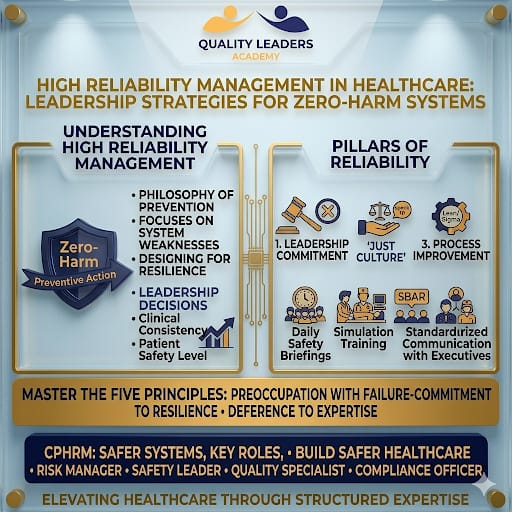
Healthcare systems operate in environments where small mistakes can lead to serious consequences. To reduce risk and improve patient safety, organizations are increasingly adopting high reliability management, a structured leadership approach based on High Reliability Organization (HRO) principles.
The goal is simple but critical: achieve consistent, safe, and high-quality care even in complex clinical environments.
UNDERSTANDING HIGH RELIABILITY MANAGEMENT IN HEALTHCARE
High reliability management refers to the way healthcare leaders design, guide, and control systems to minimize errors and maintain safety under pressure.
It is not just a safety initiative. It is a management philosophy focused on preventing failure before it happens.
The Link Between Management and Safety Outcomes
In high reliability healthcare systems, leadership decisions directly influence:
- Patient safety levels.
- Clinical performance consistency.
- Staff communication quality.
- Risk prevention effectiveness.
This makes management structure a core driver of healthcare safety.
THE FIVE PRINCIPLES THAT SHAPE HIGH RELIABILITY MANAGEMENT
These principles are the "DNA" of a zero-harm culture. They shift the focus from reactive "blame" to proactive prevention:
Preoccupation with Failure: We don't just fix errors; we hunt for the system weaknesses that caused them. Every near-miss is a gift of data.
Reluctance to Simplify: We refuse to settle for easy answers. Complex clinical processes require deep-dive analysis, not superficial fixes.
Sensitivity to Operations: Leadership doesn't exist in an office; it exists at the bedside. We stay grounded in the reality of frontline clinical work.
Commitment to Resilience: We build systems that are "error-tolerant"—capable of detecting and correcting issues before they ever reach the patient.
Deference to Expertise: Decisions are made by those with the best knowledge, not those with the highest title. Hierarchy never trumps patient safety.
THE THREE PILLARS OF HIGH RELIABILITY HEALTHCARE MANAGEMENT
Sustainable performance is built on these foundational pillars:
Leadership Commitment to Patient Safety: Leaders prioritize safety above the pressures of volume, speed, or cost.
A "Just Culture": We foster an environment where staff are empowered to report errors and risks without fear of retribution, enabling continuous organizational learning.
Structured Process Improvement: We apply rigorous methods—such as Lean and Six Sigma—to reduce variation and eliminate system waste.
OPERATIONAL STRATEGIES USED IN HIGH RELIABILITY HOSPITALS
To sustain reliability in real clinical environments, hospitals rely on clear operational strategies that turn safety principles into consistent daily actions, such as:
Daily Safety Briefings for Risk Awareness
Short team meetings help identify potential risks before clinical operations begin each day.
Leadership Walkrounds in Clinical Units
Executives and managers engage directly with frontline staff to understand safety concerns in real time.
Standardized Communication Tools
Tools like SBAR ensure that critical patient information is communicated clearly during transitions of care.
Simulation Training for High-Risk Scenarios
Healthcare teams practice emergency situations in controlled environments to improve coordination and response.
These strategies translate high reliability principles into daily hospital operations.
WHY HIGH RELIABILITY MANAGEMENT MATTERS IN HEALTHCARE SYSTEMS?
The value of high reliability management in healthcare becomes clear when examining its system-wide impact as follows:
Reducing Preventable Harm
Structured management systems significantly reduce avoidable medical errors.
Improving System Consistency
Standardized processes ensure that care quality does not vary between teams or departments.
Strengthening Clinical Communication
Clear communication reduces misunderstandings that can lead to patient safety incidents.
Enhancing Early Risk Detection
High reliability systems identify risks before they escalate into harm.
Research published in peer-reviewed healthcare journals indicates that long-term implementation of HRO-based strategies is associated with reduced adverse events and improved organizational performance.
CHALLENGES IN IMPLEMENTING HIGH RELIABILITY MANAGEMENT
Several key challenges can arise when implementing high reliability management in healthcare systems, such as:
Resistance to Cultural Change
Shifting from blame-based systems to safety-focused cultures can be difficult.
Limited Risk Management Training
Many healthcare professionals lack formal training in system-based risk management.
Inconsistent Leadership Engagement
Without strong leadership commitment, high reliability initiatives lose momentum.
Difficulty Sustaining Long-Term Improvement
Maintaining continuous improvement requires structured training and ongoing reinforcement.
PROFESSIONAL DEVELOPMENT THROUGH QUALITY LEADERS ACADEMY
Mastering high reliability management in healthcare and preparing for the CPHRM exam requires structured and guided learning.
Quality Leaders Academy provides specialized pathways designed for healthcare professionals at different learning stages:
CPHRM Focus Study & Review (Live)
Interactive live sessions that include real-time discussions, instructor guidance, and case study analysis. Ideal for professionals who learn best through engagement and structured discussion.
CPHRM Focus Study & Review (Recorded)
A flexible self-paced option designed for busy healthcare professionals who need the freedom to study at their own pace while maintaining full curriculum coverage.
CPHRM Revision Package
A focused exam preparation program designed to reinforce core concepts, strengthen weak areas, and improve exam-taking strategy through intensive review.
These programs ensure that participants are not only prepared for certification but also gain practical, verifiable skills to implement high reliability systems in real healthcare environments.
CAREER BENEFITS OF HIGH RELIABILITY MANAGEMENT EXPERTISE
Professionals trained in high reliability management are essential to modern healthcare systems.
Key Career Roles Include:
- Healthcare risk manager.
- Patient safety leader.
- Quality improvement specialist.
- Hospital operations manager.
- Compliance and safety officer.
These roles directly contribute to improving healthcare safety and system performance.
BUILDING SAFER HEALTHCARE SYSTEMS THROUGH HIGH RELIABILITY MANAGEMENT
High reliability management is a structured leadership approach that transforms healthcare organizations into safer, more resilient systems. It focuses on preventing errors, strengthening communication, and continuously improving performance.
However, achieving this level of reliability requires more than awareness; it requires trained professionals with strong risk management expertise.
Through structured training pathways like those offered by Quality Leaders Academy, healthcare professionals can develop the skills needed to apply high-reliability principles effectively and advance their careers in patient safety and healthcare quality.
Resources:
https://www.jointcommission.org/en-us/products-and-services/high-reliability
http://vizientinc.com/what-we-do/care-delivery-excellence/reliable-care-delivery
https://journals.plos.org/globalpublichealth/article?id=10.1371/journal.pgph.0006181