

Healthcare organizations operate in highly complex financial environments where even small operational inefficiencies can lead to delayed reimbursements, increased claim denials, and significant revenue leakage. In this context, the RCM workflow has become a critical structure that determines how effectively healthcare services are converted into accurate and timely payments.
An inefficient workflow disrupts coordination between clinical, administrative, and financial departments. This leads to documentation gaps, coding errors, and claim rework. In contrast, a well-structured RCM workflow improves visibility, reduces administrative burden, and enhances financial performance across the entire healthcare system.
WHAT IS AN RCM WORKFLOW IN HEALTHCARE?
An RCM workflow refers to the structured sequence of operational steps that manage the financial lifecycle of patient care, from initial registration to final reimbursement.
It defines how data, tasks, and approvals move across healthcare departments, ensuring that clinical services are accurately translated into billable and reimbursable claims.
A well-designed RCM workflow ensures:
- Seamless coordination between clinical and billing teams.
- Accurate and complete documentation flow.
- Standardized coding and claims processing.
- Reduced errors in financial transactions.
- Faster reimbursement cycles.
In modern healthcare systems, the RCM workflow acts as the backbone of financial operations.
KEY STAGES OF THE RCM WORKFLOW IN HEALTHCARE
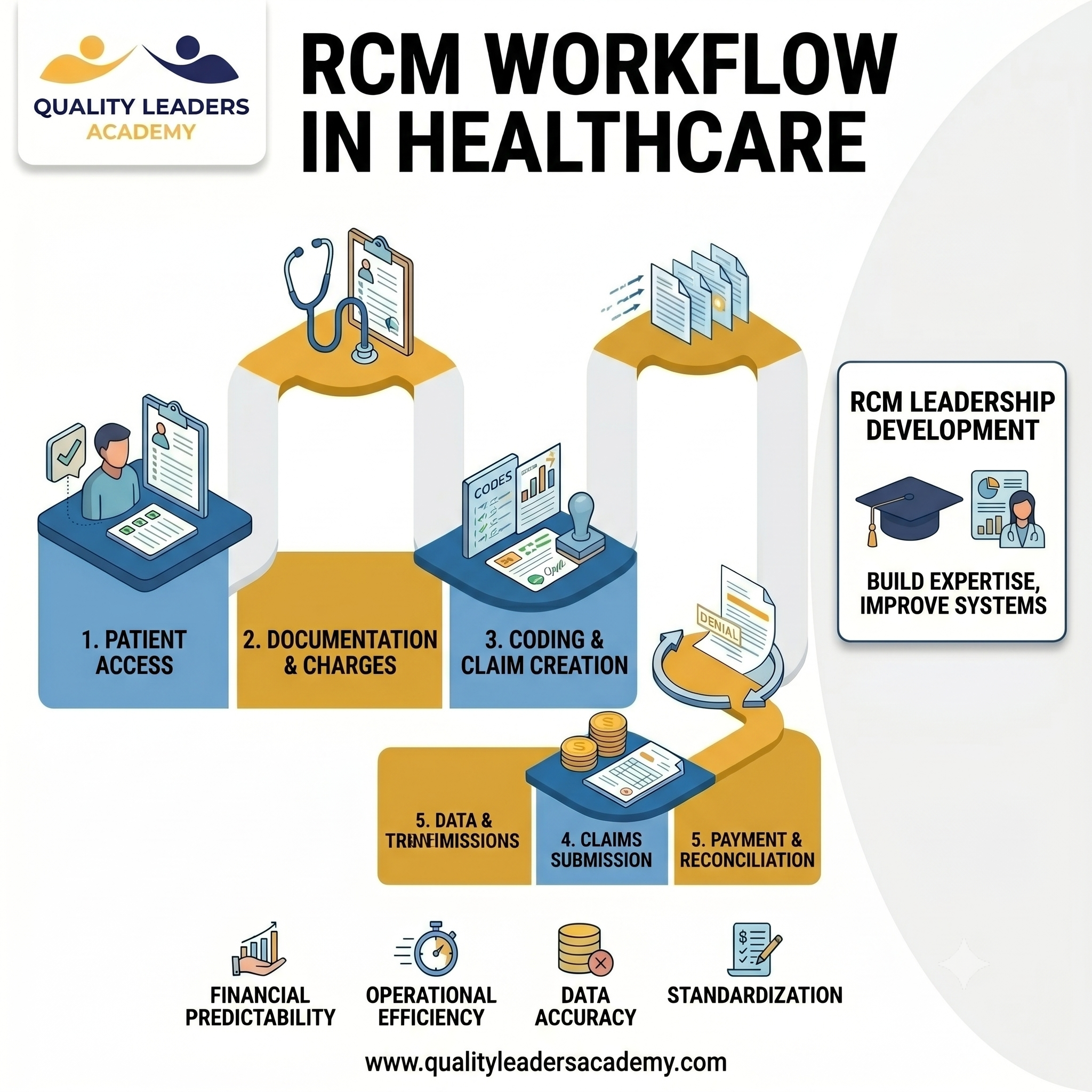
The RCM workflow follows a structured end-to-end cycle that ensures accuracy and efficiency at every stage.
1. Patient Access and Registration Workflow
This stage initiates the RCM workflow and establishes the foundation for all downstream processes.
Key activities include:
- Capturing accurate patient demographic information.
- Verifying insurance eligibility and coverage.
- Collecting financial responsibility details.
Errors at this stage can lead to claim denials later in the workflow.
2. Clinical Documentation and Charge Capture Workflow
This stage ensures that clinical services are accurately documented and prepared for billing.
Key elements include:
- Recording complete and precise clinical documentation
- Capturing all billable services provided to the patient
- Ensuring alignment between clinical care and billing requirements
Incomplete documentation is one of the most common causes of revenue loss in the RCM workflow.
3. Coding and Claim Creation Workflow
Once documentation is complete, services are translated into standardized billing codes.
This includes:
- Assigning ICD and CPT codes.
- Validating medical necessity.
- Preparing clean claims for submission.
Accurate coding is essential for reducing claim rejections and ensuring compliance.
4. Claims Submission Workflow
In this stage, claims are transmitted to insurance payers.
Key steps include:
- Electronic claim submission.
- Validation checks before submission.
- Compliance with payer-specific rules.
A strong submission workflow reduces delays and improves reimbursement speed.
5. Payment Posting and Reconciliation Workflow
Once payments are received, they must be accurately recorded and matched.
This stage includes:
- Posting payments to patient accounts.
- Reconciling payer remittance reports.
- Identifying underpayments or discrepancies.
This ensures financial accuracy and transparency in the RCM workflow.
6. Denial Management Workflow
Denial management is a corrective loop within the RCM workflow that handles rejected claims.
It includes:
- Categorizing denial reasons.
- Identifying root causes of errors.
- Correcting and resubmitting claims.
- Monitoring recurring denial patterns.
Effective denial management significantly improves revenue recovery.
WHY RCMWORKFLOW DESIGN MATTERS IN HEALTHCARE?
The design of the RCM workflow directly impacts the financial health of healthcare organizations.
Poor workflow design leads to:
- Increased claim denials.
- Delayed reimbursements.
- Revenue leakage due to missing data.
- Inefficient coordination between departments.
Well-structured workflows, however, improve:
- Financial predictability.
- Operational efficiency.
- Data accuracy across departments.
- Standardization of healthcare processes.
Workflow design is therefore a core driver of revenue cycle performance.
BEST PRACTICES FOR OPTIMIZING RCMWORKFLOW
Healthcare organizations can improve their RCM workflow performance through several key strategies:
Standardization of Processes
Uniform documentation and billing procedures reduce variability and improve consistency.
Automation of Administrative Tasks
Automating eligibility checks, claims validation, and payment posting reduces human error.
Integration of Healthcare Systems
Connecting EHR and billing systems improves data flow and reduces duplication.
Real-Time Claim Validation
Early detection of errors prevents claim rejection at submission.
Performance Monitoring
Dashboards help track denial rates, claim cycles, and financial performance trends.
Cross-Department Collaboration
Stronger communication between clinical, coding, and finance teams improves workflow continuity.
Technology’s Role in Modern RCM Workflow
Technology plays a central role in improving the efficiency of the RCM workflow.
Modern healthcare systems rely on:
- Workflow automation tools.
- AI-driven denial prediction systems.
- Data analytics for revenue optimization.
- Interoperability between clinical and financial systems.
- Real-time monitoring of claims and billing processes.
Digital transformation has significantly improved workflow accuracy, reduced manual intervention, and enhanced financial visibility.
Common Challenges in RCM Workflow Execution
Despite advancements, healthcare organizations still face challenges in RCM workflow execution:
- Fragmented systems across departments.
- Inconsistent documentation practices.
- Coding errors due to incomplete clinical data.
- Communication gaps between teams.
- High administrative workload.
- Complex payer requirements.
These issues create bottlenecks that affect both efficiency and revenue performance.
PROFESSIONAL DEVELOPMENT THROUGH QUALITY LEADERS ACADEMY
Understanding and optimizing the RCM workflow requires strong knowledge of healthcare systems, operational processes, and financial structures.
Quality Leaders Academy supports healthcare professionals working in billing, coding, revenue cycle management, and health information systems by strengthening their understanding of healthcare workflows and operational integration.
Professionals can develop expertise in:
- Healthcare workflow analysis and optimization.
- Revenue cycle process improvement.
- Healthcare data accuracy and integrity.
- Operational efficiency in healthcare systems.
- End-to-end healthcare financial processes.
This knowledge supports better alignment between clinical operations and financial outcomes, improving overall healthcare system performance.
The RCM workflow is a foundational structure in healthcare financial operations. It connects clinical care delivery with billing, coding, claims processing, and reimbursement.
When properly designed and optimized, it reduces errors, improves reimbursement speed, and enhances financial sustainability. As healthcare systems continue to evolve, workflow optimization will remain essential for improving both operational efficiency and financial performance.
Read also:
PREDICTIVE ANALYTICS IN HEALTHCARE
EFQM Management Model in Healthcare
Resources:
https://sbs-me.com/what-is-the-rcm-workflow/
https://www.inovalon.com/blog/5-ways-to-design-rcm-workflows-for-the-biggest-impact/
https://www.collectly.co/blog/revenue-cycle-management-rcm-workflows-for-healthcare-providers