

Healthcare organizations today face growing pressure to deliver high-quality patient care while maintaining financial sustainability and operational efficiency. Rising healthcare costs, payer complexity, evolving reimbursement requirements, and increasing documentation expectations have made financial performance more dependent on operational precision than ever before.
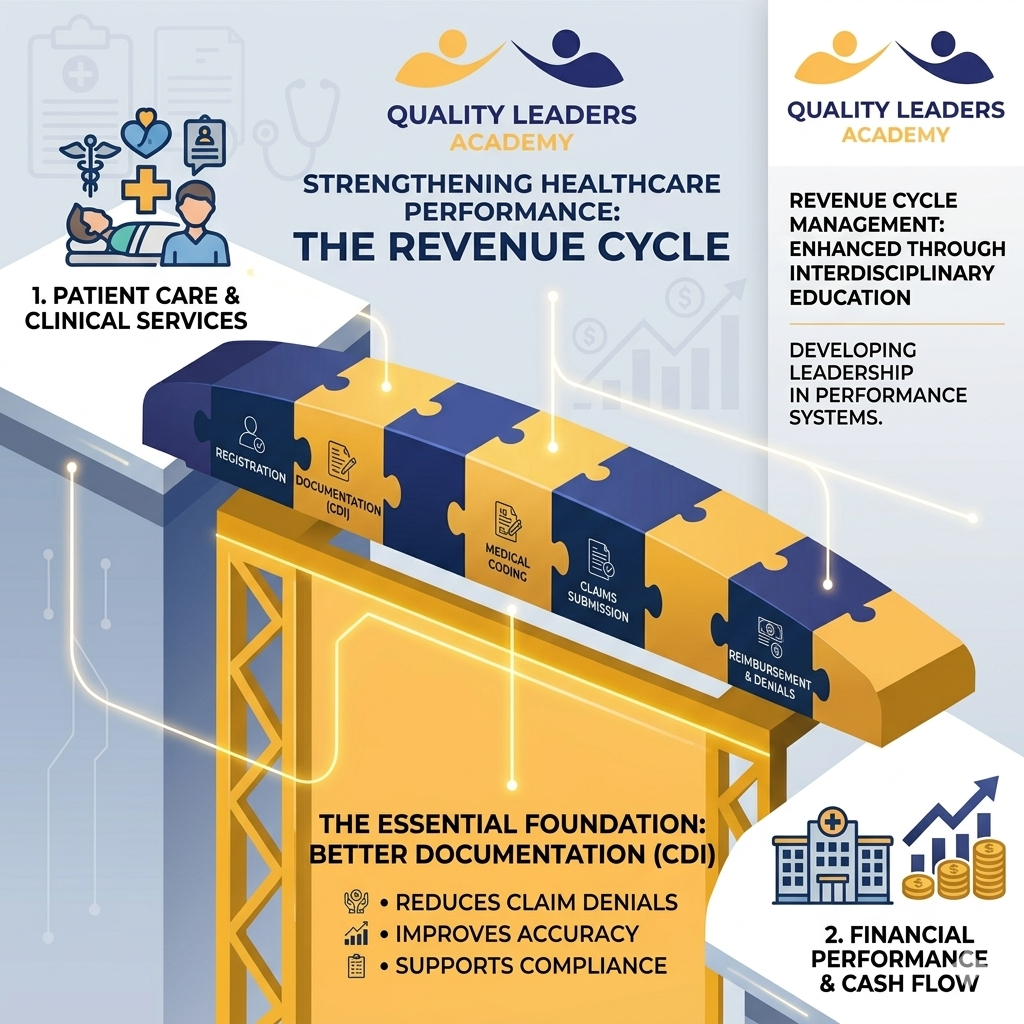
In this environment, Revenue Cycle Management in Healthcare plays a critical role in connecting clinical services with financial outcomes. Revenue Cycle Management (RCM) is not simply about billing or claims submission; it is a structured process that links patient care, clinical documentation, coding accuracy, reimbursement, and financial performance.
For hospitals, clinics, and healthcare systems, an effective revenue cycle helps improve cash flow, reduce administrative inefficiencies, strengthen compliance, and support better healthcare delivery. For healthcare professionals, understanding RCM has become increasingly valuable as organizations seek stronger alignment between clinical quality, operational performance, and financial sustainability.
WHAT IS REVENUE CYCLE MANAGEMENT IN HEALTHCARE?
Revenue Cycle Management in Healthcare refers to the end-to-end financial process healthcare organizations use to manage patient service revenue, from patient registration and insurance verification to reimbursement and payment collection.
According to healthcare coding and reimbursement standards, RCM connects clinical care with financial workflows by ensuring services delivered are accurately documented, coded, submitted, and reimbursed.
An effective revenue cycle depends on several interconnected elements, including:
- Accurate patient information.
- High-quality clinical documentation.
- Proper medical coding.
- Timely claims submission.
- Reimbursement tracking.
- Denial management and correction processes.
When these components work together effectively, healthcare organizations can improve operational performance and reduce unnecessary financial losses.
KEY COMPONENTS OF THE REVENUE CYCLE
Understanding the major stages of RCM helps healthcare professionals recognize how operational decisions affect reimbursement and healthcare efficiency.
Patient Registration and Eligibility Verification
The revenue cycle begins before clinical care starts. Accurate patient registration and insurance verification are essential for preventing claim delays and billing issues later in the process.
Errors in demographic data, insurance information, or eligibility verification can result in denied claims and delayed reimbursement. Healthcare organizations increasingly emphasize front-end accuracy because mistakes at the beginning of the revenue cycle often create downstream inefficiencies.
Clinical Documentation Improvement (CDI)
Clinical Documentation Improvement (CDI) is one of the most important elements of effective revenue cycle management.
Clinical documentation serves as the foundation for coding accuracy and reimbursement. Healthcare providers must clearly document diagnoses, procedures, patient conditions, and clinical decision-making to ensure that the medical record accurately reflects the care delivered.
Strong documentation supports:
- Coding accuracy.
- Clinical quality reporting.
- Reimbursement integrity.
- Regulatory compliance.
- Better communication across care teams.
Poor or incomplete documentation may result in coding discrepancies, reimbursement delays, or missed opportunities to accurately reflect patient complexity.
CDI programs help healthcare organizations improve documentation quality through education, interdisciplinary collaboration, and documentation review processes that support both clinical and financial outcomes.
Medical Coding and Billing
Medical coding translates healthcare services into standardized codes used for reimbursement and reporting.
Coding professionals use standardized classification systems to ensure diagnoses and procedures are accurately represented in claims submissions. Coding accuracy matters because reimbursement often depends on whether the documented care aligns appropriately with coding requirements.
Billing teams then use coded information to generate claims for payer review and reimbursement.
Accurate coding contributes to:
- Reduced claim denials.
- Better reimbursement accuracy.
- Stronger compliance.
- Improved healthcare data quality.
Claims Submission and Reimbursement
After documentation and coding are completed, claims move through payer review and reimbursement processes.
Healthcare organizations must ensure claims are complete, accurate, and submitted promptly. Clean claims, those submitted without errors, are more likely to be processed efficiently and reimbursed faster.
Effective claims management supports financial predictability and helps organizations maintain steady revenue flow.
Denial Management
Claim denials remain a common challenge across healthcare organizations.
Denials may occur because of:
- Documentation deficiencies.
- Coding inaccuracies.
- Missing information.
- Eligibility problems.
- Authorization issues.
Strong denial management processes help organizations identify recurring patterns, correct workflow gaps, and improve future claim performance.
WHY IS CLINICAL DOCUMENTATION CRITICAL TO REVENUE CYCLE SUCCESS?
Clinical documentation directly influences healthcare reimbursement because it explains the care delivered and supports coding decisions.
When documentation accurately reflects patient conditions and clinical complexity, organizations are better positioned to support coding accuracy and reimbursement integrity. In contrast, weak documentation can lead to claim delays, financial leakage, compliance concerns, and incomplete representation of patient care.
Healthcare organizations increasingly invest in Clinical Documentation Improvement (CDI) efforts because documentation quality affects both financial and clinical outcomes.
Better documentation also improves:
- Care continuity.
- Communication between healthcare teams.
- Quality reporting accuracy.
- Risk adjustment efforts.
- Patient safety documentation.
This makes CDI not only a financial initiative but also a quality improvement strategy.
TECHNOLOGY AND HEALTHCARE DATA SYSTEMS IN RCM
Technology has become increasingly important in hospital revenue cycle optimization.
Healthcare organizations rely on integrated systems to improve data accuracy, reduce workflow inefficiencies, and support financial visibility across the revenue cycle.
Modern RCM systems often support:
- Documentation workflows.
- Coding support processes.
- Claims tracking.
- Revenue analytics.
- Denial monitoring.
- Performance reporting.
Accurate healthcare data is especially important because poor-quality information can affect reimbursement, compliance, and organizational decision-making.
As healthcare systems become more digitally connected, organizations increasingly focus on interoperability between clinical and financial systems to improve efficiency and reduce administrative burden.
WHY REVENUE CYCLE MANAGEMENT MATTERS IN HEALTHCARE?
A well-managed revenue cycle strengthens both operational performance and financial sustainability.
Benefits of effective Revenue Cycle Management in Healthcare include:
Improved Financial Stability
Efficient reimbursement processes help organizations maintain predictable revenue and reduce financial disruption.
Reduced Claim Denials
Stronger documentation, coding, and eligibility processes improve claim accuracy.
Better Operational Efficiency
Organizations can reduce delays, duplication, and administrative rework.
Stronger Compliance
Accurate documentation and coding practices support payer requirements and healthcare regulations.
Better Healthcare Data Quality
Reliable clinical and financial data improve decision-making and organizational performance measurement.
Ultimately, stronger revenue cycle performance allows healthcare organizations to reinvest in patient care, staffing, and operational improvement.
COMMON CHALLENGES IN REVENUE CYCLE MANAGEMENT
Despite its importance, healthcare organizations frequently encounter barriers in RCM implementation.
Common challenges include:
- Documentation gaps.
- Coding inconsistencies.
- Fragmented workflows.
- Complex payer requirements.
- Limited staff training.
- Poor integration between clinical and financial systems.
Because healthcare environments are highly complex, improving revenue cycle performance often requires collaboration between clinicians, coders, finance teams, and operational leaders.
PROFESSIONAL DEVELOPMENT THROUGH QUALITY LEADERS ACADEMY
As healthcare organizations continue to prioritize operational efficiency and financial performance, professionals increasingly benefit from stronger knowledge in healthcare systems, quality improvement, and performance management.
Quality Leaders Academy supports healthcare professionals through educational pathways related to healthcare quality, leadership, operational improvement, healthcare management, and performance systems.
For professionals working in clinical documentation, healthcare operations, quality improvement, or healthcare administration, structured education can strengthen understanding of how documentation quality, workflow efficiency, and performance improvement contribute to organizational success.
Developing these competencies supports stronger decision-making and helps professionals contribute more effectively to healthcare transformation efforts.
Revenue Cycle Management in Healthcare is far more than a financial process; it is a system that connects patient care, documentation quality, coding accuracy, and reimbursement performance.
Healthcare organizations that strengthen documentation practices, improve coding accuracy, optimize workflows, and invest in healthcare data quality are better positioned to improve operational efficiency and financial sustainability.
As healthcare continues to evolve, professionals who understand RCM principles, clinical documentation improvement, and healthcare operational performance will play an increasingly important role in supporting efficient, high-quality care delivery.