

Healthcare organizations today face mounting financial pressure. Rising operational costs, workforce shortages, evolving payer requirements, and increasing administrative complexity are reshaping how hospitals and healthcare systems manage reimbursement. At the same time, patients expect transparent billing experiences, while providers must balance quality care with financial sustainability.
This is where RCM operations in healthcare become essential.
Revenue Cycle Management RCM operations are no longer limited to billing and collections. They function as the operational engine that supports healthcare financial performance, ensuring organizations receive timely and accurate reimbursement for services delivered. When operational workflows break down, healthcare organizations often experience delayed payments, claim denials, administrative inefficiencies, and revenue leakage.
Strong RCM operations improve not only financial outcomes but also patient experience and organizational efficiency. As reimbursement systems grow more complex, healthcare leaders increasingly recognize operational excellence in revenue cycle management as a strategic priority.
WHAT ARE RCM OPERATIONS IN HEALTHCARE?
RCM operations in healthcare refer to the day-to-day execution of processes that manage the complete financial lifecycle of patient care. Rather than simply defining Revenue Cycle Management, RCM operations focus on how healthcare organizations coordinate workflows to move accurately from patient scheduling to final payment collection.
These operations serve as the execution layer of healthcare financial management, connecting clinical care, administration, coding, billing, reimbursement, and financial reporting.
Effective healthcare revenue cycle operations depend on collaboration across multiple departments, including:
Front-office registration teams
Physicians and clinical staff
Medical coders and billers
Revenue cycle departments
Finance and compliance teams
Each department contributes information that affects reimbursement accuracy. A registration error, incomplete documentation, or coding mistake can interrupt the entire process, leading to delayed claims or denied payments.
In many hospitals, strong operational coordination is what separates financially stable systems from organizations struggling with reimbursement inefficiencies.
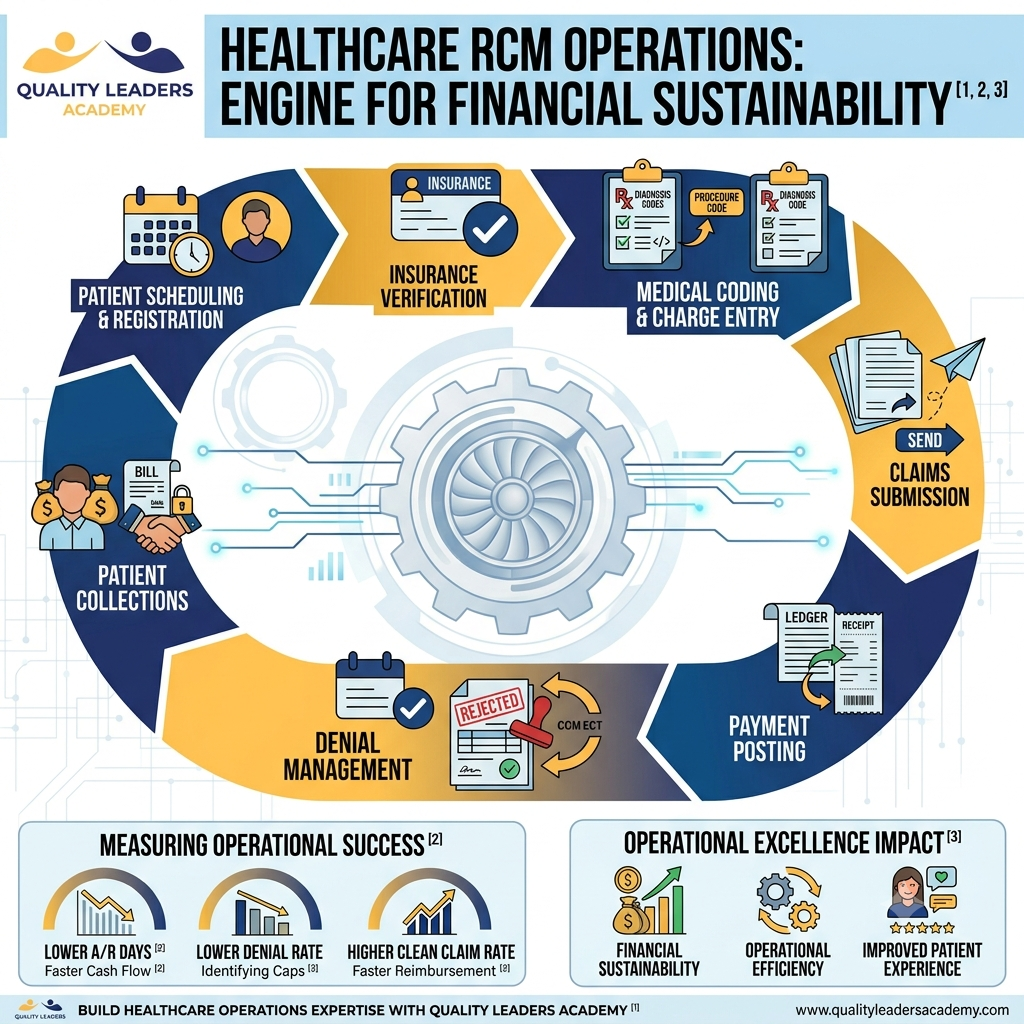
THE SEVEN OPERATIONAL STAGES OF REVENUE CYCLE MANAGEMENT
Understanding how hospital revenue cycle management functions requires examining the seven operational stages that support reimbursement.
1. Patient Scheduling and Registration
Revenue cycle operations begin before a patient receives care.
Front-office teams collect demographic details, insurance information, and patient identifiers during scheduling and registration. Even small errors at this stage, such as incorrect insurance data or missing patient information, can trigger claim denials later.
Accurate registration supports smoother reimbursement and reduces preventable revenue loss.
2. Insurance Verification
Insurance verification confirms whether services are covered before treatment begins.
Healthcare staff verify eligibility, deductibles, co-payments, prior authorizations, and payer requirements. Strong healthcare reimbursement operations reduce financial surprises for both patients and providers.
By identifying issues early, organizations can avoid costly denials and treatment delays.
3. Medical Coding and Charge Entry
After care delivery, medical documentation is translated into billable claims.
Medical coders use ICD-10 diagnosis codes and CPT procedure codes to accurately represent services delivered. Proper coding is one of the most important components of medical billing operations, because reimbursement depends on clinical accuracy.
Incomplete documentation or coding errors may result in underpayment, compliance risks, or rejected claims.
4. Claims Submission
Once coding is complete, claims move through submission systems.
Healthcare organizations submit claims through clearinghouses that check for formatting errors before sending information to insurers. Because each payer may have different requirements, operational teams must ensure claim accuracy and compliance.
A high clean-claim submission rate helps organizations receive faster reimbursement and reduces rework.
5. Payment Posting
Payment posting involves recording reimbursements from insurance companies and patients.
Revenue cycle teams reconcile payments against expected charges and identify discrepancies. This stage provides visibility into financial performance and supports more accurate accounting processes.
Efficient payment posting strengthens healthcare financial operations by improving financial tracking and reducing payment confusion.
6. Denial Management
Even high-performing healthcare systems face denied claims.
Denial management healthcare processes involve identifying rejection causes, correcting claim errors, submitting appeals, and recovering lost revenue.
For example, claims may be denied because of coding inconsistencies, missing authorizations, eligibility issues, or incomplete documentation.
Organizations with strong denial management strategies often recover significant revenue while reducing recurring operational problems.
7. Patient Collections
The final stage focuses on patient financial responsibility.
As high-deductible health plans increase, healthcare organizations must manage co-payments, deductibles, and patient balances more effectively. Transparent billing communication and payment flexibility improve the patient experience while strengthening collection performance.
Clear communication also reduces billing confusion and disputes.
MEASURING SUCCESS: KEY KPIS IN RCM OPERATIONS
Healthcare organizations rely on performance indicators to evaluate the effectiveness of claims management in healthcare and broader revenue cycle operations.
Accounts Receivable (A/R) Days
A/R days measure how quickly providers receive reimbursement after delivering care.
Lower A/R days indicate faster collections and stronger cash flow. Delays often signal operational inefficiencies, billing issues, or payer-related bottlenecks.
Denial Rate
Denial rate tracks the percentage of claims rejected by payers.
A high denial rate may indicate workflow gaps, registration problems, coding inaccuracies, or documentation challenges. Reducing denials supports financial sustainability and operational improvement.
Clean Claim Rate
The clean claim rate measures how many claims are accepted on the first submission.
Higher rates reduce administrative burden, improve reimbursement speed, and enhance healthcare operational efficiency.
Healthcare leaders frequently use these KPIs to identify performance gaps and guide process improvement efforts.
COMMON OPERATIONAL CHALLENGES IN HEALTHCARE RCM
Despite improvements in technology, healthcare organizations continue to face operational barriers.
One major challenge is fragmented workflows between departments. Clinical, billing, and financial systems may operate separately, creating communication gaps that delay reimbursement.
Staffing shortages also create operational strain. Revenue cycle teams often face high workloads, especially in coding, billing, and claims follow-up.
Payer complexity presents another challenge. Insurance requirements frequently change, making compliance more difficult for administrative teams.
Documentation errors remain a common issue as well. Missing or incomplete clinical information can delay coding and claims submission, increasing administrative burden.
These challenges demonstrate why operational coordination remains essential to successful healthcare revenue cycle operations.
MODERN TRENDS TRANSFORMING RCM OPERATIONS
Technology is rapidly reshaping RCM operations in healthcare.
Artificial intelligence (AI) and automation tools increasingly support repetitive administrative tasks, helping teams reduce manual workloads and improve claim accuracy.
Machine learning is also helping organizations predict denial risks before claims are submitted, allowing teams to intervene proactively.
Workflow automation improves efficiency in prior authorizations, eligibility verification, and payment tracking. Meanwhile, healthcare organizations increasingly adopt hybrid outsourcing models to supplement internal expertise.
Data analytics also plays a growing role in financial optimization, helping leaders identify reimbursement trends and operational inefficiencies.
Additionally, improved interoperability between clinical and billing systems helps reduce disconnected workflows and supports more accurate financial reporting.
WHY STRONG RCM OPERATIONS IMPROVE HEALTHCARE PERFORMANCE?
Strong RCM operations in healthcare influence far more than reimbursement.
Efficient workflows support financial sustainability, improve operational performance, reduce administrative waste, and minimize payment delays.
Healthcare professionals also benefit from reduced administrative burdens, allowing clinicians to focus more on patient care rather than documentation and billing complications.
Patients benefit as well through clearer billing communication, fewer claim disputes, and improved financial transparency.
Ultimately, healthcare organizations with strong revenue cycle operations are better positioned to maintain financial health while supporting high-quality care delivery.
Building Healthcare Operations Expertise Through Quality Leaders Academy
As healthcare systems become increasingly complex, professionals working in hospital administration, healthcare finance, revenue cycle departments, and health information management benefit from strengthening their operational expertise.
Developing knowledge in healthcare systems management, operational efficiency, healthcare finance workflows, process improvement, interoperability, and data-driven decision-making can help professionals contribute more effectively to organizational performance.
Educational pathways offered through Quality Leaders Academy can support healthcare professionals seeking stronger competencies in healthcare operations and system improvement. By expanding operational knowledge, professionals may be better prepared to navigate evolving reimbursement systems, improve workflow efficiency, and contribute to stronger financial performance across healthcare organizations.
In an environment where operational excellence increasingly drives sustainability, continuous professional learning remains an important investment in healthcare success.
Resources:
https://publichealth.tulane.edu/blog/revenue-cycle-management-health-care/
https://stripe.com/resources/more/revenue-cycle-management-101-what-businesses-need-to-know